Digital marketing for Texas businesses: what changes by industry, and what stays the same
What changes in digital marketing from a Texas plumber to a law firm to an online shop, what stays the same, and which channel each business starts with.
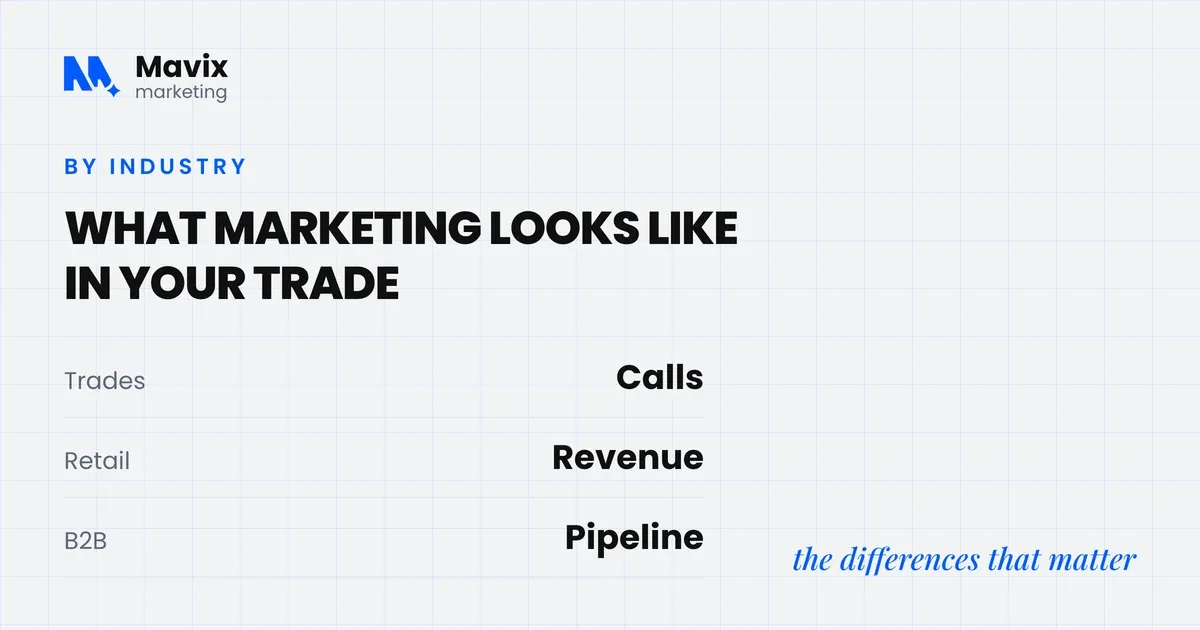
What changes from one Texas industry to the next is how fast the buyer decides and how much proof they need before they call. A plumber’s customer has water on the floor and rings the first credible name on the map. A law firm’s client reads for days first. The basics underneath stay the same: a complete Google Business Profile, a page for each service, tracking that records calls and forms, and real reviews.
There is a lot of variety to plan for. Texas has about 3.5 million small businesses, 99.8 percent of all businesses in the state, according to the SBA Office of Advocacy’s 2025 profile built on Census data (SBA Office of Advocacy). This guide does not give each industry its own chapter. It uses a planning framework of our own, five buyer types, and links each industry to the page on this site that covers it in detail.
The short version
- The grouping in this guide is Mavix’s own planning framework. It sorts businesses by how fast the buyer decides and how much proof they need, not by an official industry code.
- Google says local ranking depends on relevance, distance and prominence, and that more reviews and positive ratings can help a business’s local ranking.
- Same-week trades usually start with the Business Profile and the phone. Trust-heavy professions usually start with authored pages that answer real client questions.
- Plumbers, electricians and air conditioning contractors are licensed by the state in Texas. Plumbers through the State Board of Plumbing Examiners, the other two through TDLR.
- Google Local Services Ads checks licences, insurance and background where the category and location require it, so an unlicensed trade business cannot rely on that channel.
- Pages for towns you do not really serve risk Google’s doorway spam policy. Build a city page only where you have real work to show.
How does Mavix group Texas businesses by industry?
For planning, we sort Texas businesses into five buying patterns. The pattern decides which channel usually matters most, so it is the first question we ask. The groups are our framework, not an official classification, and many businesses sit in two of them.
| Buyer type (Mavix framework) | Example industries | How the buyer decides | Channel that usually matters most |
|---|---|---|---|
| Same-week trades | Plumbing, HVAC, electrical, roofing, pest control, cleaning | Something is broken, they call today | Google Business Profile, calls, Local Services Ads where eligible |
| Trust-heavy professions | Law firms, dental, healthcare, financial services, insurance, accounting | Research over days or weeks, reviews read closely | Service pages built on real client questions, reviews, email follow-up |
| Local hospitality and retail | Restaurants, gyms, local shops (no dedicated page on this site yet) | Nearby and deciding now | Accurate profile, photos and hours, email to past customers |
| Considered and business to business | General contractors, manufacturing, managed IT, property management, commercial print | Compare several suppliers over weeks | Project and portfolio pages, case evidence, LinkedIn for some sectors |
| National sellers and startups | Ecommerce and retail, SaaS, supplements | Compare nationally, often on price and trust | Product pages, site speed and checkout, paid search and social |
The full list of sectors covered on this site is on the industry pages.
Why is Texas not one market?
Each large Texas metro is big enough to behave like several markets, so a campaign built for “Texas” or even “Dallas” usually spends in places it should not. The Census Bureau’s Vintage 2025 estimates were released on 26 March 2026. They rank the Houston metro first in the country for numeric growth between July 2024 and July 2025, with Dallas-Fort Worth second (US Census Bureau).
| Metro (Census name) | Population, 1 July 2025 | Growth from July 2024 | County in the national top ten for growth |
|---|---|---|---|
| Dallas-Fort Worth-Arlington | 8,477,157 | 123,557 | Collin County, up 42,966 |
| Houston-Pasadena-The Woodlands | 7,904,627 | 126,720 | Harris County, up 48,695, and Fort Bend County, up 24,163 |
| San Antonio-New Braunfels | 2,813,140 | 38,402 | None in the top ten |
| Austin-Round Rock-San Marcos | 2,620,945 | 53,796 | Williamson County, up 23,814 |
Source: US Census Bureau, Vintage 2025 population estimates, press release of 26 March 2026.
The practical point is the counties. Growth in Collin, Fort Bend and Williamson counties means new residents in suburbs that search for services by their own town name, not the core city’s. Fort Worth gets lost inside campaigns that only think about Dallas. A customer in Lubbock searches differently from one in Plano. Whatever the industry, the campaign has to be built for the town the customer is standing in.
What stays the same in every industry?
Four things hold across all five groups. They are the work we put first on every Texas account, whatever the trade.
The Google Business Profile. Google says local results are based on relevance, distance and prominence, and that prominence draws on things like links to your business and how many reviews you have (Google Business Profile Help). In Whitespark’s 2026 Local Search Ranking Factors survey of 47 local search practitioners, the primary category is the top-rated factor for the map results (Whitespark). That is a survey of experts, who say themselves they have no access to Google’s algorithm, so read it as informed opinion rather than Google’s formula. In practice that means the right primary category, every service listed, photos of real work, and reviews with replies.
A page for each thing you sell. A plumber needs a page for water heater repair and another for drain cleaning. A dentist needs one for implants and one for emergency appointments. All Dogs Rock, a family-owned dog daycare in West Palm Beach, Florida, that we work with, was rebuilt on one keyword per page. Organic search became its largest source of engaged sessions in GA4, 1,490 of 3,272, though direct still brought more raw sessions and the report does not name its calendar window. That is one account, not a forecast.
Tracking before spend. A form fill or a call has to be recorded as a lead, not as a page view, or every later decision about which channel works is a guess. Set it up in week one. The conversion tracking guide walks through it.
Real reviews, answered. Google says more reviews and positive ratings can help local ranking, and that replying shows you value the feedback (Google Business Profile Help). Ask on the day the job finishes and reply to all of them. Never buy or write one. Since 2024 the FTC has a final rule banning fake reviews and reviews bought for a particular sentiment, with civil penalties for knowing violators (Federal Trade Commission).
One more habit we recommend for most accounts: a short paid search test before a content plan. A fortnight of search ads on a set of terms shows which searches turn into enquiries, and that list is the list of pages worth writing. That is our method, not a platform rule.
What changes for same-week trades?
For plumbing, HVAC, electrical and roofing, the buyer has a broken thing and calls the first credible name on the map. Distance, whether you answer the phone, and your reviews carry the decision, so the profile and the phone come first.
Licensing matters here in two ways. Texas licenses these trades at state level. The Texas Department of Licensing and Regulation licenses electricians and electrical contractors (TDLR) and air conditioning, refrigeration and heating contractors (TDLR). The Texas State Board of Plumbing Examiners licenses plumbers (TSBPE).
Separately, Google’s Local Services Ads run their own screening, which varies by category and location and can include background, business registration, insurance and licence checks (Google Local Services Help). Holding the state licence is what lets a trade pass the licence part of that check. The Local Services Ads comparison covers which to run first. Search ads catch the seasonal spikes: winter freezes, August heat, hail season for roofers.

Photo: Anıl Karakaya on Pexels.
What changes for law firms, dental and other trust-heavy professions?
The buyer researches before committing, and Google gives more weight to strong experience, expertise, authority and trust on topics that could affect someone’s health, finances or safety (Google Search Central). Law, healthcare, dental, financial services and insurance all sit in that zone.
What carries the weight is content written by or with the professional, practice-area or procedure pages built on questions real clients ask, and a habit of replying to reviews. Paid clicks tend to be expensive here. Attorneys and legal services had the highest cost per click in WordStream’s 2026 benchmark, as the cost per lead post sets out, which makes the organic side worth building early. Buying cycles are long, so an email sequence that keeps answering questions after the first visit does work a second ad cannot.
What changes for restaurants, gyms and local shops?
The searcher is nearby and deciding now. Menu accuracy, current hours and a steady stream of real photos on the profile matter more than the website. Google’s guidance on local ranking asks businesses to keep hours current, including special hours, and to add photos (Google Business Profile Help).
In our experience email is the channel these businesses use least. One weekly offer to a list of past customers can fill slow nights for less than an ad reaching strangers. Gyms sell a community, so member stories and trainer introductions on social media do what a service page cannot.

Photo: Craig Adderley on Pexels.
What changes for contractors and business to business firms?
The buyer compares over weeks and wants proof of reliability rather than a pitch. That means portfolio pages with real project photography, licences where they apply, and separate pages for residential and commercial work. General contracting does not appear among the programmes TDLR licenses (TDLR), so a builder’s proof comes from projects, insurance and reviews, and from any trade licences held by the people doing the work. Check your city’s permit office for local registration rules.
For logistics and other procurement-led sectors, LinkedIn and industry search reach the teams who decide. Franchises need a hub-and-location structure: one central site, then a page per location with something real about that city. Google’s spam policies list “multiple domain names or pages targeted at specific regions or cities that funnel users to one page” as an example of doorway abuse (Google Search Central).
What changes for ecommerce and software?
Distance stops mattering and the competition is the whole country. Site health, page speed and checkout friction matter as much as traffic, because a strong ad campaign fails if the cart leaks. On one ecommerce account managed here, Meta cost per add-to-cart went from £25.67 to £1.33, with 1,181 add-to-carts from 138,529 people reached, after the tracking and funnel were rebuilt. Those are the totals in the account’s Ads Manager export, which carries no date range, so treat them as one account’s result, not a rate to expect.
La Vela Coffee, a Miami seller of commercial coffee machines that we work with, shows the organic side. Product pages rewritten for the searches buyers make took organic clicks from 1.16K to 2.85K over six months against the six before, in Search Console. The report does not name calendar dates, and some of the movement belongs to the market. For a startup, the approach we recommend is the narrow terms nobody big is fighting for, one excellent page each, and paid search during launch weeks.
Which channel should you pick first?
Answer five questions before anyone sells you a package.
| Question | If the answer is yes | If the answer is no |
|---|---|---|
| Does the buyer decide within the week? | Profile, phone and reviews first | Content and email carry more weight |
| Does the buyer search with a town name, or does Google show a map? | The map results are where you compete | National pages and paid search matter more |
| Is one customer worth thousands of dollars? | Paid search can pay for itself on a few customers | Paid search needs volume, so test small |
| Does Texas license your trade? | Keep the licence current before applying to Local Services Ads | Proof comes from projects, insurance and reviews |
| Can you show proof: real photos, named reviews, licences? | Put it on the profile and every service page | Collect it before spending on ads |
Where the line is
Search cannot create demand. If nobody in Houston types your category into Google yet, no amount of local SEO produces a buyer, and the first channel is paid social or a longer content game.
A framework like this one is a starting point, not a plan. Two dentists in Plano can need opposite work, because one has forty reviews and a slow site and the other has a fast site and no reviews. The audit comes before the template. The accounts the work has been done on are there to read before you decide anything.
The bottom line
Industries differ in who the buyer is and how fast they decide, and that decides where to start. The work underneath stays the same: be findable where people look, prove it when they arrive, and measure what happened.
Questions people ask about this
How do I work out which industry group I belong to?
Ask how fast your buyer decides and how much a wrong choice costs them. A broken thing and a same-day call puts you with the trades. Weeks of research and a costly mistake puts you with the trust-heavy professions. Nearby and deciding now is hospitality. Comparing over a month is considered. If you sell anywhere in the country, you are a national seller. The groups are our planning framework, so use them as a guide.
Which channel should a new Texas business start with?
The Google Business Profile if customers come to you or you go to them locally, because it costs time rather than money. Then tracking, so the next decision is not a guess. Then a short paid search test to see which terms produce enquiries. Only after that does it make sense to spend on content or a bigger ad budget.
What if my business fits two industries?
Then it has two buyers and needs two sets of pages. A roofer doing emergency repairs and commercial installations serves a same-week buyer and a considered one, and one page cannot speak to both. Separate the services, give each its own page and proof, and run the fast-decision side on the profile and the phone while the considered side gets content and email.
How do I check whether people search with a city?
Type your service into Google without a city and look at what appears. A map pack and local businesses mean Google already treats the search as local, and adding the city is optional. National sites and directories mean the intent is broader. Then check Search Console for the queries you already receive. If most carry a town name, the map pack is your battleground.
Do I need a separate page for every Texas city I serve?
Only for the ones you can say something true about. A page for each town you genuinely work in, with real projects, real photos or a real address there, is worth building. A page for every town in the metro with the name swapped is the doorway pattern Google’s spam policies describe. Start with the three cities that send the most work and add from there.
How do I know if the site or the profile is the problem?
Look at where enquiries drop off. If the profile shows views and calls but the website shows few visits and no forms, the profile is doing the work and the site can wait. If the site gets visits and no enquiries, the site is leaking. If neither shows activity, visibility is the problem and the profile comes first.
Can I run Local Services Ads without a state licence?
Not in categories where Google checks a licence. Google’s screening varies by category and location and can include licence, insurance and background checks. A business in a trade Texas licenses, such as plumbing, electrical or air conditioning, needs that licence to pass. General contracting is not a TDLR licensing programme, so it falls under different checks. Confirm your own requirements in the Local Services dashboard before you apply, because a rejected application delays everything else.
Is email worth it for a restaurant or gym?
In our experience, yes, and it is one of the cheapest channels either has. A weekly offer to a list of people who have already visited can fill slow nights for far less than an ad reaching strangers. Collect addresses at the point of sale or booking, send one useful message a week, and make unsubscribing easy. A gym can add member stories and trainer introductions to the same list.
How long should I give a channel before judging it?
It depends on the channel. Paid search shows whether demand exists within a fortnight, which is why the post suggests testing with it. The profile and reviews move over a few months as reviews accumulate. Search content takes longer still and compounds after that. Set the judgement window before you start, based on the channel, and do not compare a slow channel against a fast one.
What proof matters most in my industry?
For the trades, review count and recency with replies. For law, healthcare and finance, credentials, authored content and named reviews. For hospitality, current photos and accurate hours. For construction and business to business, project photography, licensing and named clients. For ecommerce, reviews on the product and clear returns. Whatever the category, it has to be checkable, because a buyer who finds one fake stops trusting all of it.
Should a franchise location run its own marketing?
Within the hub-and-location structure the post describes, yes for the local part. The central site carries the brand and the shared content. Each location owns its Business Profile, its reviews and a location page with something real about that city. Paid search is usually run centrally with location-level budgets. What a location should not do is build a separate site that competes with the hub.
Free review
Want this looked at on your own site?
Send the address. A person reads it and writes back with the two or three things that would move your enquiry number first. Free, and yours to keep whether you hire us or not.