Meta ads underperforming in Europe in 2026: how a US advertiser can tell a real drop from a reporting change
For US advertisers whose Meta results fell in Europe in 2026: a step-by-step diagnosis to tell a real drop from a reporting, consent or tracking change.
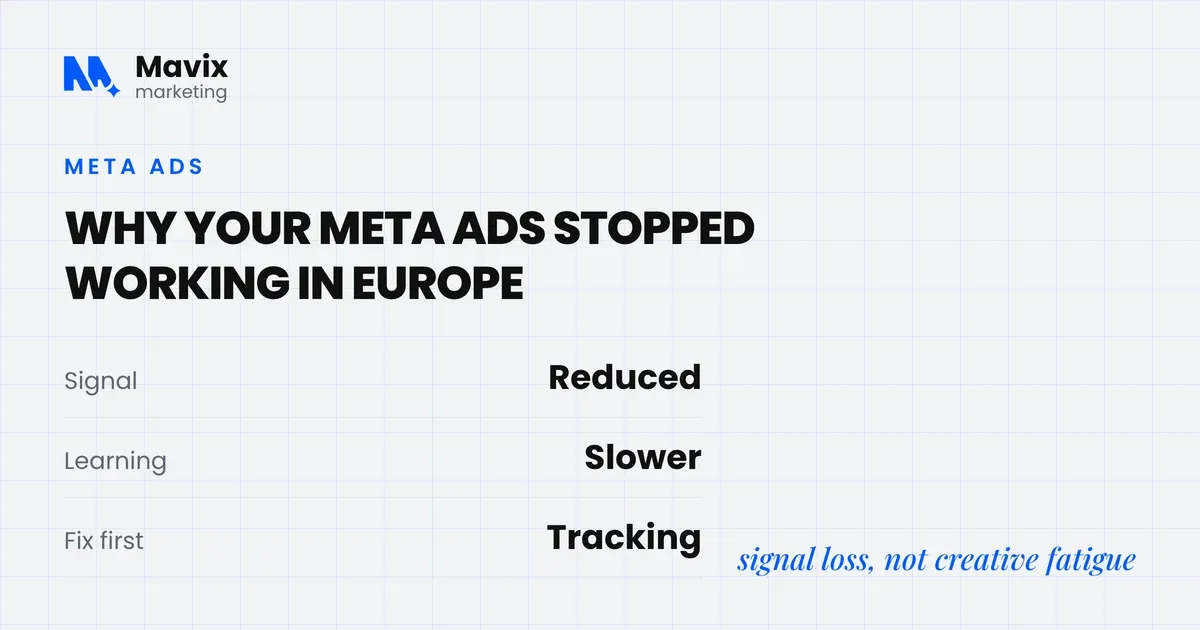
If you are a US advertiser and your Meta ads look worse in Europe this year, first find out whether your sales there fell or only the reported numbers did. Three changes in 2026 can lower what you see without changing what you sell. Only the first is global, which is why your US campaigns can look steady while the European ones do not.
On 12 January Meta stopped returning the 7-day and 28-day view attribution windows through its Ads Insights API (Meta for Developers, 16 October 2025). In January Meta also began offering users in the EU a choice to share less personal data and see less personalised ads (European Commission, 8 December 2025). And from 15 June Google moved control of the advertising data your site sends to Google Ads onto consent mode (Google Analytics Help).
This post is the diagnosis. It helps you decide which of four things happened: a reporting change, a consent gap, a tracking fault or a real drop in performance. Once you know which, the fixes are in the six Meta ads mistakes post, which is the implementation checklist for US advertisers in Europe.
The short version
- Compare Meta against a number Meta does not control. Shop orders, CRM leads or bank deposits for the same days tell you whether the drop is in the business or in the report.
- A dashboard that pulled view-through results through Meta’s API lost the 7-day and 28-day view windows on 12 January 2026. Meta now returns 1-day view as the longest view window through the Ads Insights API.
- The less personalised ads choice applies to users in the EU, according to the European Commission. It does not explain a drop in UK, Swiss or US traffic.
- A consent banner that holds back Meta’s browser events means people who decline send no browser events. Your own consent rate, from your consent platform, tells you how large that gap is.
- Six numbers from Events Manager and your consent platform settle most arguments about whether the problem is measurement, consent or the ads.
- Do not pause or rebuild while you diagnose. Changes made in reaction to a reporting drop can cause a real one.
What changed in 2026 that can lower reported Meta results?
Three dated changes, each with a different reach. The first is technical and global, so it reaches your US reporting as well. On 12 January 2026 Meta stopped returning the 7d_view and 28d_view windows through the Ads Insights API. It said windows such as 1-day click, 7-day click, 28-day click, 1-day engaged view and 1-day view remain available, “consistent with Ads Manager behavior” (Meta for Developers). Any report built on the longer view windows lost those conversions overnight.
The second is regulatory and applies to users in the EU. After the Commission’s non-compliance finding in April 2025, Meta committed to present users in the EU with a choice in January 2026. The choice is between sharing all their data for fully personalised ads and sharing less data for more limited personalisation (European Commission). Meta has not published what share of users chose the second option, so nobody outside Meta can tell you what it did to your costs.
The third is Google’s, and it matters because many advertisers run Meta and Google off the same consent banner. From 15 June 2026, Google Analytics uses consent mode in Google Ads “as the single control for data”. The Google Signals setting only controls signed-in data for behavioural reporting in Analytics (Google Analytics Help). A banner that sends the wrong consent signals now affects Google Ads data directly, and the same banner is usually the one holding back your Meta pixel.
Did my Meta ads get worse, or only the reporting?
Answer this before you change anything. Pull orders, leads or revenue for two matching periods from a source Meta does not control: the shop, the CRM or the bank. Then pull Meta-reported conversions for the same two periods on the same attribution setting. If your own number held steady and Meta’s fell, you have a measurement change. If both fell together, something in the account, the offer or the market moved.
The comparison sounds obvious, and it is the step most often skipped, because the platform number refreshes all day and the real one sits in an accounting tool. The table below turns the comparison into a decision.
| What you see | Most likely cause | How to confirm it | Where the fix is |
|---|---|---|---|
| Meta conversions down, your orders flat, drop starts the week of 12 January | Reporting: a dashboard using 7-day or 28-day view windows | Check which attribution window your report or connector requests | Rebuild the report on a window Meta still returns |
| Meta conversions down, your orders flat, drop concentrated in EU traffic | Consent or the EU ad choice reducing what Meta can see | Compare Meta events with site sessions by country, and read your consent rate | Conversions API and consent setup, in the mistakes post |
| Meta conversions far below your orders all year, not only since January | Tracking fault: pixel only, missing parameters, broken deduplication | The six-number check below | Server events with deduplication and better customer data |
| Your orders down and Meta down by a similar share | Real performance change | Cost per result by country and ad set over time, creative age, offer changes | Structure, audiences and creative, in the mistakes post |
| Cost per result up right after you paused or cut ad sets | Self-inflicted: edits sent ad sets back into learning | Delivery column and the dates of your edits | Stop editing, consolidate, wait for delivery to settle |
Why does my reporting tool show fewer conversions than before?
Usually because it asked Meta for a window Meta no longer returns. Connectors and dashboards that pull data through the Ads Insights API were affected by the 12 January change even if nobody touched Ads Manager (Meta for Developers). Accounts that relied on video and awareness campaigns, where people see an ad and buy later without clicking, have the most view-through credit to lose.
Check the attribution window your report requests, then rebuild your comparison from February onwards on a window that still exists. Keep the monthly back-end count alongside it, so you have a line that Meta’s reporting changes cannot move.

Photo: Mikhail Nilov on Pexels.
How much does a consent banner hide from Meta?
As much as your decline rate. If your consent setup holds back Meta’s browser events until a visitor accepts marketing cookies, visitors who decline send no browser events, so Meta cannot count them or optimise towards them. That is a common setup in Europe, because the rules generally require consent first. In the EU, the European Data Protection Board lists tracking pixels among the techniques covered by the ePrivacy consent rule (EDPB Guidelines 2/2023). In the UK, the ICO says you cannot set non-essential cookies before the user has consented (ICO).
That makes the banner a performance setting as well as a legal one. Published consent-rate benchmarks vary widely with banner design, so the only rate worth using is your own. Many consent platforms report it by country. If yours does not, that is worth fixing before anything else in this post.
Those are European and UK rules, and they reach your European visitors even though your company is in the US. US state privacy laws are separate and work differently. California’s Attorney General says people may ask a business to stop selling or sharing their personal information. It says a Global Privacy Control signal must be honoured by covered businesses as a valid request (California Department of Justice).
The six-number check
Open Events Manager and your consent platform, and write each number down.
- Event Match Quality on your main conversion event. Meta scores it out of 10 and says it reflects how well the customer information on a server event can be matched to a Meta account (Meta for Developers). As a rule of thumb of ours, not a Meta threshold, a score under about five out of ten suggests too few customer parameters are being sent.
- Where the event arrives from: browser only, server only, or both. Meta recommends using the Conversions API in addition to the pixel and sharing the same events through both (Meta for Developers).
- Whether deduplication is working. Meta matches a pixel event and a server event when the event name and event ID agree, and only if they arrive within 48 hours of each other (Meta for Developers).
- Which customer parameters you send. Hashed email and phone number at the point of conversion give Meta more to match on than IP address and browser details alone.
- Meta-reported conversions against your own count for the last 28 days. If Meta sees sixty of your hundred orders, your visibility is sixty percent.
- Your consent rate for EU and UK traffic, from the consent platform, split by country if it allows. Keep US traffic out of this number.
Numbers five and six together tell you most of the story. If visibility is close to your consent rate, the gap is consent. If visibility is well below it, the gap is tracking.
What does each result tell me to fix first?
Read the six numbers in order and stop at the first one that fails. A low match score or pixel-only events point to tracking, and the fix is server events with deduplication and better customer data. A low consent rate points to the banner. A report that fell only in January points to the attribution window. Only when all of those pass is it worth looking at the ads themselves.
The fixes for each of these, and the order to make them in, are set out in the six Meta ads mistakes post. The reason to diagnose first is that each fix is different. Rebuilding creative will not recover events a banner is holding back, and a Conversions API setup will not rescue an offer nobody wants.

Photo: Polina Tankilevitch on Pexels.
What should I leave alone while I diagnose?
Budgets, ad sets and bids. The costly reaction to a reporting drop is to pause ad sets that look weak in the report, then restart them. Every significant edit can put an ad set back into learning, where delivery is less stable, so a reporting drop turns into a real one a few weeks later. The mistakes post covers Meta’s learning threshold and how to size an ad set for it.
Keep spend steady while you work through the six numbers. After a fix lands, give the account two to four weeks of steady spend before judging it. That window is our recommendation from practice, not a figure Meta publishes.
Will moving budget to Google get around this?
Not the consent part. From 15 June 2026 your consent mode signals decide what Google Ads can collect (Google Analytics Help), and the banner holding back Meta’s pixel is usually the one sending those signals. Search also only helps where people already type what you sell. Meta shows your ads to people who were not searching. Cutting one because January looked bad can remove the demand the other was catching. The Meta against GA4 post explains why the two platforms will never report the same number.
The bottom line
Ads Manager is a model of your business, and in Europe this year the model sees less than it used to. That holds for a US advertiser as much as a local one. Before you change a bid, compare it with what reached the shop or the bank, find out which of the four causes you have, and fix that one first.
Questions people ask about this
How do I know whether the January change hit my account?
Compare reported conversions for the weeks either side of 12 January against your own order or lead counts for the same weeks. If Meta’s number fell and yours did not, the change is in the reporting. Then check whether your report or connector requested the 7-day or 28-day view window, because those stopped being returned through Meta’s API that day. Video and awareness campaigns carry the most view-through credit, so expect the largest reported drop there.
Can I get the longer view windows back?
No. Meta stopped returning the 7-day and 28-day view windows through its Ads Insights API on 12 January 2026, and the longest view window left is one day. What you can do is stop comparing this year with last year on the old basis. Rebuild your benchmark from February onwards on a window that still exists, and keep a monthly back-end count alongside it so you have a reporting line that Meta cannot change.
What should I do if my Event Match Quality score is low?
Send more of the parameters Meta can match on. Hashed email and phone number at the point of conversion usually move the score most, and an external ID helps where you have one. Check that the pixel and the Conversions API are both sending the same event with a matching event ID, so Meta can deduplicate them. Then wait a few days and read the score again, because it updates as new events arrive.
Do I need a developer for the Conversions API?
Not always. Most major ecommerce and form platforms have a native integration that sends server events with a few clicks, and consent platforms often connect to it too. A custom site or unusual checkout does need a developer. Whichever route you take, test in Events Manager that each conversion arrives once from the browser and once from the server, and that the two are being deduplicated.
Is it lawful to send hashed customer data to Meta from Europe?
Only with a lawful basis, which for most small advertisers, US ones included, means consent given on the banner. Hashing protects the data in transit but does not change whether you were allowed to share it. Send server events only for visitors who opted in, keep a record of that consent, and read your consent platform’s guidance on connecting to Meta. If you are unsure, ask a privacy adviser before switching it on.
What if my consent rate is far below the benchmark?
Look at the banner first. If rejecting is the prominent option and accepting is buried, expect a low rate. Test clearer wording, an equal choice between the two buttons and a design that matches the site. Do not make rejecting harder than accepting, because that carries regulatory risk. Then check the rate is being measured correctly, since a banner firing late or on the wrong pages can report a lower rate than reality.
Should I pause campaigns while I fix tracking?
Not unless the account is losing money on real results measured outside Meta. Pausing and restarting can put ad sets back into learning, which turns a reporting drop into a real one. Keep the ad sets that sell running at a steady budget and fix the pixel, Conversions API and consent setup underneath them. Then give the account two to four weeks after the fix before you judge the numbers.
How do I compare Meta’s numbers with my own?
Pick one source of truth outside Meta, such as shop orders or CRM leads, and one fixed period, ideally the last twenty-eight days. Count conversions there. Count Meta-reported conversions for the same days on the same attribution setting. The ratio is your visibility, and the point is to track it monthly. A stable ratio means the ads are being judged fairly. A moving one means the tracking changed.
Does this apply to UK advertisers as well?
Partly, and the same answer holds for a US advertiser targeting the UK. UK consent rules also require consent before non-essential cookies, so the banner check applies to UK visitors. The API attribution window change applies to every account. The less personalised ads choice is an EU measure according to the European Commission, so do not assume it explains a UK drop. For UK campaigns, start with the tracking and consent checks, then look at creative and offer.
Why did cost per result rise after I cut budget?
Because cutting budget or pausing ad sets can send a campaign back into learning, and delivery during learning is less stable. On top of that, a smaller budget on a thinner EU signal gives Meta fewer conversions to learn from, so it takes longer to settle. Consolidate rather than trim. One campaign with enough budget to get out of learning will usually do better than several small ones that never do.
What if my agency says the drop is normal?
Ask them for the two comparisons in this post: your own conversion count against Meta’s for the periods either side of January, and the six numbers from Events Manager and the consent platform. A good agency will already have them. If they cannot show you whether the drop is measurement or performance, they are reading the dashboard rather than the account, and that is worth knowing before you renew.
Free review
Want this looked at on your own site?
Send the address. A person reads it and writes back with the two or three things that would move your enquiry number first. Free, and yours to keep whether you hire us or not.