SEO agency or freelancer: which one fits your situation?
Agency, freelancer or in-house SEO compared on published costs, where each one wins, and the questions that expose the difference.
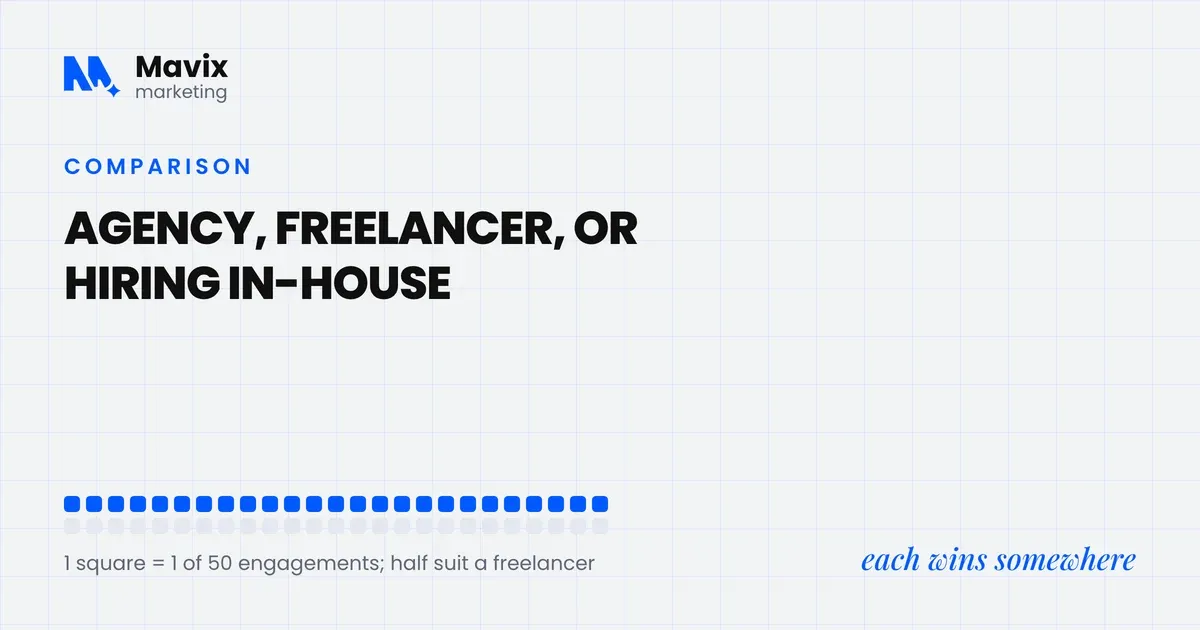
A freelancer fits one bounded, specialist job on a tight budget. An agency fits work that spans several skills and has to keep running when one person is away. An in-house hire fits only when there is a full week of work and somebody senior enough to judge it. On price, Ahrefs’ survey of 439 SEO providers found agencies average $3,209 a month and freelancers $1,348.63 (Ahrefs).
We are an agency, so read this with that in mind. There are situations where a freelancer is the better answer and we name them below. Judge whether the comparison is fair rather than whether it is flattering.
The short version
- Freelancers cost less per month on average. Ahrefs’ survey of 439 providers put the average freelancer retainer at $1,348.63 and the average agency retainer at $3,209.
- How much less depends on who you ask. Ahrefs found agencies charge 138 percent more than freelancers. Backlinko’s survey of more than 300 SEO professionals put the gap at about 30 percent.
- A freelancer wins on one clearly defined specialism, a small scope and direct access to the person doing the work.
- An agency wins on work that spans technical fixes, content, links and measurement, and on continuity when somebody is ill or leaves.
- An in-house hire costs far more than the salary. At the June 2026 employer cost ratio from the Bureau of Labor Statistics, Indeed’s $81,881 average SEO salary becomes roughly $117,000 a year.
- Whichever you choose, keep the accounts in your name. Google advises giving an SEO only read access to Search Console at the audit stage.
How do an agency, a freelancer and an in-house hire compare?
On cost, the three are far apart. On what they are good at, they barely overlap. The figures below come from the Ahrefs survey, which calculated its averages from the top of each respondent’s price bracket, so treat them as upper estimates (Ahrefs). The in-house figures come from Indeed and the Bureau of Labor Statistics.
| Freelancer | Agency | In-house hire | |
|---|---|---|---|
| Average monthly cost | $1,348.63 retainer | $3,209 retainer | About $9,750, salary plus benefits |
| Average hourly rate | $71.59 | $98.90 | About $39 in salary alone, on a 2,080-hour year |
| Most common one-off project fee | $101 to $250 | $2,501 to $5,000 | Covered by the salary, whether or not there is a project |
| Skills covered at once | One, deeply | Technical, content, links and measurement | One, plus whatever you buy in |
| Cover when someone is away | None | The rest of the team | None |
| Your time it takes | Quick decisions and access, because there is nobody else | A monthly call and content approvals | Day-to-day management |
Read the cost row and the skills row together. A freelancer is the cheapest way to buy one skill and an expensive way to buy four, because one person who is excellent at all four is rare. An in-house hire costs the most and is the only option that gives you somebody’s whole week. An agency sits in the middle on price and keeps running when one person is ill.
When does a freelancer make more sense?
When the job is narrow, the budget is tight or you want to talk to the person doing the work.
One clearly defined specialism. If what you need is a technical audit and the fixes implemented, a strong technical freelancer will often do it better and cheaper than a generalist agency team. The work is bounded, it needs depth rather than breadth, and there is no coordination overhead.
Small scope, tight budget. Below a certain monthly spend, agency overhead is a large share of what you are paying for. There is a point where you are buying process rather than work, and that point is real. In the Ahrefs data, the most common agency retainer is $500 to $1,000 a month, while for freelancers it is to (Ahrefs).
Direct access to the person doing it. No account manager and no relay. For some owners that is the whole argument, and it is a good one.

Photo: iam hogir on Pexels.
When does an agency make more sense?
When the work spans several skills and has to keep going regardless of who is on holiday.
Work that spans disciplines. Technical fixes, content, conversion work and authority building are four different skills. One person who is excellent at all four is rare and expensive, and one person who claims to be all four often is not.
Continuity. A freelancer going quiet, taking a full-time role or getting busy with a larger client is one of the most common reasons businesses call us. With a team, the work does not stop because somebody is ill.
Being able to escalate. When something goes wrong, there is a difference between one person saying they will look at it and a team that has seen the problem before.
When is hiring in-house the right call?
When there is enough work to keep somebody occupied permanently, and somebody senior enough to tell whether the work is good. The second condition is the one people underestimate. A junior marketer with nobody to learn from produces activity that nobody can evaluate, and the salary runs regardless.
Budget for the full cost, not the salary. The Bureau of Labor Statistics found wages and salaries were 70.0 percent of private-industry employer compensation costs in June 2026, with benefits the other 30.0 percent (BLS). Indeed’s average for a US SEO specialist is $81,881 a year, from 905 salaries in job postings over the past 36 months (Indeed). Divide by 0.70 and the employer cost is roughly $117,000 a year, before tools and recruitment time. The real cost of an agency, a freelancer and an in-house SEO works through that arithmetic in full.
What should you ask all three before choosing?
Ask all three options the same four things. The answers sort them faster than any pitch.
Who does the work, and are they in this conversation? At an agency this separates the ones where the pitch team is the delivery team from the ones where it is not.
What happens if I need something outside your specialism? A good freelancer will name what they do not do. A weaker one will say they can handle it.
What happens if you are unavailable for three weeks? There is a real answer to this and there is a reassuring one.
Who owns the accounts and the content? The answer should be you, in all three cases. It is not always. Google’s own advice is to grant an SEO only read access to Search Console when they first audit your site, not write access. It also reminds owners that they are responsible for the actions of any company they hire (Google Search Central).
Google’s page on hiring an SEO adds its own questions worth borrowing, including what results they expect and in what timeframe, and how they measure success. Hold every answer against the fact that Google says no one can guarantee a first-place ranking. For what a realistic timeframe looks like, see how long SEO takes.

Photo: Kampus Production on Pexels.
Which one fits your situation?
Small, bounded, technical, tight budget: a freelancer, and pick a specialist rather than a generalist.
Several disciplines, needs to keep running, and you would rather not manage it: an agency.
Enough volume for a full-time person and somebody able to judge their work: in-house, with an agency or freelancer for the specialisms they lack.
If your situation is the first one, we will tell you that on the call rather than quote you. If you are still working out a budget, what SEO costs sets out the published price ranges.
The bottom line
The choice is less about who is cheapest than about whether you need one skill or four, and whether you have a full week of work for someone. Price the options on the same basis, keep every account in your own name, and choose the one whose weakness you can live with.
Questions people ask about this
Is a freelancer cheaper?
Per hour, usually yes. Per outcome, it depends entirely on whether the work needed is inside their specialism. A freelancer who is genuinely strong technically can beat a mediocre agency at technical work and cost less. The same person asked to also produce content, build links and rebuild your tracking is being asked to be four people.
What is the risk with a freelancer?
Concentration. One person means no cover when they are ill, busy or lose interest, and when they leave the knowledge goes with them. That risk is manageable if you document things and it is real.
When is in-house right?
When you have enough sustained work to keep somebody busy and somebody senior enough to manage them. A junior in-house hire with nobody to learn from is the most expensive of the three options. That is because the salary runs whether or not the work is any good and there is nobody to notice.
How do I tell a specialist freelancer from a generalist?
Ask what they turn down. A specialist names the work they do not do without hesitating, and can point to two or three similar jobs. A generalist says they can handle whatever you need. Then ask them to describe how they would approach your specific problem. The specialist talks about your site within a minute. The generalist talks about process. Choose on the answer, not the rate.
What should I do when my freelancer goes quiet?
First, check what you hold. Confirm you own Search Console, analytics and the site logins, and export whatever work exists. Then set a date in writing by which you need a reply. If it passes, treat the engagement as ended and hand the documentation to whoever is next. The damage from a quiet freelancer is rarely the missed work. It is the month spent waiting to find out.
Does the size of the agency matter?
Less than who does the work. A small agency where the person on the call does the delivery can beat a large one where your account sits with a junior. What size buys is cover and range. What it costs is distance. Ask how many accounts each delivery person holds and who you would talk to on a bad day. Those two answers matter more than the headcount on the website.
Should I ask for a trial project before committing?
Yes, and choose one with a clear end. A technical audit with a prioritised fix list is ideal, because you can judge the quality without waiting for rankings. Pay for it properly. A free trial gets a template and a paid trial gets attention. If the audit is good and the person is responsive, extend. If either is not, you have learned that cheaply.
What happens to my content and accounts if I switch?
Nothing, if they were in your name from the start. That is why the question about ownership sits in the list. Before switching, export the content, the keyword targets and any reports, and remove the old provider’s access on the day the new one starts. If the old provider owned the accounts, ask for a transfer in writing. Refusal tells you everything about how the engagement was set up.
Can I use an agency and a freelancer together?
Yes, if the split is clean. A common pattern is an agency running content and reporting while a specialist freelancer handles technical work or a migration. Put in writing who owns the strategy, who reports the numbers and who can change the site. Without that, both will make reasonable decisions that contradict each other. With it, you get depth and cover at the same time.
How do I compare quotes from an agency and a freelancer fairly?
Write down what each quote includes, line by line, and what it does not. Then put both on the same monthly basis and add what you would pay for the missing pieces. A cheaper freelancer quote that leaves content and links to you is not cheaper once you cost your own time. Judge on the total, and on the answers to the four questions, not on the headline figure.
What if I already have a marketing person in-house?
Then the question is what they lack, not whether to replace them. A generalist in-house marketer paired with a specialist freelancer for technical work is a strong combination. An in-house person with no time for SEO at all needs an agency to carry it. Ask them which parts of the work they can judge. Buy help for the parts they cannot, and keep them as the owner of the numbers.
How much of my own time does each option take?
More than the pitch suggests, in every case. A freelancer needs you to make decisions and unblock access quickly, because there is nobody else. An agency needs a monthly call and someone to approve content. An in-house hire needs management, which is the cost people forget. If you have no time at all, an agency is usually the least demanding of the three, and you should say so on the first call.
Free review
Want this looked at on your own site?
Send the address. A person reads it and writes back with the two or three things that would move your enquiry number first. Free, and yours to keep whether you hire us or not.