
SEO case study · The last 28 days against the 28 days before
17% more search clicks in 28 days for an orthopaedic clinic group
The clinic's own pages were fighting each other for the same searches. Seven pairs were merged, titles were rewritten and clicks rose within a month.
4.56K
clicks, from 3.9K
66.3K
impressions, from 52.5K
7.2
average position, from 7.3
Measured over
The last 28 days against the 28 days before
What to notice
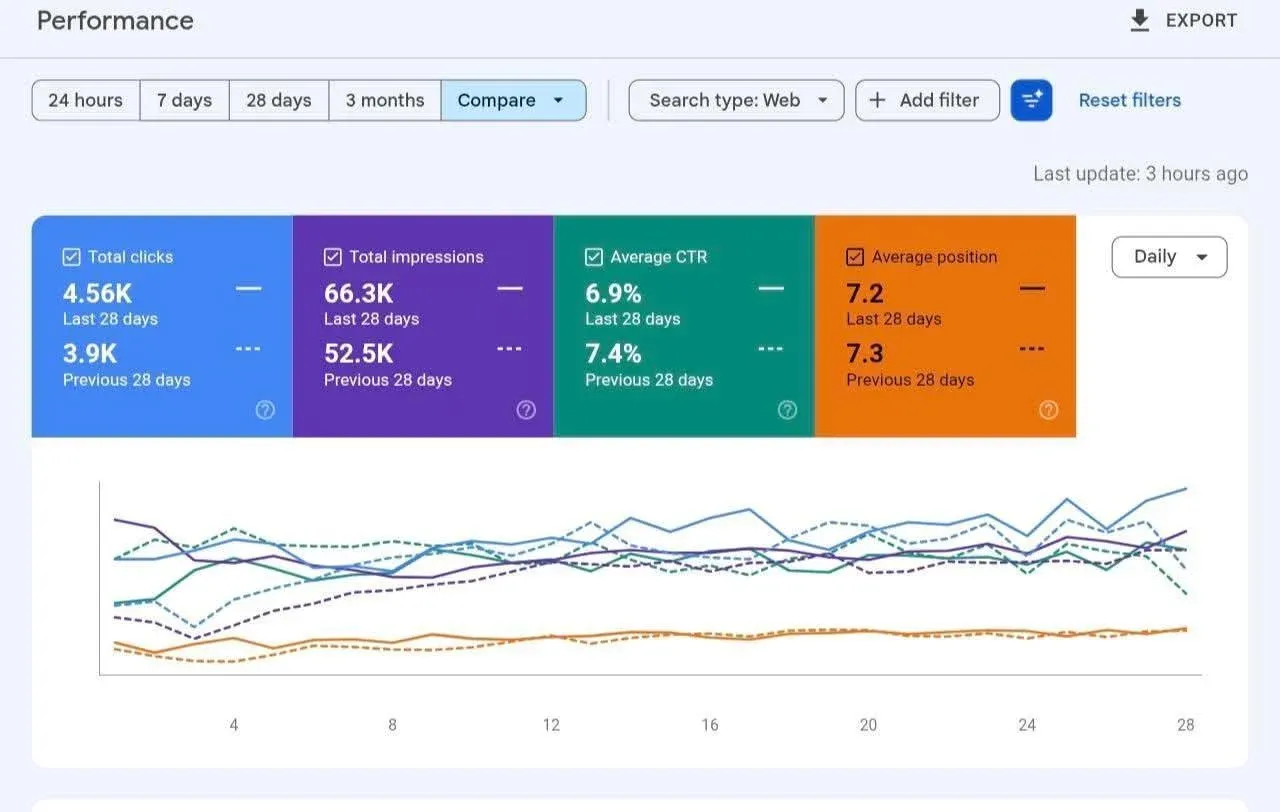
The top row compares the two periods: 4.56K clicks against 3.9K, 66.3K impressions against 52.5K. On the chart the solid click line pulls above the dashed line for the previous period in the final days.
Want numbers like these?
Get a free written review of your own account.
Who the business is
A group of clinics treating orthopaedic and sports injuries. It is not named here, so it is described by its trade and by what the screenshot shows.
Why marketing mattered
A patient with an injury searches for a specific treatment and books with one of the first clinics they see. The page that shows up has to be the right one.
- Service
- SEO
- Sector
- Orthopaedic clinic group, SEO
- Period measured
- The last 28 days against the 28 days before
- Figures from
- A Search Console performance screenshot for the account
What was not working
The problem
A clinic group whose own treatment pages were competing with each other in search. Impressions were rising, and a smaller share of the people who saw the site were clicking.
- Several pages covered the same treatment and competed with each other.
- The site was shown for broad questions from people who were not looking to book.
- Treatment pages had no FAQ markup, so they could not show question-and-answer results.
Where things stood before the work began
In the previous 28 days the site took 3.9K clicks from 52.5K impressions, at a 7.4% click-through rate and an average position of 7.3.
- 3.9K
- clicks in the previous 28 days
- 52.5K
- impressions
- 7.4%
- click-through rate
What we found, and why we started there
The thinking
Sorting every search by how often it was shown against how often it was clicked pointed to two things: pages that overlapped, and titles that did not say what a patient needed to read. Those were fixed first because they cost nothing but editing time.
How we did it, step by step
- 1
Titles and descriptions rewritten
Every search with many impressions and few clicks was traced to its page, and that page's title and description were rewritten for a patient ready to book.
- 2
Seven overlapping page pairs merged
The weaker page of each pair was folded into the stronger one, with a permanent redirect so no links were lost.
- 3
FAQ markup on 14 treatment pages
Real patient questions, taken from the questions Google shows for each search, were added and marked up.
What the numbers show
The result
+17%
organic clicks in 28 days
Clicks went from 3.9K to 4.56K against the previous 28 days, and impressions from 52.5K to 66.3K. Click-through rate fell from 7.4% to 6.9% and position held at about 7.
| Measure | Before | After |
|---|---|---|
| Clicks | 3.9K | 4.56K |
| Impressions | 52.5K | 66.3K |
| Click-through rate | 7.4% | 6.9% |
| Average position | 7.3 | 7.2 |
From the work to the outcome
- Overlapping pages merged
- Clearer titles
- 66.3K impressions
- 4.56K clicks
How to read this, and what it does not prove
A 28-day comparison from Search Console. Clicks and impressions rose; click-through rate fell from 7.4% to 6.9%, which the page reports as it is.
Twenty-eight days is a short window. Click-through rate went down, not up, in this period: the site was shown for more searches than it was clicked for. Clicks are visits, not booked appointments. The client is not named, so a reader cannot check the screenshot against the account. It is one account with no control group: it shows what happened alongside the work, and it cannot show how much of that the work caused.
Want this for your business?
It starts with a free written review.
What you can take from this
Check whether your pages compete
Two pages on the same treatment split the ranking between them. One strong page beats two weak ones.
Read click-through rate with impressions
A falling rate while clicks rise usually means you are being shown for new searches, not that the old ones got worse.
Write titles for the person booking
A title should tell a patient what the page treats and that they can book.