How much should a plumber spend on Google Ads? Work the budget back from the booked job
Most plumbers set an ads budget from what they can spare. Work it back from click price, lead rate and booked jobs instead, using 2025 plumbing benchmarks.
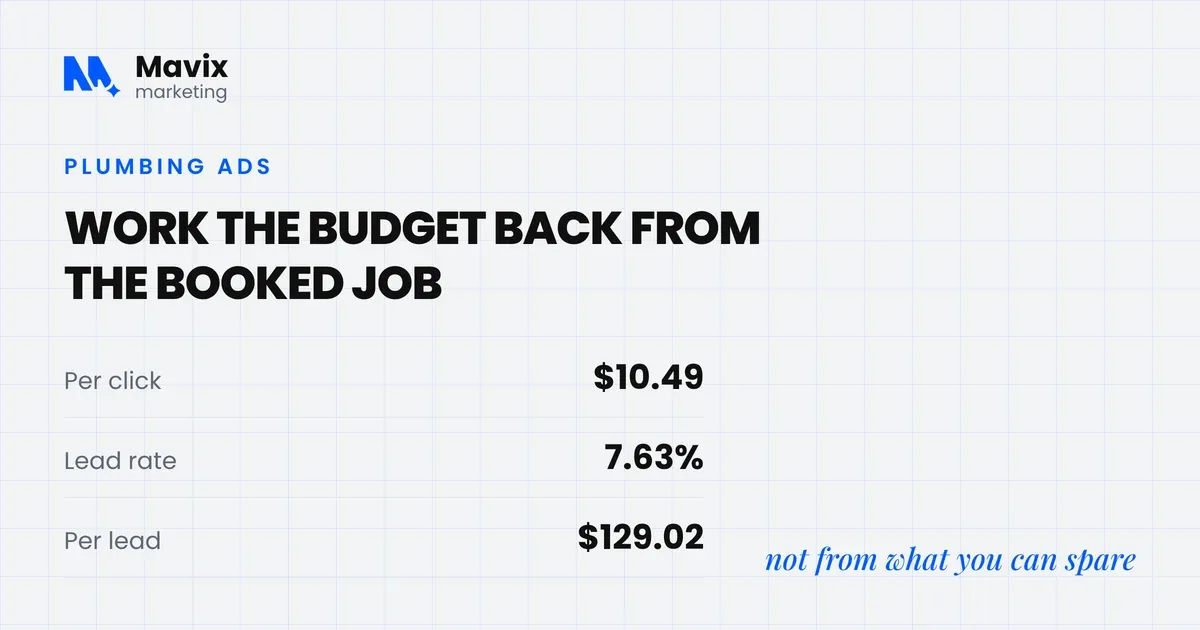
A plumber should spend whatever it costs to buy the number of booked jobs they want, at a cost per job their margin can carry. At 2025 median plumbing prices of $10.49 a click and a 7.63 percent lead rate, a booked job costs about $275 if half your leads book. Fifteen jobs a month is then about $4,125, or $136 a day.
This page is for plumbing company owners who run Google Ads or are about to, and want a budget they can defend with arithmetic. It shows the benchmark numbers, the steps to work out your own budget, and the point where the numbers say Google Ads is the wrong place to spend.
The short version
- Plumbing search ads cost a median $10.49 a click and $129.02 a lead in LocaliQ’s 2025 home services benchmarks, across 3,211 US campaigns.
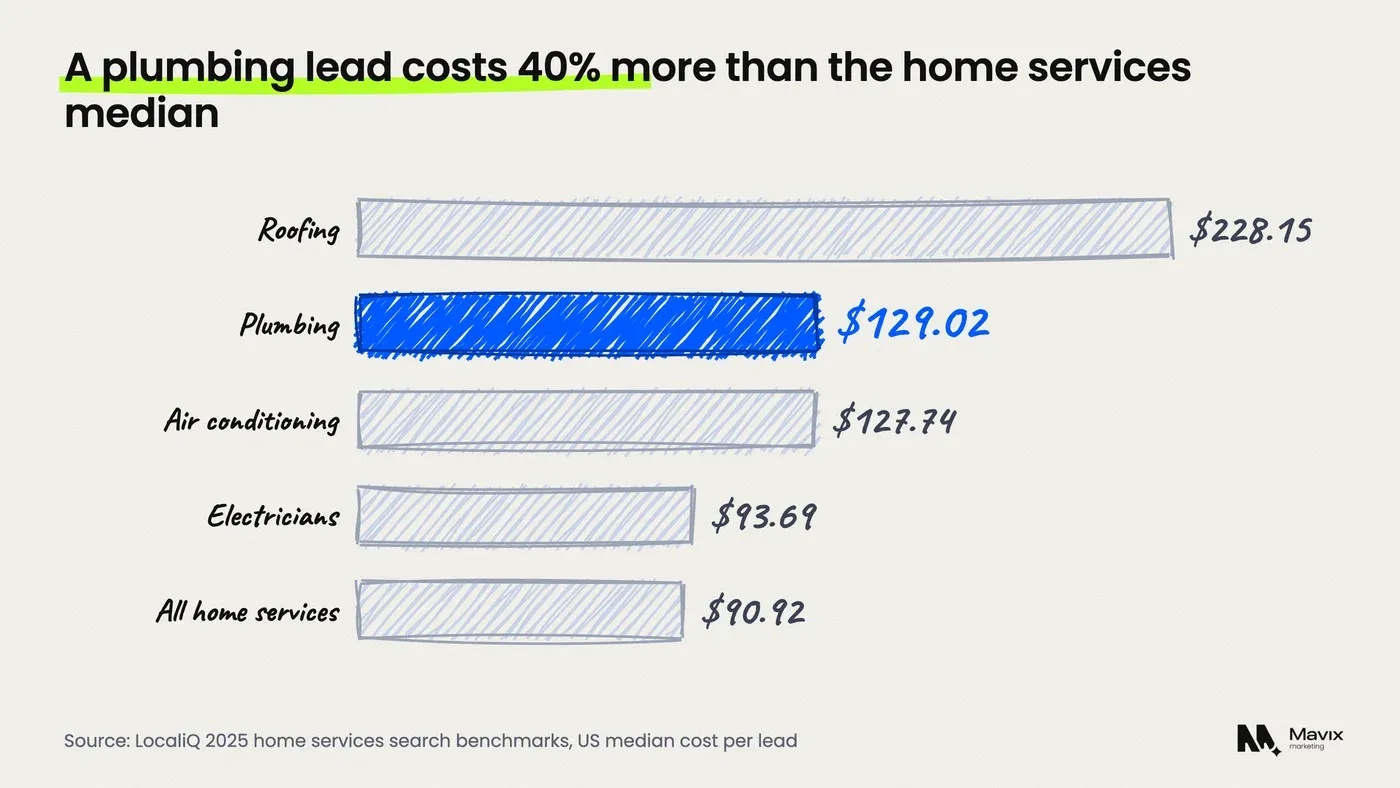
- Plumbing leads cost more than the $90.92 median for all home services, and less than roofing at $228.15.
- Work the budget back: jobs wanted, times cost per booked job, where cost per booked job is cost per lead divided by the share of leads that book.
- At median prices, $1,000 a month buys about 95 clicks, 7 leads and 3 to 4 booked jobs if half the leads book. That is too little data to judge a campaign on.
- Google can spend up to 2 times your average daily budget on one day and up to 30.4 times it in a month, so set the budget from the monthly total you can afford.
How much should a plumber spend on Google Ads?
Enough to buy the booked jobs you want, and no more than your profit per job can carry. LocaliQ’s 2025 benchmarks put plumbing at a median $10.49 a click, a 7.63 percent conversion rate and $129.02 a lead (LocaliQ). Multiply the cost of a booked job by the jobs you need, and that is the budget.
A conversion rate is the share of clicks that become a lead, meaning a call or a form. A flat figure such as “$2,000 a month” means nothing until it is turned into jobs. For a plumber in a dense metro with strong competition, $2,000 might buy six jobs. For one in a small town with cheaper clicks, it might buy fifteen. The method below works for both, because it starts from your numbers and uses the benchmarks only where you have none yet.
What does a plumbing click and lead cost on Google Ads?
A plumbing click cost a median $10.49 and a lead $129.02 in LocaliQ’s 2025 report, which measured 3,211 US home services search campaigns between April 2024 and March 2025. LocaliQ says its figures are medians, chosen to reduce the pull of outliers, so the click price divided by the conversion rate does not exactly equal the published lead price.
| Trade (LocaliQ category) | Cost per click | Conversion rate | Cost per lead |
|---|---|---|---|
| Plumbing | $10.49 | 7.63% | $129.02 |
| Air conditioning install and repair | $9.68 | 6.56% | $127.74 |
| Electricians | $12.18 | 9.08% | $93.69 |
| Roofing and gutters | $10.70 | 3.70% | $228.15 |
| All home services | $7.85 | 7.33% | $90.92 |
The table shows plumbing in the expensive half of home services: clicks cost a third more than the trade-wide median and leads cost about 40 percent more. Plumbing also had a 4.97 percent click-through rate in the same report, below the 6.37 percent for home services as a whole, so fewer people who see a plumbing ad click it.
For the full set of plumbing numbers with their sources, see plumbing marketing statistics for 2026. For why a benchmark lead price is a mirror and not a target, read Google Ads cost per lead benchmarks.
How do you work out a plumbing Google Ads budget?
Start from booked jobs and work backwards through four numbers you can find in your own records. The cost of a booked job is your cost per lead divided by the share of leads that book. The monthly budget is that cost times the jobs you want. Use the LocaliQ medians only for the numbers you do not have yet.
- Cost per click. From your account, or the $10.49 median if you are starting. Google’s Keyword Planner also forecasts daily clicks and cost for your own keywords and area (Google Ads Help).
- Conversion rate. The share of clicks that call or send a form. The median is 7.63 percent.
- Booking rate. The share of leads that become a booked job. This one has no benchmark. It depends on how fast you answer and how you price. Count it from your call log or a lead tracking spreadsheet.
- Jobs wanted. How many extra jobs a month your team can actually take.
A worked example, using the medians and an assumed booking rate of 1 in 2:
- $10.49 a click divided by 7.63 percent gives $137.48 per lead.
- $137.48 divided by 50 percent gives $274.97 per booked job.
- 15 booked jobs a month times $274.97 is $4,124.55 a month.
- Google bills against an average daily budget, and a month is counted as 30.4 days, so that is $135.68 a day.
If one in three leads books instead of one in two, the cost per job rises to $412 and the same fifteen jobs cost about $6,187. The booking rate moves the budget as much as the click price does, and it is the number you control.
What does each monthly budget actually buy?
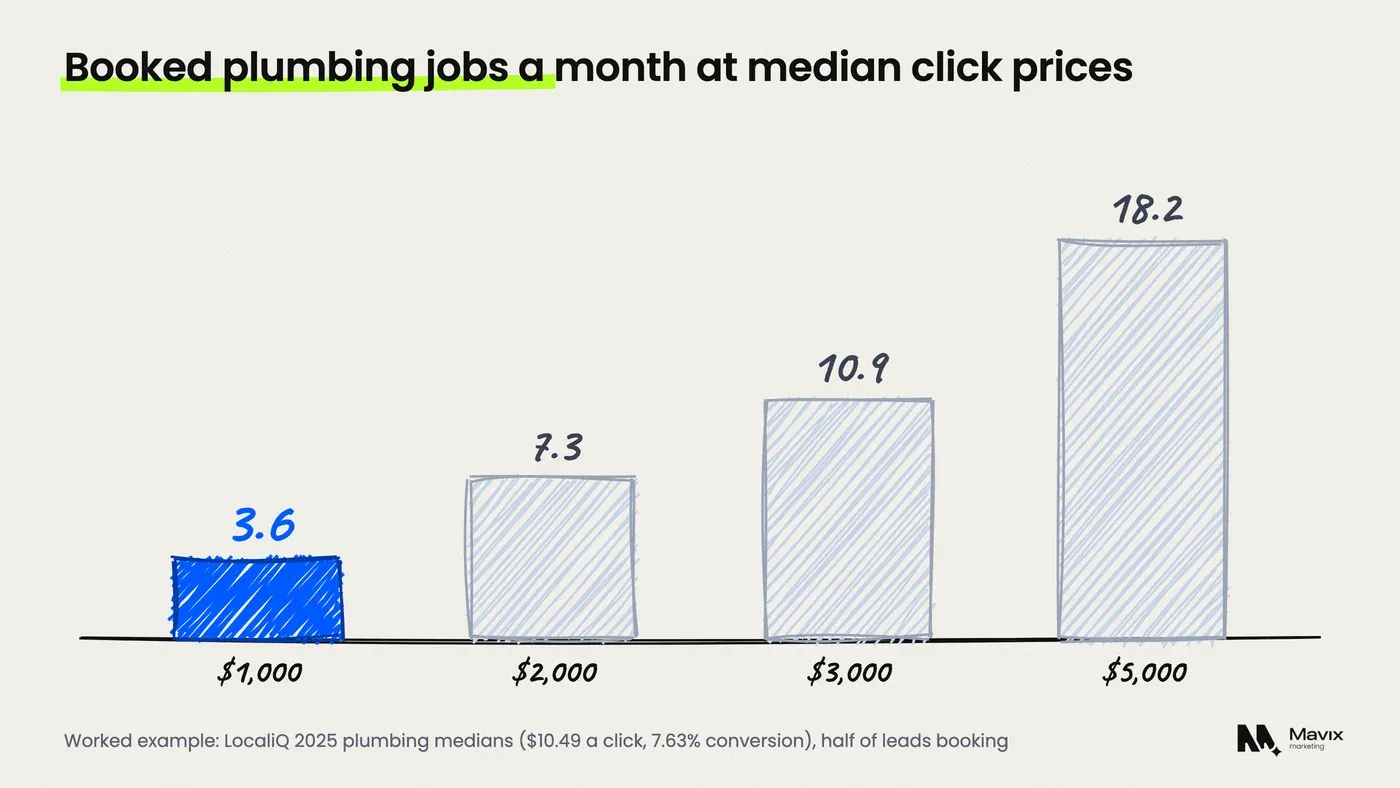
At the median plumbing click price and conversion rate, each $1,000 a month buys about 95 clicks, about 7 leads, and 3 to 4 booked jobs if half the leads book. The table below runs the same arithmetic at four budget levels, using LocaliQ’s medians and the assumed 50 percent booking rate.
| Monthly budget | Clicks | Leads | Booked jobs (half book) |
|---|---|---|---|
| $1,000 | 95 | 7.3 | 3.6 |
| $2,000 | 191 | 14.5 | 7.3 |
| $3,000 | 286 | 21.8 | 10.9 |
| $5,000 | 477 | 36.4 | 18.2 |
The point of the table is the bottom of it, not the top. At $1,000 a month you get so few leads that two slow weeks or one bad week look the same, and you cannot tell whether the campaign works. Real accounts also do not scale in a straight line: the first dollars buy the most urgent searches, and later dollars buy weaker ones.
Google’s budget rules matter here too. A campaign can spend up to 2 times its average daily budget on a single day and up to 30.4 times it in a month (Google Ads Help). Decide the monthly figure first, then divide by 30.4. A frozen-pipe morning can eat two days of budget, and that is the system working as designed.
What is the most a plumber can afford to pay per click?
The most you can pay per click is your profit per job, times the share of it you will spend on getting the job, times your booking rate, times your conversion rate. Work it out before you look at the benchmark, because if your ceiling is below the $10.49 median click price in LocaliQ’s data, a bigger budget will not fix it.
Two worked examples, both assuming a 50 percent gross margin, half that profit spent on getting the job, half of leads booking and the 7.63 percent median conversion rate:
| Average job value | Profit per job | Most per booked job | Most per lead | Most per click |
|---|---|---|---|---|
| $600 | $300 | $150 | $75 | $5.72 |
| $1,500 | $750 | $375 | $187.50 | $14.31 |
A plumber whose average job is a $600 repair cannot buy median-priced clicks at a profit on the first job. A plumber selling water heater swaps, sewer line work and repiping can. This is why a plumbing account usually splits emergency and planned work into separate campaigns with separate budgets, and spends most on the searches behind the bigger jobs. Our Google Ads for plumbers page sets out that structure.
Repeat customers change the sum. If a household you win calls you again for years, you can afford to pay more for the first job. Use your own repeat rate, not a guess, and put the numbers through the lead generation calculator.
Where do Local Services Ads fit in a plumbing budget?
Local Services Ads are Google’s pay-per-lead ads that sit above search ads, and most plumbers should fund them first, beside or before search ads. You pay for valid leads instead of clicks, set an average weekly budget, and Google says lead prices vary by location, job type, lead type and bidding mode (Local Services Help).
Two details matter for the budget:
- Missed calls can be charged. Google counts a missed call as a valid lead if the caller stays on the line for over 20 seconds during your business hours. An unanswered phone costs money here too.
- Spend can run over in a week. Google can exceed the weekly budget in a given week but not the monthly maximum, which is the weekly budget times the average number of weeks in a month.
Run both and compare the cost per booked job from each, not the cost per lead. The comparison of Local Services Ads and Google Ads walks through which one tends to be cheaper for a home service business.
Why a plumbing budget fails even when the arithmetic works
The arithmetic assumes every click is a person who needs a plumber, and every call gets answered. Neither is true by default, and both leak money before the budget is the problem.
- Wrong searches. Broad keywords pull in people looking for plumbing parts, DIY diagrams and plumbing jobs. The search terms report shows them. Our post on negative keywords for home services has the starting list.
- Unanswered phones. Ads that run when nobody answers buy calls that go to voicemail and then to a competitor. Schedule ads to the hours someone picks up.
- No tracking. Without counting calls as conversions, you cannot work out a cost per lead at all. If clicks arrive and calls do not, work through why Google Ads clicks turn into no leads before raising spend.
- Too small an area. A tight radius around the shop may not hold enough searches to spend the budget, while a wide one buys calls from towns you will not drive to.
When the numbers say no, the money may be better spent on the map listing. A plumber with strong reviews and a full Google Business Profile wins calls without paying per click, which the local SEO for plumbers page covers.
Questions people ask about plumbing Google Ads budgets
What is a good cost per lead for a plumber on Google Ads?
A good cost per lead is one where your booked jobs still make a profit after the ad cost. The 2025 median for plumbing was $129.02 in LocaliQ’s benchmarks, so anything well below that is doing better than most accounts. Judge it against your own most-per-lead figure, which is profit per job times your share for marketing times your booking rate.
Is $500 a month enough for plumbing Google Ads?
It is enough to test whether the phone rings, not enough to judge a campaign. At the median $10.49 a click, $500 buys about 48 clicks a month and, at a 7.63 percent conversion rate, three or four leads. One good or bad week swings the result. If $500 is the limit, put it into Local Services Ads or one tight emergency campaign.
Should plumbers spend more on Google Ads in winter?
Spend should follow your own call history. If your busiest emergency weeks are cold snaps, yes: an emergency campaign that runs out of budget by mid-morning misses the most urgent calls. Raise the emergency budget ahead of a forecast freeze and bring it back down when the weather turns, since Google can already spend up to twice the daily budget on a busy day.
How long before plumbing Google Ads pay off?
Expect the first month to be a calibration month. New campaigns need time to gather enough calls to show which keywords and hours book jobs, and a small budget stretches that out. Judge it at the end of a full month on cost per booked job, then cut the keywords and hours that produced calls but no jobs.
Does a bigger budget lower my cost per lead?
Usually not. The first dollars go to the most urgent, most relevant searches, and each extra dollar buys searches a little further from someone with water on the floor. More budget tends to bring more leads at the same or a higher cost each. Lower cost per lead comes from better keywords, answered calls and a page that makes calling easy.
What percentage of revenue should a plumber spend on Google Ads?
There is no reliable trade-wide percentage, and a rule of thumb ignores your margins and booking rate. Work from cost per booked job instead: decide the jobs you want, price them using your own conversion and booking rates, and check the total against your profit per job. The percentage of revenue then falls out of the sum rather than driving it.
The bottom line
Do not pick a budget from what feels affordable. Find your booking rate and profit per job first, work out the most you can pay per click, and only then multiply by the jobs you want. If your ceiling sits below about $10 a click, fix the booking rate and the job mix before spending more.
If you want the sum done on your own account, get your plumbing Google Ads account checked for free. You get your real cost per booked job and a budget that matches it, usually within one working day.
Free review
Want this looked at on your own site?
Send the address. A person reads it and writes back with the two or three things that would move your enquiry number first. Free, and yours to keep whether you hire us or not.