
SEO case study · 4 July 2023 to 28 June 2024
470K organic clicks in a year for a home goods retailer
An online home goods store had stalled in search. Its category pages were reworked around what shoppers type, and the store closed the year at its highest daily clicks.
21.3M
impressions
2.2%
click-through rate
8.8
average position
Measured over
4 July 2023 to 28 June 2024
What to notice
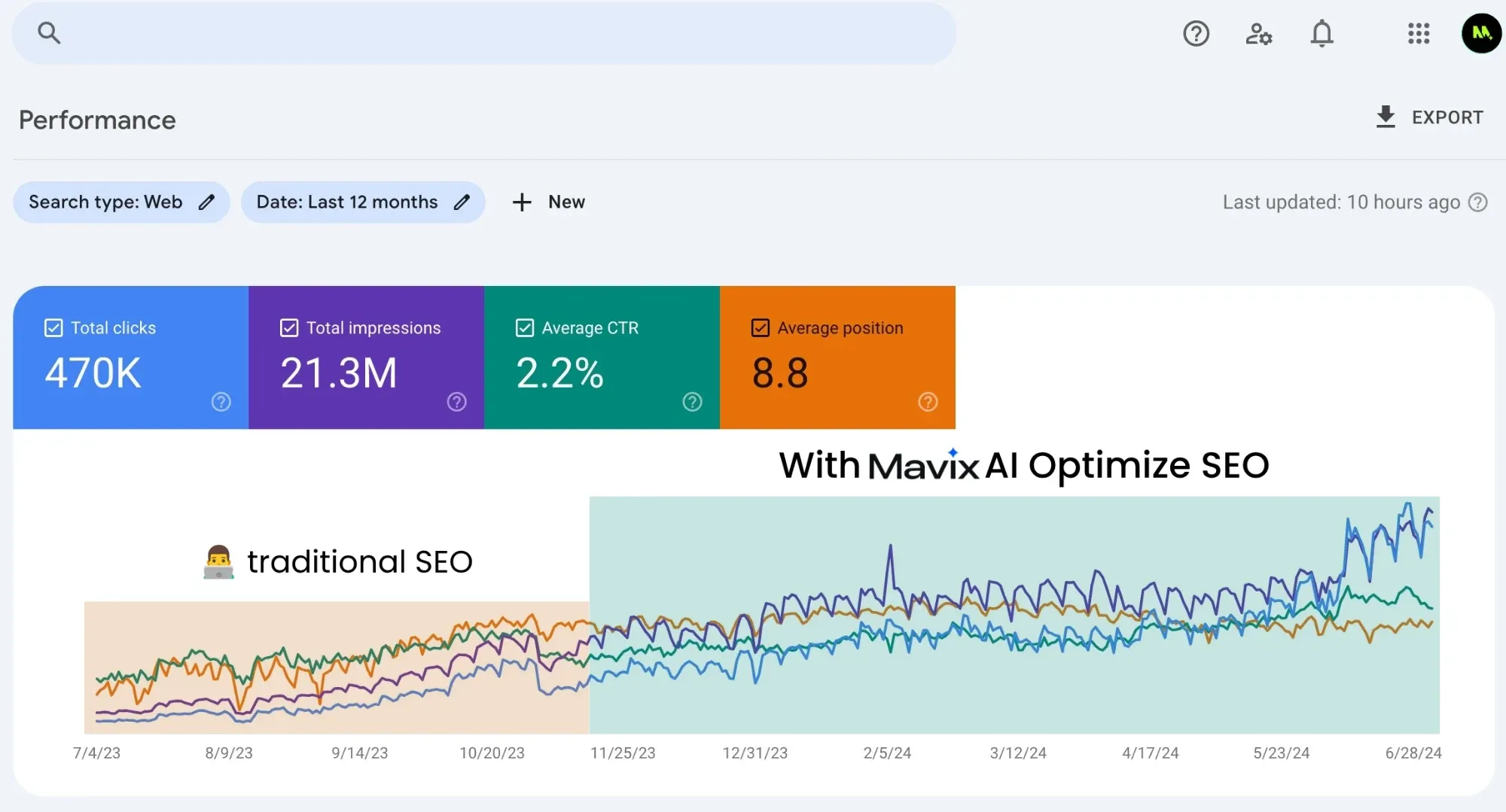
The top row gives the year: 470K clicks, 21.3M impressions, 2.2% click-through rate, average position 8.8. On the chart, the lines run flat under the first band and rise under the second, with the steepest climb in the last two months.
Want numbers like these?
Get a free written review of your own account.
Who the business is
An online retailer selling home goods across thousands of products. The business is not named here, so it is described by its trade and by what the chart shows.
Why marketing mattered
A store this size lives on its category pages. When those pages match the searches shoppers make, every product under them gets found without an advert being bought.
- Service
- SEO
- Sector
- Home goods retailer, SEO
- Period measured
- 4 July 2023 to 28 June 2024
- Figures from
- A Search Console performance chart for the account
What was not working
The problem
An online store with thousands of product pages whose search clicks rose and fell with no pattern. Growth from search had stalled, and the category pages were not matched to what shoppers typed.
- Search growth had stopped.
- Clicks moved up and down from week to week with no pattern.
- Category pages were built around the catalogue, not around what shoppers search for.
Where things stood before the work began
The first five months on the chart show a store that is visible but not growing. Clicks and impressions drift sideways from July to late November 2023.
What we found, and why we started there
The thinking
The category pages decide which searches a store can appear for, so they were the first thing changed. Mavix used AI-assisted analysis of search demand to rework them across the site, then kept adjusting as the data came in.
How we did it, step by step
- 1
Category pages reworked across the site
Each category page was matched to the searches shoppers use for that kind of product, starting around 25 November 2023.
- 2
Search demand reviewed as it moved
The pages were adjusted against what Search Console showed people were typing, not set once and left.
What the numbers show
The result
470K
organic clicks in 12 months
470K clicks from 21.3M impressions across the 12 months, at an average position of 8.8. The daily lines climb through the months after the category pages were reworked, and are at their highest in the final weeks.
From the work to the outcome
- Category pages matched to searches
- More searches shown for
- 21.3M impressions
- 470K clicks
How to read this, and what it does not prove
Twelve months of Search Console totals, 4 July 2023 to 28 June 2024. The figures are for the whole year, not only the months after the change. The bands and labels on the chart were added by Mavix.
The totals cover the whole year, including the months before the change, so they are not a before and after comparison. A home goods store also has a busy season, and part of the winter rise will be seasonal. Clicks are visits, not orders, and no revenue figure was supplied. The chart is an annotated image, not the raw export, and the client is not named, so a reader cannot check it against the account. It is one account with no control group: it shows what happened after the change, and it cannot show how much of that the change caused.
Want this for your business?
It starts with a free written review.
What you can take from this
Fix category pages before product pages
A category page reaches every product under it. One good category page does the work of hundreds of product edits.
Read a yearly total with its split
This total includes five months before the change. The chart shows where the growth sits, the total does not.
Allow for the season
Home goods sell more in winter. Compare the same months a year apart before crediting the work with all of a rise.