Local SEO for roofers: the categories, service areas, storm pages and reviews that put a roofing company in the map pack
Roofers lose map pack spots to wrong categories, thin storm pages and old reviews. What to set, what to write, and what Google bans.
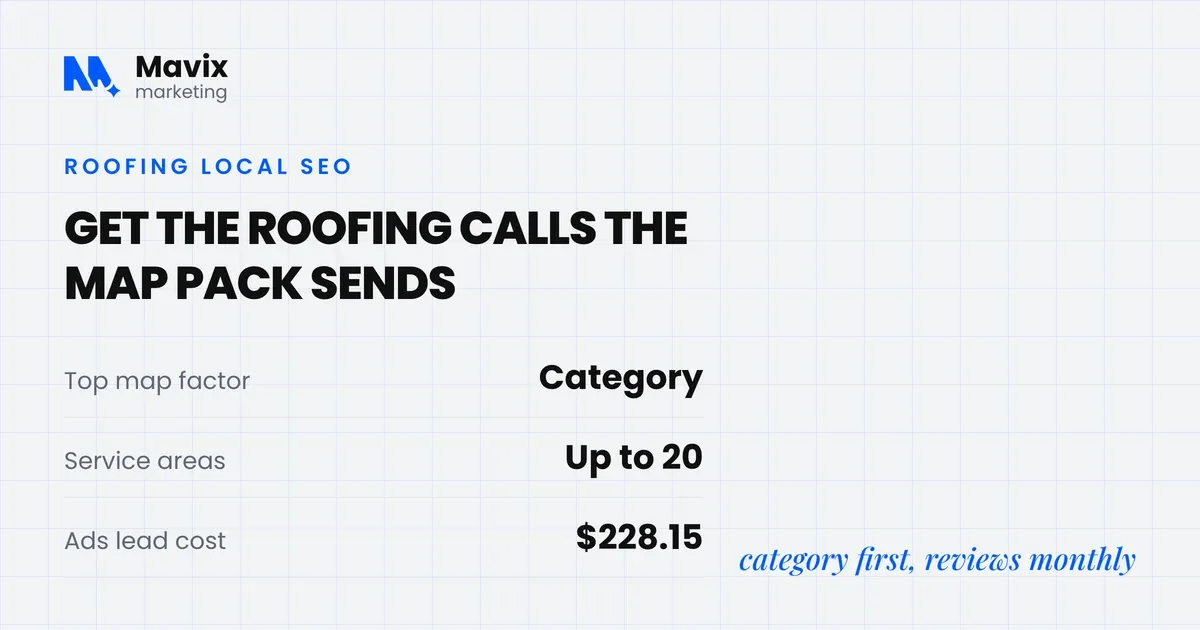
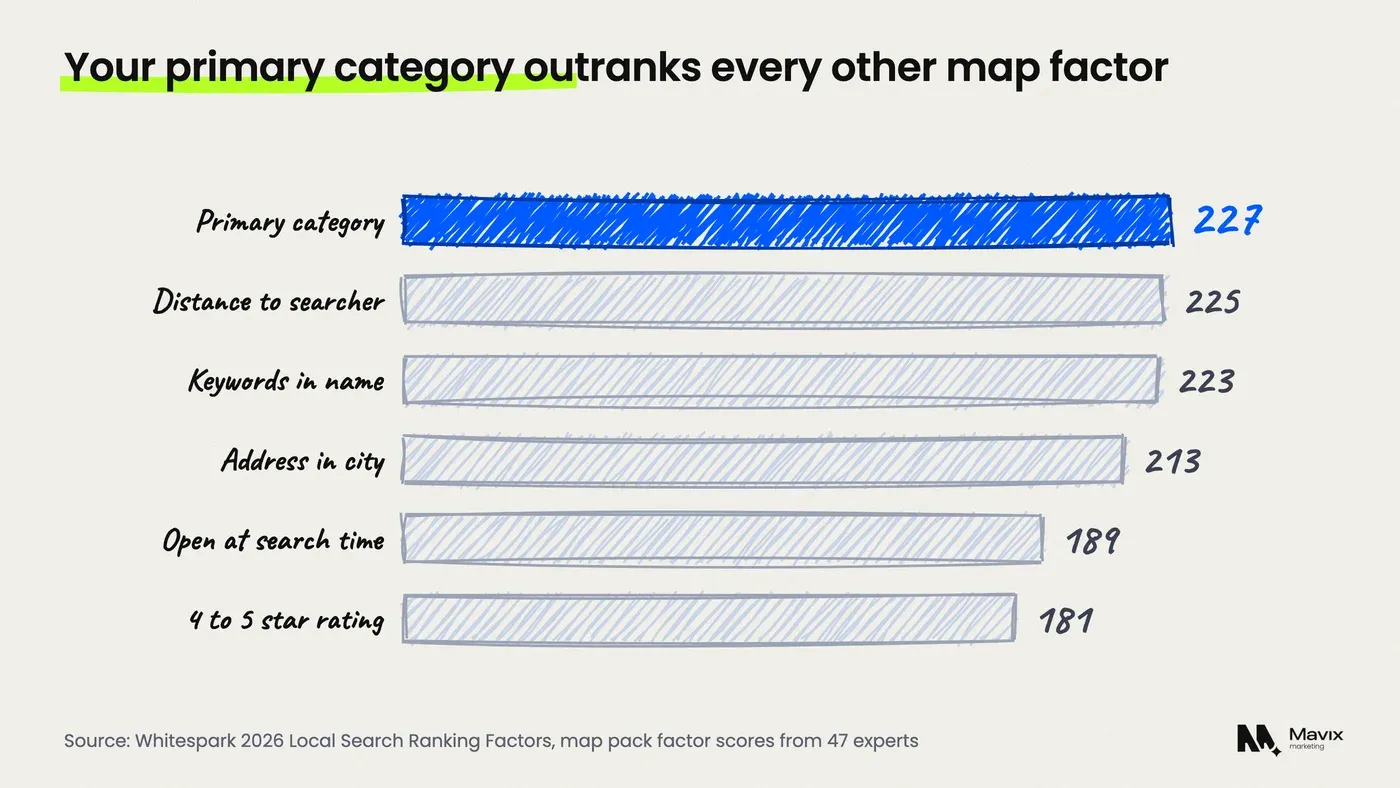
A roofer gets into the Google map pack with four things. They are a primary category of Roofing contractor and a service area that matches where the crews actually go. The other two are a steady flow of recent reviews and a website with one real page per service. Whitespark’s 2026 survey of 47 local search experts ranks the primary category as the single strongest map pack factor.
This page is for owners of roofing companies, from one-crew outfits to multi-crew contractors, who want more calls from the map without paying per lead. It covers the Business Profile settings, the reviews, the pages to write, how to handle storm work without breaking Google’s rules, and the mistakes that keep roofers out.
The short version
- The primary Business Profile category is the top map pack factor in Whitespark’s 2026 Local Search Ranking Factors, scored by 47 experts. For most roofers it should be Roofing contractor.
- Google allows up to 20 service areas, set by city or postal code, and says the whole area should stay within about two hours’ drive of your base.
- Roofing search ads cost a median $228.15 a lead in LocaliQ’s 2025 benchmarks, the dearest of the home services trades it measured, which is why the map listing is worth the work.
- 74 percent of US consumers only consider reviews from the past three months, according to BrightLocal’s 2026 survey, so a roofer needs reviews every month, not a burst once a year.
- Fifty near-identical “roof repair in [town]” pages fit Google’s own definition of doorway abuse. Storm pages are safe when each one covers a real event with real detail.
How does Google decide which roofers show in the map pack?
Google ranks local results on three things: relevance, distance and prominence. Relevance is how well your profile matches the search, and distance is how far you are from the searcher. Prominence is how well known you are, judged partly by links and reviews, according to Google’s own local ranking page. Google also says there is no way to pay for a better local ranking.
Whitespark’s 2026 Local Search Ranking Factors, where 47 practitioners scored 187 factors, puts these at the top for the map pack:
| Rank | Factor | Score | What a roofer controls |
|---|---|---|---|
| 1 | Primary Business Profile category | 227 | Fully |
| 2 | Distance from searcher to business | 225 | Not at all |
| 3 | Keywords in the business name | 223 | Only through the real legal name |
| 4 | Physical address in the city searched | 213 | Only by where the office is |
| 5 | Open at the time of search | 189 | Fully, through listed hours |
| 6 | High Google rating (4 to 5 stars) | 181 | Through the work and the asking |
The table shows that half of the top six are fixed by where you are and what you are called. The other half, category, hours and rating, are settings and habits a roofer can change this week.
What category should a roofer pick on Google Business Profile?
Roofing contractor, as the primary category, for almost every roofing company. The primary category is the single strongest map pack factor in Whitespark’s 2026 survey, and Google’s guidelines say to use as few categories as possible to describe your core business. They also say never to use categories as keywords (Google Business Profile guidelines).
Add secondary categories only for work you actually sell and quote for. Search the category picker for each, because Google’s list changes:
- Primary: Roofing contractor.
- Secondary, if you do the work: gutter installation or cleaning, siding, skylights.
- Leave out: any category for work you subcontract, and a general contractor category unless you really run whole builds.
Every extra category you do not serve spreads relevance thinner and brings calls you turn away. The plan post on Google Business Profile categories goes through the choice for other trades too.
Should a roofer show their address or set a service area?
Most roofers should hide the address and set a service area, because customers do not visit a roofing office. Google says a service-area business should remove its address if it does not serve customers there. It lets you add up to 20 service areas by city or postal code, but not as a radius (Google Business Profile Help).
Two rules catch roofers out:
- Two hours, not two states. Google’s guidelines say the service area should not extend farther than about two hours of driving time from your base. Listing every county you have ever re-roofed in breaks that.
- No virtual offices. A rented mailbox or shared desk address you do not work from is not eligible for a Business Profile under the same guidelines. A profile built on one can be removed, and its reviews go with it.
Whitespark’s experts score “address showing, not a service-area business” as a factor too, so a roofer with a real yard or showroom customers can visit may rank better showing it. Only show it if customers really are served there.
What should a roofing website have for local SEO?
One page per service you sell and one page per main town you work in, each with something true and specific on it. The map listing links to your site, and Google’s relevance signal reads the site as well as the profile. A single “Services” page listing roof repair, replacement, gutters and inspections gives Google little to match.
The pages that earn their place:
| Page | What makes it worth ranking |
|---|---|
| Roof replacement | Materials you fit, a price range, how long a job takes, warranty |
| Roof repair | Common repairs with starting prices, same-week availability |
| Storm and hail damage | How an inspection works, what to photograph, how claims run |
| Gutters, siding, skylights | Only if you sell them, with your own photos |
| Each main town | Jobs done there, local roof styles, permit notes, a named review |
The table shows each page earning its rank with facts a homeowner would ask for. A town page with your photos of three jobs on named streets is useful. The same page with the town name swapped is not. The plan post on service area pages shows how to tell the two apart, and the local SEO checklist covers citations, schema and the rest.
How do roofers write storm pages without breaking Google’s rules?
Write a page for a real storm, with real detail, not a page for every town a storm might hit. Google’s spam policies define doorway abuse as pages created to rank for similar searches. They give the example of pages “targeted at specific regions or cities that funnel users to one page” (Google Search spam policies). The same policy bans generating many pages without adding value, which it calls scaled content abuse.
A storm page that is safe and useful:
- Names the event. The date, the areas hit, hail size or wind speed from the local weather service report.
- Says what to check. Dented gutters and vents, missing shingles, granules in the downspouts, with your own photos.
- Explains the claim. What the insurer usually asks for, what an inspection report contains, how long it takes.
- Shows your capacity. How fast you can inspect, and whether you are booking now.
- Gets updated or retired. Once the storm work is done, fold the page into your main storm damage page.
What does not work is fifty pages titled “Hail damage roof repair in [town]” with the same text. It is the pattern out-of-town storm chasers use, so a page that proves you are local and were there also sets you apart from them.
How many Google reviews does a roofer need?
Enough to beat the roofers ranking beside you, and new ones every month. BrightLocal’s 2026 survey of 1,002 US consumers found 74 percent only consider reviews from the past three months and 68 percent need a rating of four stars or more (BrightLocal). Google says more reviews and positive ratings can help local ranking.
Roofing has a review problem built in: people buy a roof once every couple of decades. The fix is to ask at the moment the customer is happiest, which is the day the crew cleans up and leaves.
- Ask every customer. Google’s policy bans selectively asking only happy customers for reviews, and bans any discount or gift in exchange for one (Google contributed content policy).
- Send the link by text the same day. A short link from your profile’s “Ask for reviews” button.
- Reply to every review. BrightLocal found 89 percent of consumers expect owners to respond, and half are put off by templated replies.
Say you finish 25 roofs a month and one customer in five leaves a review when asked. That is five new reviews a month, about 15 in any three-month window, which is the window most readers look at. The plan post on how to get more Google reviews has the wording and the timing.
What does it cost a roofer to skip local SEO?
Roughly what the same leads would cost from search ads. Roofing and gutters had the dearest leads of any home services trade in LocaliQ’s 2025 benchmarks. The median was $228.15 a lead, $10.70 a click and a 3.70 percent conversion rate, across 3,211 US campaigns (LocaliQ).
A worked example: if the map listing brings five extra leads a month, buying the same five through search ads at the median would cost $1,140.75 a month, or $13,689 a year. That is the value to weigh against the time or the fee for local SEO. Map pack leads are not free, because reviews, photos and pages take work, but they do not stop the day a budget runs out.
The roofing marketing statistics post has more of the numbers behind roofing leads. For what a done-for-you service involves, see local SEO for roofing companies.
What do roofers get wrong in local SEO?
The commonest mistakes are settings and shortcuts, not missing content. Each one below either breaks a Google guideline or wastes the strongest factors in the Whitespark table.
- Keywords stuffed into the business name. “Smith Roofing | Best Roofer Dallas Hail Repair” breaks Google’s rule against unnecessary information in the name, and anyone can suggest an edit that removes it. Keywords in the name only help when they are the real name.
- Hours that say closed. “Open at time of search” is a top-five factor. If you take emergency tarp calls at night, list the hours you really answer.
- Stock photos. Upload photos of your crews, trucks and finished roofs, taken on the job.
- A profile no one owns. A previous marketer’s login, or a duplicate profile from an old address, splits reviews and confuses Google.
- Review bursts. Fifty reviews in a week after a year of none looks like a campaign, and fails the three-month window readers use.
Local SEO is also not the right first spend for every roofer. A brand-new company with no reviews in a city full of established roofers will wait months for the map, and may need roofing Google Ads to fill the calendar in the meantime.
Questions people ask about local SEO for roofers
How long does local SEO take for a roofing company?
Most of the profile changes show up within weeks, but climbing the map pack in a competitive city usually takes several months of steady reviews and pages. Distance never changes, so a roofer based across town from the searcher may never rank there however good the profile is. Judge progress on calls from the profile, which Google reports, not on one ranking check.
Can a roofer rank in the map pack for towns outside their address?
Sometimes, but distance is the second strongest factor in Whitespark’s 2026 survey, so it is hard. Setting a service area does not make you rank everywhere inside it. Town pages on your website, with real jobs from each town, help you rank in the ordinary search results there, which often do more than the map for nearby towns.
Should roofers use Local Services Ads as well as local SEO?
Many should run both, because Local Services Ads are Google’s pay-per-lead ads that sit above the ordinary results, so they catch searchers before they reach the map. Compare the two on cost per booked job, not cost per lead. Local SEO builds the reviews and the profile that make any Google listing more likely to get the call.
Do Google Business Profile posts help a roofer rank?
Posts do not appear in the top ten map pack factors in Whitespark’s 2026 survey, so do not expect them to move the ranking. They can help the people who find your profile, by showing a recent job, a storm notice or a seasonal offer. Spend the time on reviews and photos first, and use posts when you have real news.
What should a roofer do about a fake negative review?
Flag it from the Business Profile as breaking Google’s policy, for example as a conflict of interest or off-topic, and reply politely in public with the facts. Do not offer anything to have it removed, because Google’s policy bans offering incentives to change or remove a review. The plan post on responding to negative reviews has reply wording.
How much does local SEO cost for a roofing company?
It depends on the city and how much of the work you do yourself. A single-location service business typically pays a monthly retainer, and the local SEO cost guide sets out the ranges with their sources. Compare the fee against what the same leads would cost from search ads, which for roofing was a median $228.15 a lead in LocaliQ’s 2025 data.
The bottom line
Set the primary category to Roofing contractor, set a service area you really drive to, and remove any address customers never visit. Then ask every finished job for a review, the same day, every month. Write pages that prove you were there. Do not build town or storm pages that only swap the name.
If storm season brings calls to the roofer down the road instead of you, get your roofing map listing checked for free. You get a written list of what is holding the profile back, usually within one working day.
Free review
Want this looked at on your own site?
Send the address. A person reads it and writes back with the two or three things that would move your enquiry number first. Free, and yours to keep whether you hire us or not.