Mavix Marketing Mavix Marketing, home +1 (510) 312-5086

Store growth

Ecommerce SEO measured in revenue per visitor, not a prettier traffic chart

An online store has a search problem most sites do not. It generates thousands of URLs on its own, most of which should never be indexed, while the pages that could earn money are thin because they were built from a product feed. On the store audits run here, a handful of category pages produce nearly all the organic revenue and the long tail produces almost nothing.

See the case studies
  • 470K organic clicks in 12 months SEO

What we report on

  • Organic revenue and revenue per session
  • Non-brand organic revenue share
  • Indexed pages against catalogue size
  • Category page rankings and conversion rate
  • Crawl budget spent on indexable URLs

Certified across the platforms we buy on. 150+ businesses, 7 years.

  • Google Ads Partner
  • Google Partner certification
  • Meta Business Partner
  • TikTok Marketing Partner
  • Shopify Partner
  • SEMrush Agency Partner

How it works, in plain steps.

SEO: get found by people who are ready to buy.

1We find what your buyers actually type.

emergency plumberboiler repair costplumber near meblocked drain todaylandlord gas certificate

Tap a step to see it again.

Fit

Who this is for, and who it is not.

Worth reading before the rest of the page. If the right-hand column describes you, the honest answer is that this is not the service to buy.

This is for you if

  • You sell online and organic is a small share of revenue relative to paid.
  • You have many products and no clear view of which pages earn anything.
  • Your category pages are a product grid and nothing else.
  • Your product descriptions came from the supplier, and so did every competitor's.
  • Paid costs are rising and you need a channel that does not bid against you.

This is not for you if

  • You have a handful of products and no category depth. Conversion work pays back faster.
  • Your margins cannot carry any cost to win a customer, in which case the problem is pricing.
  • You want product descriptions machine-generated at scale with no review. That is the situation you are already in.

If you are on the right-hand side, say so in the form anyway. We will tell you what we would do in your position, which costs you nothing and costs us fifteen minutes.

Where this work has been done.

Industries with their own page, each with what goes wrong in search, paid and email for that trade.

What this actually fixes.

Faceted navigation is eating the crawl

Filters for colour, size, price and brand combine into tens of thousands of crawlable URLs, almost none of which should be indexed. Crawl budget goes to permutations while the pages that matter get visited rarely.

Category pages are grids with nothing to rank on

The category page is the page with the most buying intent on a store and usually the emptiest. A grid of products and a title tag cannot compete with a retailer who wrote a buying guide onto theirs.

Product descriptions are identical to everyone else's

Manufacturer feed copy is on every site selling the item. There is nothing there for a search engine to prefer, and nothing for a customer to buy on either. La Vela's machine pages had this exact problem: catalogue copy, written for nobody in particular.

The two numbers that decide where the work goes

Revenue per session by landing page says which pages already convert and therefore deserve more traffic. Search demand by category says where traffic is available. The work starts where those two overlap.

Every store opened here has had the same shape: a small number of category pages producing most of the organic revenue, and a very long tail producing almost nothing. The instinct is to fix the tail because it is bigger. The money is in making the head pages better.

Why a store with thousands of pages ranks for almost nothing

Three things, and they compound.

The crawl is spent on filters. Every filter combination is a URL. Colour times size times price times brand produces a number that gets large fast, and a crawler will happily spend months exploring it while the category page that sells gets visited rarely.

The category page is a grid. It is the page with the most buying intent on the store and usually the emptiest. A title tag and forty product tiles cannot compete with a retailer who wrote the buying guide onto theirs.

The product copy belongs to the manufacturer. The same paragraph is on every store selling the item. Google has no reason to prefer yours, and a customer has nothing to decide on.

So the store has thousands of pages and, from Google’s point of view, almost no reasons to rank any of them.

What changed at La Vela Coffee

A three-generation coffee business selling commercial machines and espresso equipment out of Miami, with product pages written for the catalogue and no page at all for leasing, rentals or wholesale.

The machine pages were rewritten first, in order of what buyers were searching for: the C2 Classic, the Rancilio Classe 5, 7 and 9, the D8 single boiler, the Eversys E4 Classic. Then the pages that had never existed were built: equipment leasing for restaurants and offices, machine and coffee-bar rental for events, Miami distribution and wholesale. Then the internal links tied products to services to the Miami pages.

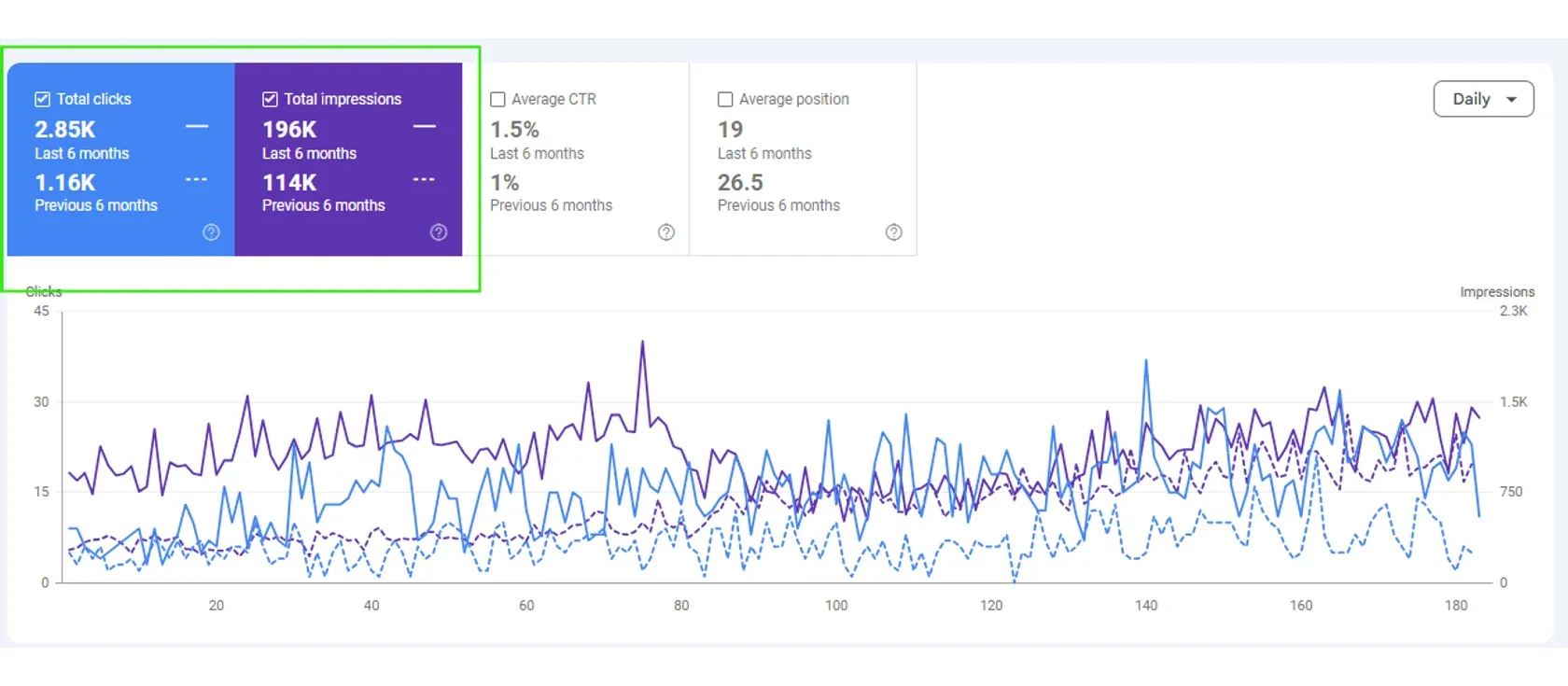
Six months against the previous six: organic clicks 2.85K against 1.16K, impressions 196K against 114K, 43 keywords in the top three. Organic revenue went from nothing to just over $1,400, which is a small number on a product where a single machine sale is worth more, and it is reported here as a channel starting rather than a channel that had already paid for itself.

Where the line is

A machine-written description for every SKU is not a fix. It is the same thin page in more words, and Google’s scaled content abuse policy names exactly that.

Not every product should be indexed. Variants, discontinued lines and products nobody searches for dilute the store when they are in the index. Deciding which pages earn their place is part of the job, and deleting is sometimes the right answer.

And the store’s own tail will not pay for its own rewrite. The top slice by margin and demand gets written properly. The rest gets measured, and the writing stops where the return does.

Fix the pages that sell. Then let Google find the rest.

Exactly what gets done.

Not a list of capabilities. This is the work that happens on your site and in Search Console, and the monthly report can be held against every line of it.

01

Indexation control over generated URLs

Facets, filters, sorts, internal search and parameter variants brought under deliberate control. Which combinations are worth indexing, which get a canonical, which get blocked, and why each decision was made, written down so the next theme update does not undo it.

02

Category pages built to convert and to rank

Real content above and below the grid answering what a buyer is deciding between: sizing, compatibility, materials, use case, comparison. Written to help someone choose, which is also what makes it rank.

03

Product content that is yours

Descriptions rewritten around use, fit, comparison and the questions your support team gets asked. Prioritised by margin and search demand rather than trying to rewrite the whole catalogue at once. At La Vela the C2 Classic, the Rancilio Classe range and the Eversys E4 got this treatment first, because those were the machines with buyers behind the searches.

04

Internal linking through the catalogue

Related products, complementary categories, and links from content to the commercial pages that should benefit. On a large catalogue this is often the highest-value work available for the least cost.

05

Technical work specific to stores

Out-of-stock and discontinued product handling, pagination, variant URLs, structured data for products and reviews, and site speed on template pages that render at scale.

06

Revenue reporting by landing page

Organic revenue and revenue per session by category and product, so the work goes where the margin actually is.

How long it takes

What happens, and when.

Nobody can tell you in advance what your account will do. What can be said in advance is what will have happened by when.

  1. 01
    Weeks 1 to 3

    Crawl, index and revenue baseline

    Full crawl, indexation map against the catalogue, and a revenue baseline by landing page. This usually shows that a small fraction of pages earn nearly everything, which changes where the work goes.

  2. 02
    Weeks 4 to 8

    Control the index, fix the categories

    Faceted navigation brought under control and the top revenue categories rebuilt properly. These two together account for most of the first movement.

  3. 03
    Weeks 9 to 16

    Product content and internal links

    Product content rewritten in priority order by margin and demand, internal linking built through the catalogue, structured data implemented.

  4. 04
    Ongoing

    Expand into demand you can see

    Search Console shows which product and category terms Google is testing you for. New category and buying-guide pages get built against demand that is already visible rather than guessed at.

Outcomes, not activities.

Rankings are an activity. These are the things that should change in the business as a result, and each one has a number in Search Console or analytics that either moved or did not.

  • Organic revenue that can be read by page, so the next month's work goes where the margin is.
  • A crawl that spends its time on the pages that sell rather than on filter permutations.
  • Category and product pages that rank because they help a buyer choose, which is the same reason they convert.

Three things you can hold us to.

Revenue by page, from week one

The baseline is organic revenue by landing page, not sessions. On every store opened here that number has changed where the work went.

An indexation policy, in writing

Which facets index, which canonicalise, which are blocked, and why. Written down, because a theme update will otherwise undo it silently.

The head of the catalogue first

Rewriting the top slice of products by margin and demand, measuring, and stopping where the writing cost stops paying back. Pretending the whole tail is worth it is how the project stalls.

What drives the number.

Catalogue size and platform. A thousand-product store on Shopify with clean templates is a different job from a fifty-thousand-SKU store with a custom platform and uncontrolled facets. The crawl in week one says which you are.

Included

  • Crawl, indexation map and revenue baseline by page
  • Facet and parameter policy, implemented
  • Category page content and structure
  • Product content for the priority slice of the catalogue
  • Store-specific technical work and structured data
  • Monthly report opening with organic revenue by page

Not included

  • Replatforming or theme development
  • Machine-generated descriptions for the whole catalogue
  • Paid shopping campaigns, which run under media buying
See how pricing works

What happens if it underperforms

If the 90-day target is missed, every retainer fee is refunded plus $1,000, on the conditions in the contract: baseline measured in your own Search Console and GA4, changes implemented, tracking working throughout.

Numbers from live accounts.

SEO

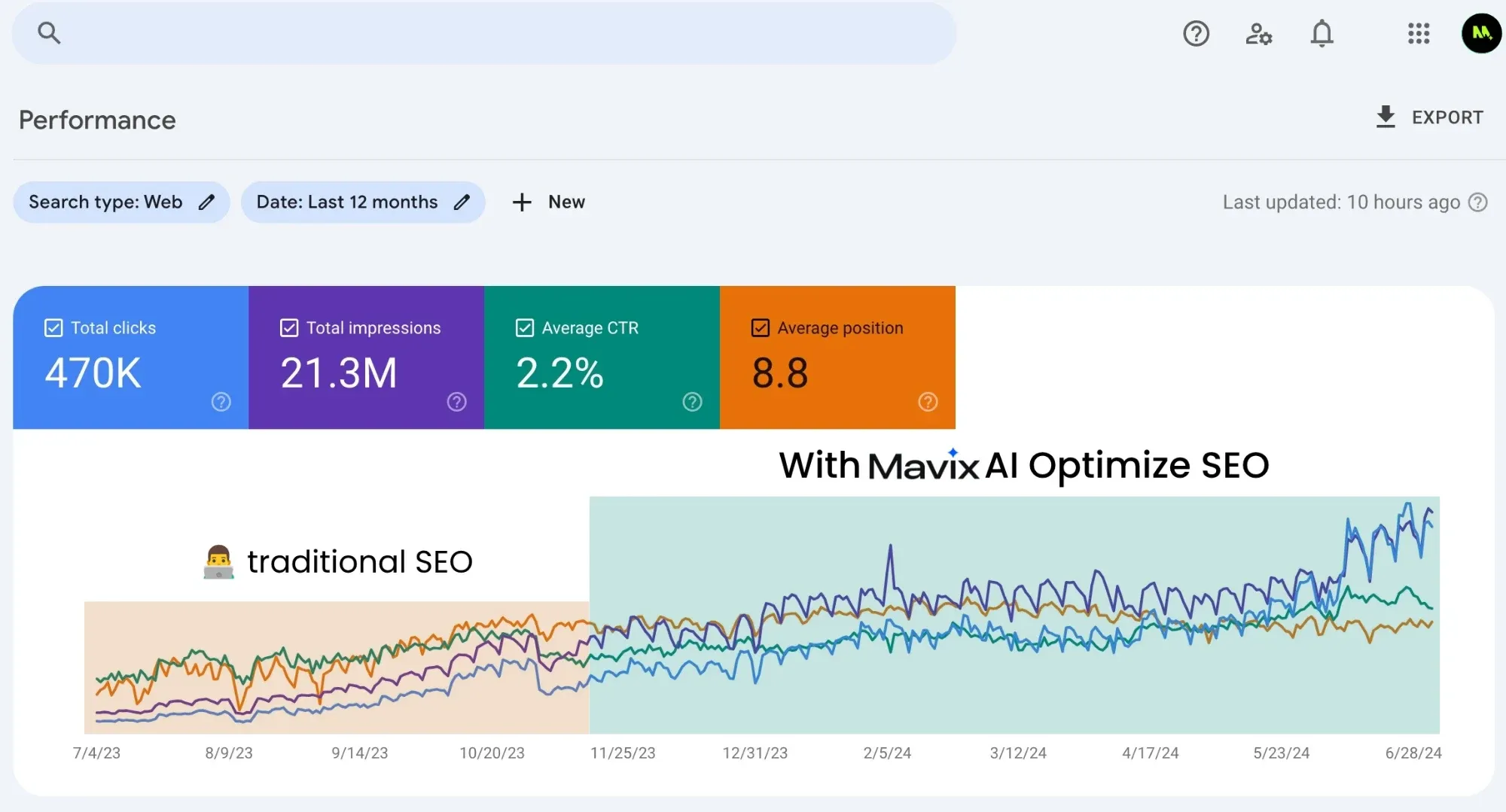
470K

organic clicks in 12 months

21.3M impressions at an average position of 8.8.

Real accounts, anonymised by client agreement. Currency as recorded in the account. Movement varies by market, budget and starting position.

Proof

Accounts where this work was done.

Every figure below is legible in the screenshot beside it, and every card says what the numbers do not establish.

Search Console comparing six months against the previous six: clicks 2.85K against 1.16K, impressions 196K against 114K, average position 19 against 26.5

La Vela CoffeeSEO

+146%organic clicks

  • 2.85Kclicks, from 1.16K
  • 196Kimpressions, from 114K
  • 19average position, from 26.5
Read from
The client's own Search Console
Period
Six months against the six months before it
Read the full story
Search Console over 12 months showing 470K clicks, 21.3M impressions, 2.2% click-through rate and an average position of 8.8, with a band marking the change of approach in late November 2023

Home goods retailer, SEOSEO

470Korganic clicks in 12 months

  • 21.3Mimpressions
  • 2.2%click-through rate
  • 8.8average position
Read from
The client's own Search Console
Period
4 July 2023 to 28 June 2024, twelve months
Read the full story
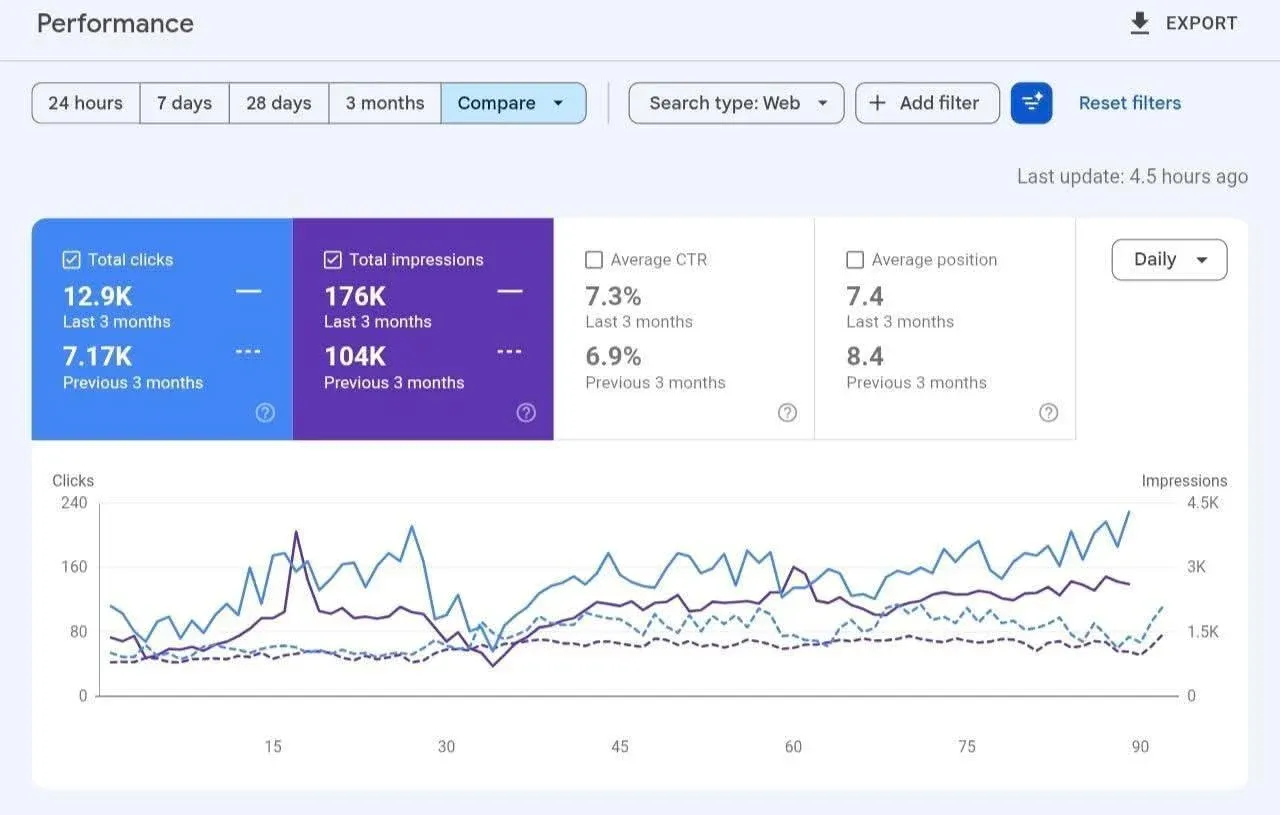
Search Console comparing the last three months with the previous three: clicks 12.9K against 7.17K, impressions 176K against 104K, click-through rate 7.3% against 6.9%, position 7.4 against 8.4

Online pharmacy, SEOSEO

+80%organic clicks in three months

  • 12.9Kclicks, from 7.17K
  • 176Kimpressions, from 104K
  • 7.4average position, from 8.4
Read from
The client's own Search Console
Period
The last three months against the three months before
Read the full story
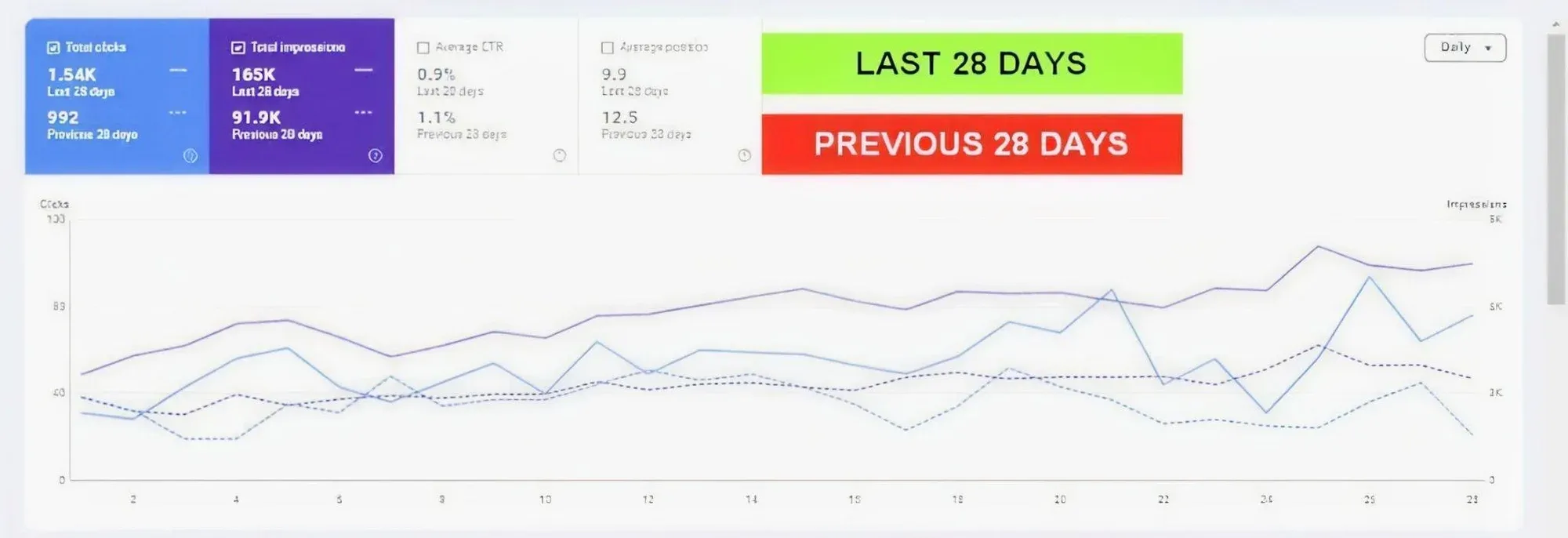
Search Console comparing the last 28 days with the previous 28: clicks 1.54K against 992, impressions 165K against 91.9K, click-through rate 0.9% against 1.1%, position 9.9 against 12.5

Skincare brand selling direct, SEOSEO

+55%organic clicks in 28 days

  • 1.54Kclicks, from 992
  • 165Kimpressions, from 91.9K
  • 9.9average position, from 12.5
Read from
The client's own Search Console
Period
The last 28 days against the 28 days before
Read the full story

A 50% increase in 90 days, or a refund plus $1,000.

A 50% increase in organic traffic, keyword rankings or direct enquiries within 90 days of the engagement starting.

  • The baseline is measured in your own Google Search Console and GA4 in week one, and you get a copy of it before any work starts.
  • The 90 days run from the day access is granted, not the day the contract is signed.
  • Recommended changes are implemented, or we are given the access to implement them ourselves.

On camera

Four clients on camera, in their own words.

Four clients, four industries, one thing in common: the number moved and they said so on camera.

  • Still from the video testimonial by Ahmed

    It is the best long-term investment we have made in the company, full stop.

    Ahmed · Business owner · SEO

  • Still from the video testimonial by Sandra

    The cost per lead from organic is a fraction of what we pay on ads, and that math gets better every month.

    Sandra · Founder · SEO

  • Still from the video testimonial by Aaliyah

    People can book a table without calling during the dinner rush. My host actually thanked me.

    Aaliyah · Restaurant owner · Website

  • Still from the video testimonial by David

    These tech geeks know the Facebook analytics and the data and the pixels and all that stuff that makes a musician’s head explode.

    David · The Wankers · Social ads

Reviews

What clients say, in their own words.

4.9 out of 5 from 22 published reviews

Arjun Malhotra Director, Malhotra Packaging

I have been in business long enough to know that every agency has a presentation about why they are different. That part doesn't interest me. What mattered to us was whether they understood our market and whether they would actually do the work after the meeting was over. So far, they've been practical, responsive and consistent. We discuss priorities, the team works on them, and we review what was done. I prefer that kind of relationship.

Trustpilot review
Camila Torres Founder, Casa Bonita Events

I am probably not the easiest person to build a landing page for because I change my mind constantly. First I wanted it minimal. Then more colour. Then less colour. Then I hated the headline. Then I wanted the old headline back. 😂 What I liked was that the team didn't get irritated or disappear every time I asked for another round of changes. We kept working through it until it finally felt like us.

Told us on a call
Mike Sullivan Owner, Sullivan Plumbing

My son said we needed SEO. I said fine, but I didn't want to hear about it every week. Mavix sorted the important stuff and kept it simple.

Google review

Photos are illustrative. Every quote is the client's own words.

Questions

Questions people actually ask.

01 We are on Shopify. Does that limit what is possible?
It constrains some things and not the ones people expect. URL structure is fixed and collection filtering behaves in specific ways. Category content, product content, internal linking, speed and structured data are all fully workable. The platform is rarely the reason a store does not rank.
02 Should every product page be indexed?
No. Products with no search demand, near-identical variants and discontinued lines usually should not be. A large catalogue of thin indexed pages dilutes the site rather than strengthening it. Which ones get indexed is a decision made per catalogue, not by default.
03 What do we do with out-of-stock products?
It depends on whether the product is coming back. Temporarily unavailable products stay live with the status shown, because the URL has history. Permanently discontinued products redirect to the closest equivalent or the parent category. Deleting them and serving a 404 loses whatever the page had earned.
04 Is it worth rewriting thousands of product descriptions?
Not all at once, and usually not all of them. Sort by margin and by search demand, rewrite the top slice properly, and measure. Most catalogues have a long tail that will never justify the writing cost.
05 How long does ecommerce SEO take to show in revenue?
Indexation fixes can change what Google crawls inside weeks. Category rankings take a quarter to settle. At La Vela, a store selling commercial espresso equipment, the measured window was six months, and organic revenue went from nothing to just over $1,400 in it. That is a channel starting, on a product where one machine sale is worth more than that.

What this is usually run alongside, and why.

Work it out yourself

Model the numbers before you talk to anyone.

  • Marketing budget calculator A monthly budget from your revenue and growth goal, split across paid ads, search and email, with fees and media spend separated so cost per lead stays honest.
  • Keyword clustering tool Paste a keyword list and group it by intent so you can see which terms belong on one page and which need their own. Runs entirely in your browser, so the list never leaves the tab.
  • SEO ROI calculator Model what organic search would be worth at your conversion rate, close rate and customer value. Shows the payback month and the cumulative return, with the ramp assumption stated rather than buried.

Do it yourself first

The same work, written out step by step.

Check the figures

The reference numbers behind the advice.

Run the checks

The checklist we work through on these accounts.

Read next

Written from the accounts this work was done on.

In your industry

How this works in a specific market.

Free review

Send the address. We will tell you what it is costing you.

  • Search. What you rank for now, and the searches you should be winning.
  • Paid. What the spend is buying, and the campaigns quietly eating it.
  • Email. Whether the list is mailed at all, and what the missing flows are worth.
  • Tracking. Whether it measures anything real, or counts page views as sales.

A 50% increase in 90 days, or you get a refund plus $1,000. Yours to keep whether you hire us or not.

Send the site. We will say what we would fix first.

A minute to fill in. A written answer from a person, not a sequence.

Free, and yours whether you hire us or not.

Free review

A written plan for more enquiries from your site.

  • What you rank for, and what you should.
  • What the ad spend is buying, and what a lead really costs.
  • Which follow-up emails your list is missing.
  • Whether your tracking counts anything real.

Read by a person, written for your business, back within one working day. Yours to keep whether you hire us or not.

150+ businesses since 2019. No sequence, nobody chases you.

Free, and yours whether you hire us or not.

Book a call

Pick a time that suits you.

Fifteen minutes with the founder, who will have read your site before you speak.