
SEO case study · 16 November 2025 to 12 February 2026
An education software company got its product pages into Google
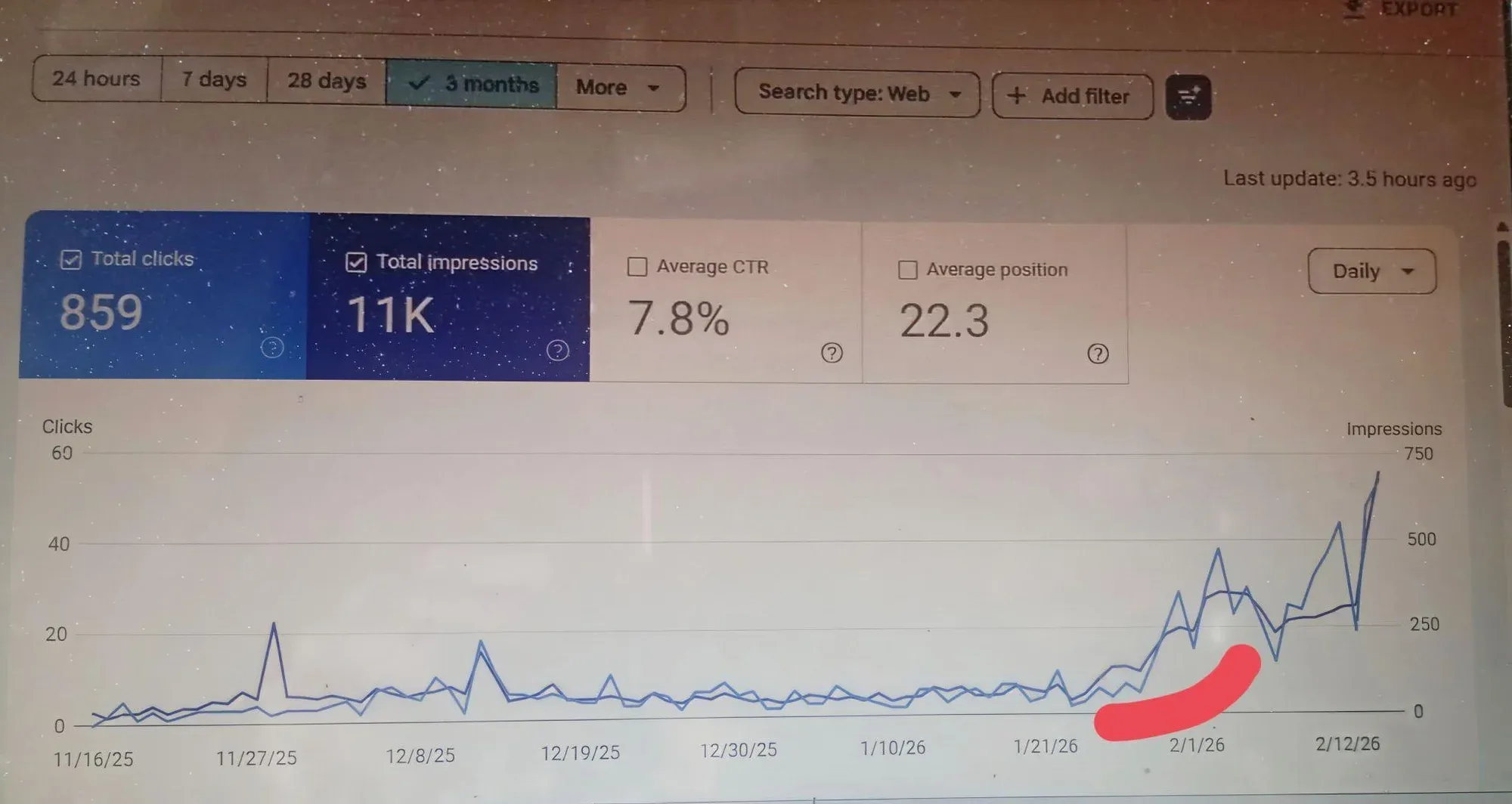
For two months the site drew almost nothing because its product pages were not indexed. Once Google could reach them, clicks went from under five a day to more than forty.
11K
impressions
7.8%
click-through rate
22.3
average position
Measured over
16 November 2025 to 12 February 2026
What to notice
The top row reads 859 clicks, 11K impressions, 7.8% click-through rate and position 22.3. The lines lie flat for two months, and the red mark shows where both begin to climb at the start of February.
Want numbers like these?
Get a free written review of your own account.
Who the business is
A company selling assessment software to schools and universities. It is not named here, so it is described by its trade and by what the screenshot shows.
Why marketing mattered
Schools research software carefully before asking for a demo. If the feature pages are not in Google, that research happens on a competitor's site.
- Service
- SEO
- Sector
- Education software company, SEO
- Period measured
- 16 November 2025 to 12 February 2026
- Figures from
- A Search Console performance screenshot for the account
What was not working
The problem
A company selling assessment software to schools and universities. Google had found its product pages and chosen not to index them, so the pages that sell could not appear in search at all.
- Most product and feature pages were "Discovered, currently not indexed".
- No sitemap covered the features and pricing sections.
- The blog was the only part Google crawled, and it did not link to a single product page.
Where things stood before the work began
From 16 November 2025 to about 21 January 2026 the site drew under five clicks on most days, with the odd spike of ten to twenty.
What we found, and why we started there
The thinking
The click-through rate was already 7.8% at an average position of 22, so the pages people did see were the right ones. The problem was reach: Google had no path to the pages that sell.
How we did it, step by step
- 1
Thin pages expanded
The six thinnest pages, some under 200 words, each gained 400 to 600 words of specific copy.
- 2
Sitemap submitted and indexing requested
A sitemap covering the features, pricing and solutions pages was submitted, and indexing was requested by hand for the 12 most important pages.
- 3
Blog linked to product pages
The six most-crawled blog posts were linked to the product pages they relate to, giving Google a route in.
What the numbers show
The result
859
organic clicks in three months
859 clicks from 11K impressions between 16 November 2025 and 12 February 2026. The lines run nearly flat until late January, then climb to 40 to 60 clicks a day in February.
From the work to the outcome
- Product pages indexed
- Shown for product searches
- 11K impressions
- 859 clicks
How to read this, and what it does not prove
About three months of Search Console totals, 16 November 2025 to 12 February 2026. The total is small because nearly all of it was earned in the final weeks.
Most of the clicks come from the last two to three weeks, which is too short to call a level. The screenshot is a photograph of a screen, with a red mark added to show where the rise begins. Clicks are visits, not demo requests. The client is not named, so a reader cannot check the screenshot against the account. It is one account with no control group: it shows what happened alongside the work, and it cannot show how much of that the work caused.
Want this for your business?
It starts with a free written review.
What you can take from this
Check what Google has actually indexed
The Pages report in Search Console lists what was found and left out. Look there before writing anything new.
Link your blog to your product
If the blog is what Google trusts, it should point at the pages you need found.
A high click rate at a low position is good news
It means the page is right and only the position needs work.