
SEO for landscaping companies: the pages, photos and profile that bring in calls, season by season
Landscaping SEO that brings calls: a page per service, town pages only where you work, real project photos, steady reviews, and pages timed before each season.

SEO for a landscaping company comes down to five things. A Google Business Profile set up as a service-area business and one website page for each service you sell come first. Then add town pages only where you have real jobs to show, a steady flow of recent reviews, and your own project photos. Publish seasonal pages weeks before each season starts, not when the phones go quiet.
This page is for owners of lawn care, landscaping and hardscaping companies who want more calls from Google without paying for every click. It covers the pages to build, how to set up the profile, and why photos and reviews carry more weight in this trade. It also covers when to publish for each season, and what the work is worth in ad money saved.
The short version
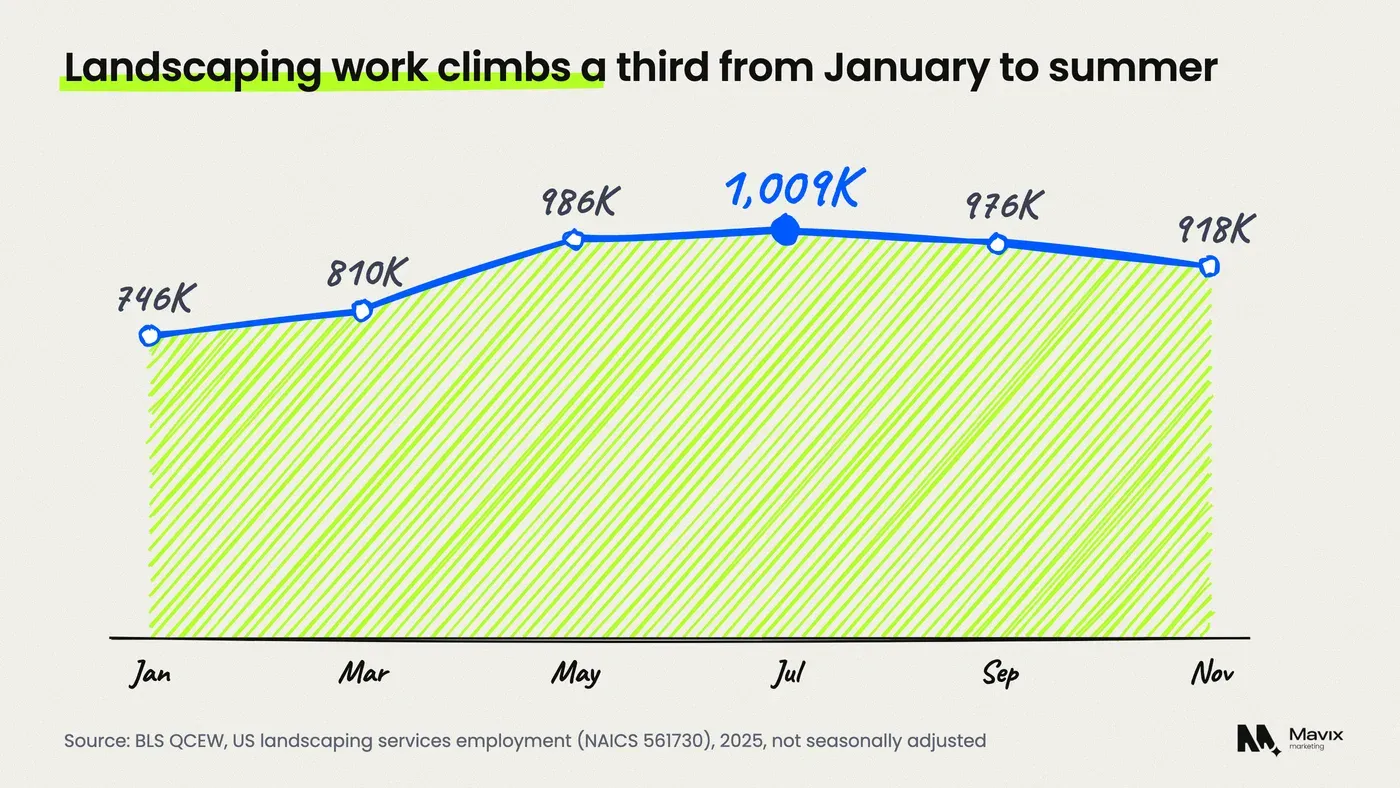
- US landscaping employment swings from 745,595 in January 2025 to 1,009,244 in June 2025, according to the Bureau of Labor Statistics. Your SEO calendar should follow the same curve, a season early.
- 97 percent of US consumers check reviews before choosing a local business and 74 percent look for reviews from the last three months, in BrightLocal’s 2026 survey of 1,002 adults.
- A landscaping lead from Google Ads cost a median $117.92 in LocaliQ’s 2025 home services benchmarks, which is the price an organic lead saves you.
- Google’s guidelines say a service-area business should hide its address, and Google allows up to 20 service areas within about 2 hours’ drive.
- Town pages that differ only by the town name count as doorway pages under Google’s spam policies. Build one only where you have real jobs to show.
What does SEO for a landscaping company involve?
It means showing up in two places: the map results, which come from your Google Business Profile, and the ordinary results below them, which come from your website. Google says local results are mainly based on relevance, distance and popularity (Google Business Profile Help). Your website and profile supply the relevance and popularity. Distance is set by where the customer is standing.
For a landscaper, the two work together. Someone searching “lawn care near me” usually sees the map first. Someone searching “paver patio cost” or “drought tolerant yard ideas Austin” sees websites. One company can win both, but only with a site that has a page for each thing it sells. Our post on local SEO vs SEO explains where each kind of result comes from.
Which service pages should a landscaping website have?
One page for each service people search for separately and you want to sell. That means lawn care, planting and garden design, hardscaping and patios, irrigation, tree and shrub care, seasonal cleanups and, in cold states, snow removal. A single “Services” page listing all of them ranks for none, because Google cannot tell which one the page is about.
| Service page | What the page must show | When demand peaks |
|---|---|---|
| Lawn care and mowing | Plans, what a visit includes, frequency, towns served | Spring through summer |
| Hardscaping and patios | Finished projects, materials, typical price range, timeline | Spring and early summer |
| Planting and garden design | Before and after photos, plant choices for your climate | Spring and autumn |
| Irrigation | Install and repair, water rules in your area | Late spring, summer |
| Seasonal cleanups | Spring and fall cleanup checklists, leaf removal | March to April, October to November |
| Snow removal (cold states) | Residential or commercial, contracts, response times | Late autumn sign-ups, winter |
The table shows each page has a different job and a different season. If two services draw the same searches, they can share a page. Our guide to keyword clustering shows how to check that against Google’s own results before you build anything.
Every service page needs the same core. Put the service in the main heading with your main town. Add photos of your own jobs, what it costs or what moves the price, and the towns you cover. Finish with recent reviews that mention the service, and one clear way to ask for a quote.
How many town pages does a landscaping company need?
Only as many as you can fill with real local work, which for most landscapers is three to eight. Google’s spam policies list “having multiple domain names or pages targeted at specific regions or cities that funnel users to one page” as doorway abuse (Google Search Central). Twenty pages that swap the town name are a risk, not a plan.
A town page earns its place when it carries things only that town has:
- projects you finished there, with photos and the street or neighbourhood named
- local conditions: soil, HOA rules, watering restrictions, common plants that fail there
- reviews from customers in that town
- how often your crews are there, and how fast you can quote
The guide to service area pages that rank covers the structure in more detail. Start with the towns where you already have the most jobs and the best margins, not the biggest town on the map.
How should a landscaper set up a Google Business Profile?
As a service-area business with the address hidden, unless customers visit your yard. Google’s guidelines say “if you’re a service-area business, you should hide your business address from customers” (Google Business Profile Help). Google also allows up to 20 service areas, with the whole area within about 2 hours’ drive of your base.
Four settings matter most:
- Primary category. Choose the one that matches the work you most want: “Landscaper” for design and install, “Lawn care service” for recurring mowing. Add the others as secondary categories.
- Services. List every service from your website, in the words customers use.
- Photos. Upload your own jobs every month, through the season and out of it.
- Hours. List the hours you answer the phone. A profile shown as closed can miss the evening searches when homeowners plan weekend work.
If the profile does not show at all, work through why a Google Business Profile is not showing before anything else.
Why do project photos matter so much for landscaping SEO?
Because the customer is buying a result they can see, and Google can only match your photos to searches if you tell it what they show. Google’s image guidance calls alt text “the most important attribute” for image metadata and asks for “filenames that are short, but descriptive” (Google Search Central). A file called IMG_4471.jpg says nothing. “paver-patio-round-rock.jpg” does.
Photos also work on the profile and in reviews. In BrightLocal’s 2026 survey, 36 percent of consumers said an appealing photo or video with a review is an important factor in whether they trust it. Ask happy customers to add a picture of the finished garden with their review.
Three habits to build into every job:
- Take a before photo from a fixed spot, and an after from the same spot.
- Name the file with the service and town before you upload it.
- Put the photo on the matching service or town page, next to the text about that job, which Google’s guidance also asks for.
Stock photos do the opposite. A homeowner can tell a stock lawn from a real one, and so can anyone comparing you with the company down the road.
How do reviews affect a landscaping company’s rankings?
Reviews feed the popularity part of Google’s local ranking, and they decide whether the person who finds you calls. BrightLocal’s 2026 survey found 97 percent of consumers check reviews before choosing a local business. It also found 68 percent will only use one with at least four stars, and 74 percent look for reviews from the last three months (BrightLocal).
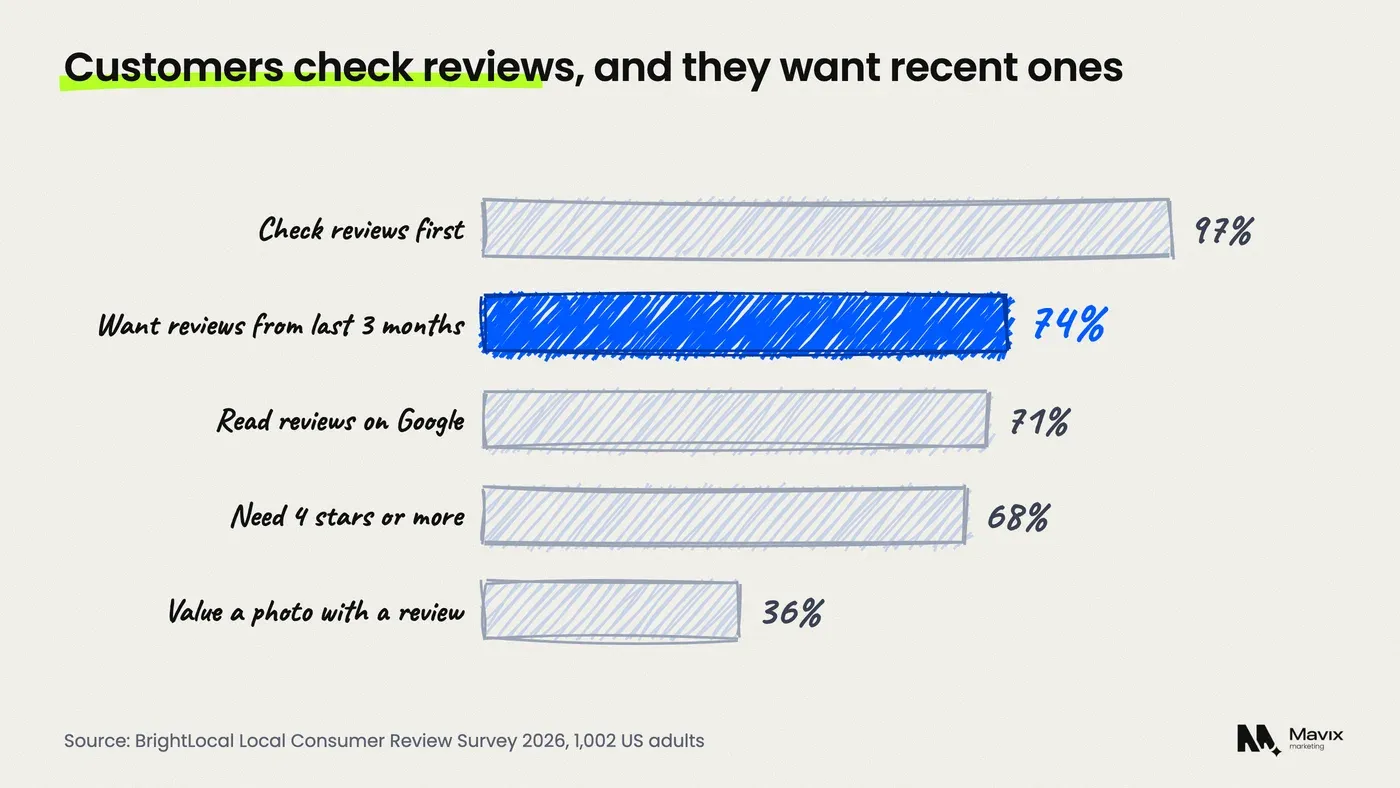
The three-month figure is the one that hurts landscapers. If you ask for reviews only in spring, by February your newest review is months old, just as homeowners start comparing companies. Ask after every job, including fall cleanups and snow contracts. The post on how to get more Google reviews covers how to ask without breaking Google’s rules.
When should a landscaper publish seasonal content?
Six to ten weeks before the season it serves, because new pages take time to be found and to climb. Bureau of Labor Statistics data shows US landscaping employment rising from 745,595 in January 2025 to 927,458 in April and peaking at 1,009,244 in June (BLS). Demand runs ahead of hiring, so spring pages belong online by February.
| Publish or update by | For the season | Pages to work on |
|---|---|---|
| January to February | Spring | Spring cleanup, lawn care plans, patio and planting projects |
| April | Summer | Irrigation, watering rules, lawn problems in heat |
| August | Fall | Fall cleanup, leaf removal, aeration and seeding, planting |
| September to October | Winter | Snow removal contracts, holiday lighting if you offer it |
| November to December | Next spring | Design consultations and booking ahead for spring installs |
The table shows the work happens in the quiet months. Winter is when a landscaper has time to write pages, sort photos from the season and ask the year’s customers for reviews. Our guide to how long SEO takes explains why pages published in March rarely help the same spring.
What is SEO worth to a landscaping company?
Measure it in the ad money it replaces. LocaliQ’s 2025 home services benchmarks put landscaping at a median $8.76 a click and $117.92 a lead on Google search ads, across US campaigns from April 2024 to March 2025 (LocaliQ). Every lead that arrives from the map or a ranking page is one you did not buy at that price.
A worked example: a lawn care page and three town pages bring 10 extra enquiries a month in season.
- 10 enquiries times $117.92 is $1,179.20 a month you would otherwise spend on ads for the same leads.
- Over a seven-month season, that is $8,254.40.
- If 1 in 3 enquiries books a recurring mowing plan, that is about 23 new plan customers a season, many of whom renew.
The numbers are only as good as your tracking. Count calls and forms from organic search separately from ads, and ask every new customer how they found you. If you want this planned for your area, our SEO for landscaping companies page sets out the work month by month. For the full set of landscaping figures with sources, see landscaping marketing statistics.
Mistakes landscapers make with SEO
Most landscaping sites lose rankings to the same handful of problems:
- One “Services” page for everything. It ranks for nothing in particular.
- Copy-paste town pages. Twenty pages with only the town name swapped invite a doorway problem.
- Stock photos. They tell the customer and Google nothing about your work.
- The home address shown on the profile when customers never visit it, against Google’s guidelines.
- Reviews only in spring. The profile looks stale for the next nine months.
- Starting in March. SEO started when the phones are already ringing helps next year, not this one.
- Heavy photo files. Full-size camera images make pages slow on a phone. Resize before upload.
SEO is also not the answer to every problem. If you need calls next week, or the season starts in a month, paid ads are faster. The Google Ads for landscapers page covers that route.
Questions people ask about SEO for landscaping companies
How long does SEO take for a landscaping company?
Expect the first clear results in three to six months for a site with some history, and longer for a brand new one. That is why timing matters in this trade: work started in autumn has time to take effect before spring. Profile fixes such as categories and services can show within days, but service and town pages take months to climb.
Should a landscaper do SEO or Google Ads?
Both, for different jobs. Ads bring calls this week and can be turned up for the spring rush. SEO builds leads you do not pay per click for, but it takes months. Most landscapers run ads for the busiest services in season and build SEO in the quiet months, so ad spend can fall as organic leads rise.
Does a landscaping company need a blog?
Not in the sense of weekly posts. It needs useful pages that answer what customers ask before they call: what a paver patio costs, when to aerate, which plants survive your summers. A handful of these, written from your own jobs and kept up to date, does more than a stream of generic gardening tips copied from elsewhere.
Can I rank in towns where I do not have an office?
Yes, in the ordinary website results, with a town page that shows real work there. In the map results it is harder, because distance from the searcher is one of Google’s main ranking inputs. You will usually rank most strongly near your base, and further out only where your reviews and relevance beat closer companies.
Should lawn care and design have separate websites?
Usually not. One site with separate service pages builds authority in one place, and customers who start with mowing often buy planting or patios later. Separate sites make sense only when the businesses are truly separate, with different names, phone numbers and crews.
Does snow removal need its own page?
Yes, if you sell it. People search for snow removal separately from landscaping, often for commercial contracts with a different decision maker. Publish the page in early autumn, when property managers sign winter contracts, and list response times, equipment and the areas you cover.
The bottom line
Use the quiet months. Build a page for each service, a few town pages backed by real jobs, and fill them with your own photos. Set the profile up as a service-area business, and ask for a review after every job, all year. Then the spring rush finds you ready instead of scrambling.
If your landscaping site is not bringing the calls it should, get your landscaping SEO checked for free. You get the pages, photos and profile fixes that would bring the most calls next season, usually within one working day.
Free review
Want this looked at on your own site?
Send the address. A person reads it and writes back with the two or three things that would move your enquiry number first. Free, and yours to keep whether you hire us or not.