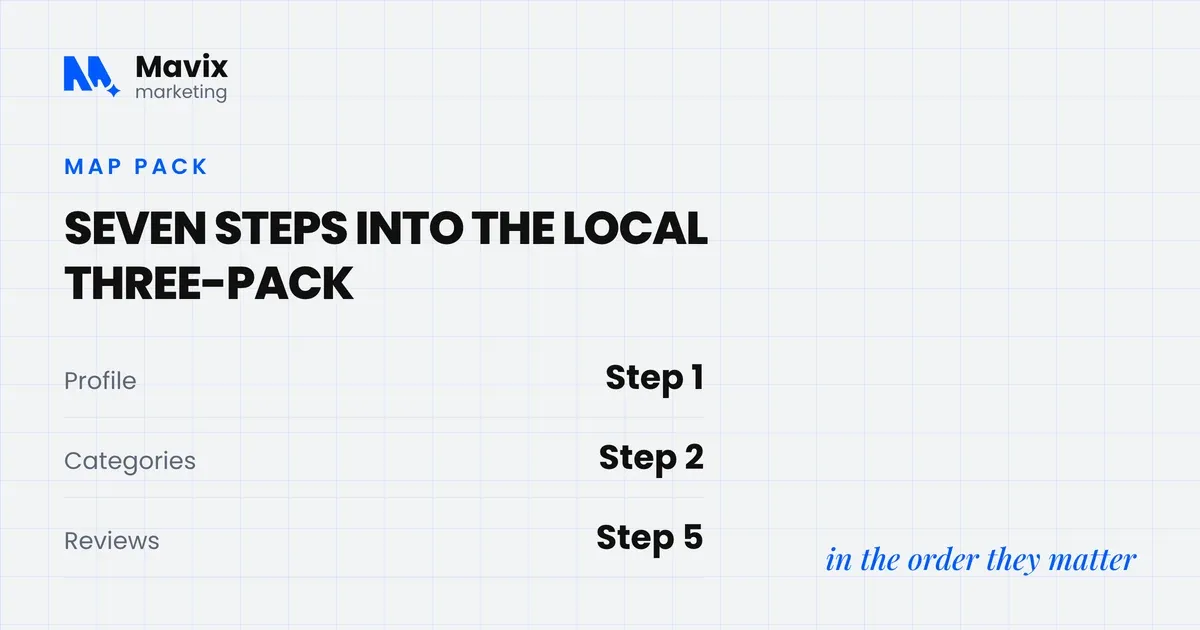
The local SEO checklist for businesses that sell to a place
A local SEO checklist in the order that moves map results: profile, reviews, website, measurement and citations, with the Google rule behind each step.
Google says its local results are mainly based on three things: relevance, distance and prominence (Google Business Profile Help). Distance is where the searcher is standing. Relevance and prominence come largely from your Business Profile and your reviews, which is why a local SEO checklist starts there and not on the website.
That is uncomfortable if you have just paid for a website. It is also good news, because the profile work is cheaper and quicker than anything else on this list. Here is the whole checklist, in the order we work through it, with the Google rule behind each item.
The short version
- Google names three local ranking factors: relevance, distance and prominence. It also says there is no way to request or pay for a better local ranking.
- The Business Profile comes first. Google says businesses with complete and accurate information are more likely to show up in local results.
- Keywords added to the business name break Google’s guidelines and can get the profile suspended. The name should match your signage and stationery.
- Google prohibits offering anything in exchange for a review, and in the US the FTC can seek civil penalties for fake reviews and for incentives tied to a positive review.
- A page per town with only the name swapped is a doorway page, a pattern Google’s spam policies name directly.
- Without call tracking you cannot tell whether the profile, the website or word of mouth produced the job.
What you get
| Format | What it is | Who it is for | Time to use |
|---|---|---|---|
| checklist | A printable checklist covering the profile, the site and the review process, with space to record what you find in each service area. | Service businesses, trades, clinics and any company serving a defined geographic area where a meaningful share of enquiries arrive as phone calls. | Three hours, then thirty minutes monthly |
The checklist at a glance
| Area | What to check | It passes when | The rule behind it |
|---|---|---|---|
| Business name | The name on the profile | It matches your signage and stationery, with nothing added | Google’s guidelines for representing your business |
| Categories | Primary and secondary categories | As few as possible, as specific as possible, all describing what you are | Google’s guidelines for representing your business |
| Address | Shown address or service area | A real, staffed location, or the address hidden if you travel to customers | Google’s guidelines for representing your business |
| Reviews | How you ask | Every customer is asked, nothing is offered in exchange | Google’s review policy, and the FTC rule in the US |
| Website | Service and area pages | One page per service, area pages only where there is something local to say | Google’s spam policies on doorway pages |
| Structured data | LocalBusiness markup | It describes what is visible on the page | Google’s structured data guidelines |
| Measurement | Calls and bookings | Profile calls and website calls are counted separately | Mavix recommendation |
What should I fix first on my Google Business Profile?
Fix the primary category and the business name first. Local search practitioners rank the primary category as the strongest single map pack factor in Whitespark’s 2026 survey, and the name is the field most likely to get a profile suspended (Whitespark). That survey is an opinion poll of 47 experts, not a formula Google has published, so read it for the order of work.
- Check the primary category. Google asks for as few categories as possible, as specific as possible, and says to pick ones that complete the sentence “this business IS a” (Google Business Profile Help).
- Add secondary categories only for work you actually do, and remove any that describe something you do not sell.
- List every service you offer as a service on the profile, with a description for each.
- Check the business name is your real trading name. Google’s guidelines say including unnecessary information in the name is not permitted and could result in suspension (Google Business Profile Help).
- Check the address and service area match reality. A virtual office is not eligible, and P.O. boxes or mailboxes at remote locations are not acceptable (Google Business Profile Help).
- Check opening hours, and use special hours for holidays. Google lists hours among the details that help a profile show up (Google Business Profile Help).
- Add photos, and keep adding them. A profile with photos from two years ago reads as a business that may have closed.
- Fill in the attributes that apply to you.
- Post to the profile at least monthly. That is our recommendation, not a Google rule.
- Do not build a routine around the old questions and answers section. Google switched off its Q&A API on 3 November 2025 while it changes how Q&A works (Google for Developers), so put the answers people need in your services, description and website instead.

Photo: Anıl Karakaya on Pexels.
How many reviews do we need, and how should we ask for them?
There is no fixed number. Google says more reviews and positive ratings can help local ranking and that replying to reviews shows you value the feedback (Google Business Profile Help). What matters is how you compare with the businesses above you and how recently your reviews arrived.
- Count your reviews against the three businesses ranking above you, and note how recently each of them received one.
- Build a process for asking at the moment the job is finished. Google suggests sharing a review link or a QR code (Google Business Profile Help).
- Ask by name, from a person, not from a system that sounds like one.
- Reply to reviews, including the good ones, within a few days.
- Reply to bad reviews without getting defensive. The reply is read by everybody who comes after, not only by the reviewer.
- Never offer anything in exchange for a review. Google treats a discount or free service offered for a review as fake and misleading content (Google Business Profile Help). In the US, the FTC’s rule on consumer reviews has been in force since 21 October 2024 and bans fake reviews and incentives conditioned on a positive review (FTC).
- Gather them steadily rather than in bursts. In BrightLocal’s 2026 survey of 1,002 US consumers, 74 percent said they look for reviews written in the last three months (BrightLocal). BrightLocal sells review software, so treat that as direction rather than a precise figure.
What does the website need for local search?
The website needs a page for each service you sell and consistent contact details, and it needs to be fast on a phone. In the same Whitespark survey, practitioners put on-page signals at 15 percent of map pack weight, behind the profile and reviews (Whitespark).
- Build a page for each service you actually sell, rather than one page listing all of them.
- Put the name, address and phone number in the same format everywhere they appear.
- Make the phone number a real tel link so it can be tapped on a phone.
- Add LocalBusiness structured data that matches what is on the page. Google’s guidelines say not to mark up content that is not visible to readers (Google Search Central). The LocalBusiness documentation lists the fields.
- Build area pages only where there is something genuinely local to say. Google’s spam policies name pages targeted at specific regions or cities that funnel users to one page as doorway abuse (Google Search Central).
- Embed a map on the contact page, and state the service area in words as well.
- Check the site on a phone over mobile data, because that is how many local searchers will meet it.
How do I know whether local SEO is working?
Count calls and booked jobs, not rankings. Without call tracking, local search is a belief rather than a measurement. The phone rings, the job gets booked, and nobody can say whether the marketing caused it.
- Put call tracking in place before doing anything else in this section.
- Track profile calls separately from website calls.
- Read the profile’s performance report monthly. Google shows calls, direction requests, website clicks, bookings, messages, the searches people used and profile views (Google Business Profile Help).
- Track rankings by location rather than as one average, because distance to the searcher is one of Google’s three factors and an average hides being invisible in half your area.
- Record how many enquiries turned into booked jobs. That is the number that pays for the work.
- Compare year on year rather than month on month if your trade is seasonal.

Photo: Andrea Piacquadio on Pexels.
Are citations and directory listings still worth the time?
Yes, for accuracy more than volume. Practitioners in Whitespark’s survey put citation signals at 6 percent of map pack weight (Whitespark), so fixing the listings that are wrong is worth more than adding new ones.
- Check the name, address and phone match on your site, your profile and the main directories.
- Fix the wrong ones before adding more listings.
- Claim your listing on Bing Places and on Apple Business, which replaced Apple Business Connect on 14 April 2026 and is where you manage how you appear in Apple Maps (Apple Newsroom). Both are free and often left unclaimed.
Why this list exists
The most common finding when we open a local account is that the business ranks first for its own company name and almost nothing else, and reads that as working. Brand searches convert well and cost little to win, which makes the numbers look healthy.
The customers you do not have yet are the ones searching for the service rather than the company, and that is where the competition is. The order of this list matters as much as its contents. On a neglected profile, the profile work often moves the map results before any of the site work has started. The map pack steps for Texas businesses walk the same order with worked examples.
The bottom line
Local search rewards the business whose details are accurate, whose reviews keep arriving and whose pages say something true about the places it serves. Do the profile first because it is the cheapest. Keep the reviews steady because that is the part competitors stop doing. Measure calls rather than positions, because calls are what you are paying for.
Questions people ask about this
Why does a competitor with a worse website outrank us on the map?
Because Google’s local results are mainly based on relevance, distance to the searcher and prominence, and prominence draws on things like links and the number of reviews a business has. Website quality counts for less in the map than in the organic results below it. In practice a well-kept profile with steady genuine reviews often beats a better website with few, and the profile is usually the fastest thing to fix.
Can I create listings for cities I do not have an office in?
No. Google’s guidelines say a virtual office is not eligible for a Business Profile, and an office at a co-working space needs signage, customers received during business hours and your own staff there. Listings at addresses you do not operate from risk suspension, and suspensions are slow to reverse. Use a service area instead, and build a page only where you have something genuinely local to say.
How many reviews do we need?
More than the businesses ranking above you, gathered steadily. There is no absolute number, because it is relative to your market. Count theirs, count how quickly they are gaining them, and ask every finished customer rather than chasing a total.
How do I choose the right primary category?
Search your main service in a private window and read the primary category of the three businesses in the map pack. Match the most specific one that describes what you sell most of. A kitchen fitter is not a general contractor. Then add secondaries for the rest of your work, and remove any category that describes something you do not do, because Google asks for as few categories as possible.
What should I do if my profile is suspended?
Stop editing. Gather evidence that the business operates at that address, such as a business registration, licence, tax certificate or utility bill. Those are the types Google lists. Make sure the name and address on them match the profile. Then file one appeal with a plain explanation. Google asks you not to submit multiple appeals for the same issue or create a new profile while one is under review.
Should I respond to a review that is unfair?
Yes, briefly and without arguing. State the facts once, offer to resolve it offline, and stop. The reply is read by every future customer, not only by the reviewer, and a calm answer to a hostile review does a lot for trust. If the review breaks Google’s policies, flag it through the profile as well, but reply anyway in case it stays.
How do I track rankings by location?
Use a grid tool that checks your position from many points across the service area instead of one search from your desk. Local results change with the searcher’s location, and a single average hides being invisible in half your area. Run it monthly, record the shape, and treat the points where you disappear as the list of areas that need pages, reviews or mentions.
Do I need call tracking if I only get a few calls?
Yes, because with few calls each one matters more, not less. Without it you cannot say whether the profile or the website produced the job, and you will make budget decisions on a feeling. A single tracking number on the profile and another on the site is enough to start. Record the outcome of each call beside it, and the sheet becomes your measurement.
What should I post on the profile each month?
A finished job with a photo and a sentence about where it was. A seasonal service you want more of. A change to hours or a new service. Posts do not need to be clever. They show the searcher that the business is active, which matters when the competitor above you last posted two years ago. Set a monthly reminder and keep it to ten minutes.
What if my opening hours change with the season?
Update the profile the week they change, and use the special hours feature for holidays. Google’s guidelines allow current seasonal hours to be used as your regular hours. A searcher who arrives at a closed door is unlikely to try again and may leave a review saying so. Set a calendar reminder for each change, and check the hours on Apple and Bing at the same time.
What if a competitor has keywords in their business name?
Leave it alone and do not copy it. Practitioners rate keywords in the name as a strong map pack factor, which is why people do it. But Google’s guidelines say unnecessary information in the name is not permitted and could result in suspension. You can suggest an edit to their listing, but the better use of the time is your category, services and reviews.
Does a service area business need to show its address?
No. Google’s guidelines say a service-area business should hide its address, and give a plumber working from home as the example. If you travel to customers, set the service area to where you actually work, within about two hours’ drive of your base as Google suggests. Showing a home address with walk-in hours invites trouble, so set it to the truth and put the effort into reviews and pages for the towns that matter.
Free review
Want this looked at on your own site?
Send the address. A person reads it and writes back with the two or three things that would move your enquiry number first. Free, and yours to keep whether you hire us or not.