
Paid advertising case study · The export carries no date range
2,631 leads at £2.68 each on Meta for a local services business
A lead form full of unusable enquiries and creative built around the wrong offer were replaced, and the cost of a lead fell to pennies on the best ad set.
2,631
leads delivered
£0.77
best ad set cost per lead
205K
people reached
Measured over
The export carries no date range
What to notice
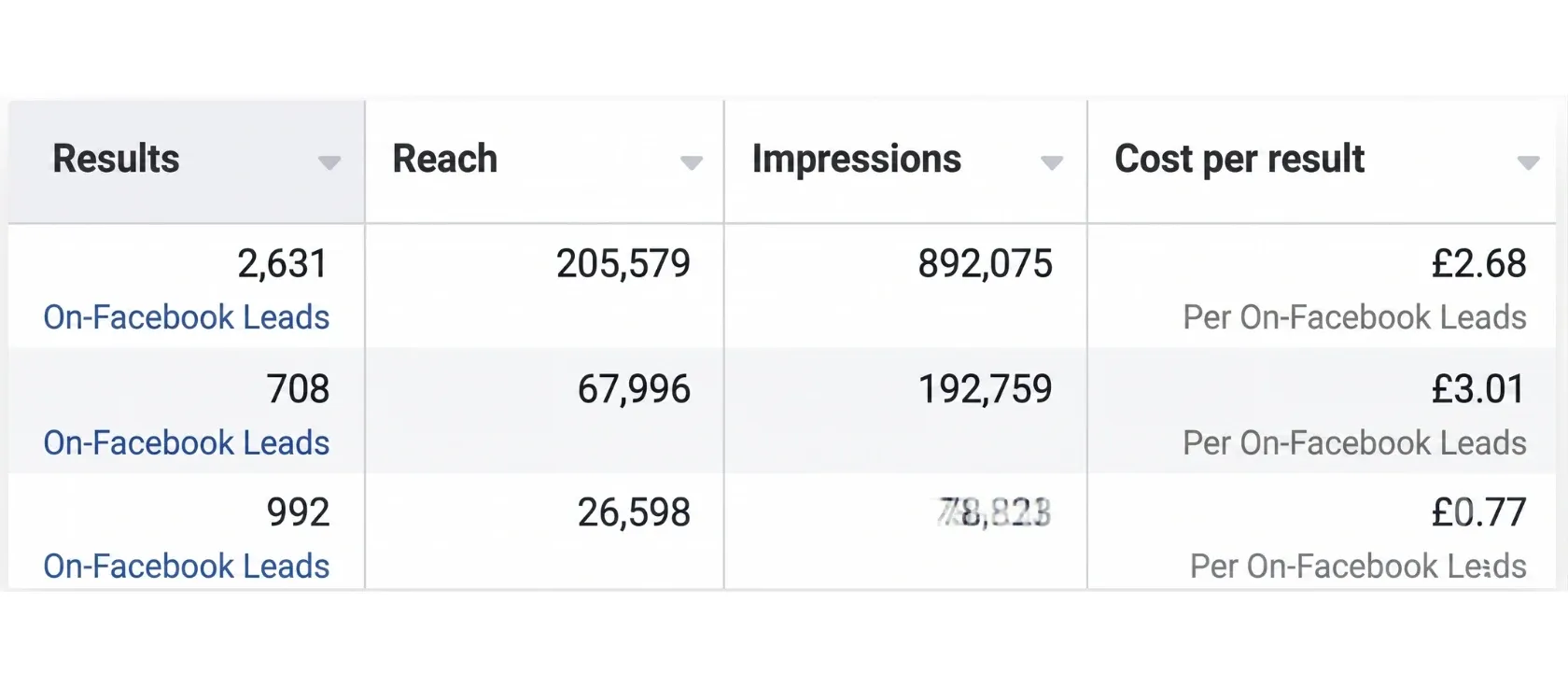
Meta Ads Manager for the campaign: 2,631 on-Facebook leads at £2.68 each, and a reach of 205,579. The leads are form fills inside the platform, which is what makes them this cheap, and the best ad set is the £0.77 line.
Want numbers like these?
Get a free written review of your own account.
Who the business is

A local services business advertising on Facebook and Instagram. The owner asked not to be named, so the account is described by its numbers.
Why marketing mattered
A lead form that fills with the wrong people costs twice: once for the ad, and again for the time spent replying to enquiries that go nowhere.
- Service
- Paid advertising
- Sector
- Meta, lead generation
- Period measured
- The export carries no date range
- Figures from
- Screenshot of Meta Ads Manager
What was not working
The problem
A lead form that filled with unusable enquiries, and creative built around an offer the audience had no reason to care about.
- The lead form filled with enquiries the business could not use.
- The creative was built around an offer the audience had no reason to care about.
- The account was paying for volume that produced no work.
Where things stood before the work began
The account was collecting leads and the leads were unusable. The deck records the starting position as a form full of the wrong enquiries and creative around the wrong offer, rather than as a cost per lead.
What we found, and why we started there
The thinking
The form was doing what forms do, which is collect whoever the ad attracts. The ad was attracting the wrong people because the offer meant nothing to the right ones. So the offer came first, the creative was rebuilt around it, and the ad sets were run against each other so the budget could follow the ones producing leads at the lowest cost.
How we did it, step by step
- 1
The offer rebuilt around what the audience wanted
Creative was rewritten around an offer the audience had a reason to act on, so the form began filling with the right people.
- 2
Ad sets run against each other
The account average was £2.68 per lead and the best ad set reached £0.77, which is the spread that tells you which audiences and creative to keep.
Adjusted as it ran
How the work was adjusted as it ran
The gap between the account average of £2.68 and the best ad set at £0.77 is the optimisation itself: the ad sets were compared and budget followed the ones that produced leads cheapest.
What the numbers show
The result
£2.68
cost per lead
2,631 on-Facebook leads at £2.68 each across a reach of 205,579, with the best-performing ad set down at £0.77 per lead.
From the work to the outcome
- Offer the audience wanted
- 205K people reached
- 2,631 form leads
- £2.68 per lead, £0.77 at best
How to read this, and what it does not prove
Delivered totals from the account itself; the export carries no date range. On-Facebook leads are form fills inside the platform, so read the £2.68 as the cost of a form fill rather than of a booked job. The £0.77 is the best single ad set, not the account.
On-Facebook leads are form fills inside the platform, which are cheaper and generally lower intent than an enquiry made on a website. The £0.77 figure is the best single ad set rather than the account, and quoting the best ad set as though it were the account is exactly the trick this note exists to prevent.
Want this for your business?
It starts with a free written review.
What you can take from this
The offer decides who fills the form
Targeting cannot fix an offer nobody wants. Rebuilding the offer changed who arrived before a single audience setting moved.
Run ad sets against each other
The spread between £2.68 and £0.77 is the information. Budget follows the ad sets at the low end.
Read an on-platform lead for what it is
A form fill inside Facebook is cheaper and lower intent than an enquiry on your website. The next step is qualifying it fast.