Negative keyword list for home service businesses: what to block, and how to keep it current
Job seekers, DIY searchers and parts buyers eat home services budgets at $7.85 a click. A starter negative keyword list by trade, and how to keep it current.
A negative keyword list for a home service business blocks the searches that will never become a paid job: people looking for work in your trade, people doing it themselves, people buying parts, and people who want a different service. Start with the groups below, then add to the list every week from your own search terms report.
This page is for owners of plumbing, HVAC, electrical, roofing, pest control, cleaning and other home service businesses that run Google Ads. It gives a starter list by group and by trade, the match types to use, where each negative belongs, and the mistakes that block paying customers.
The short version
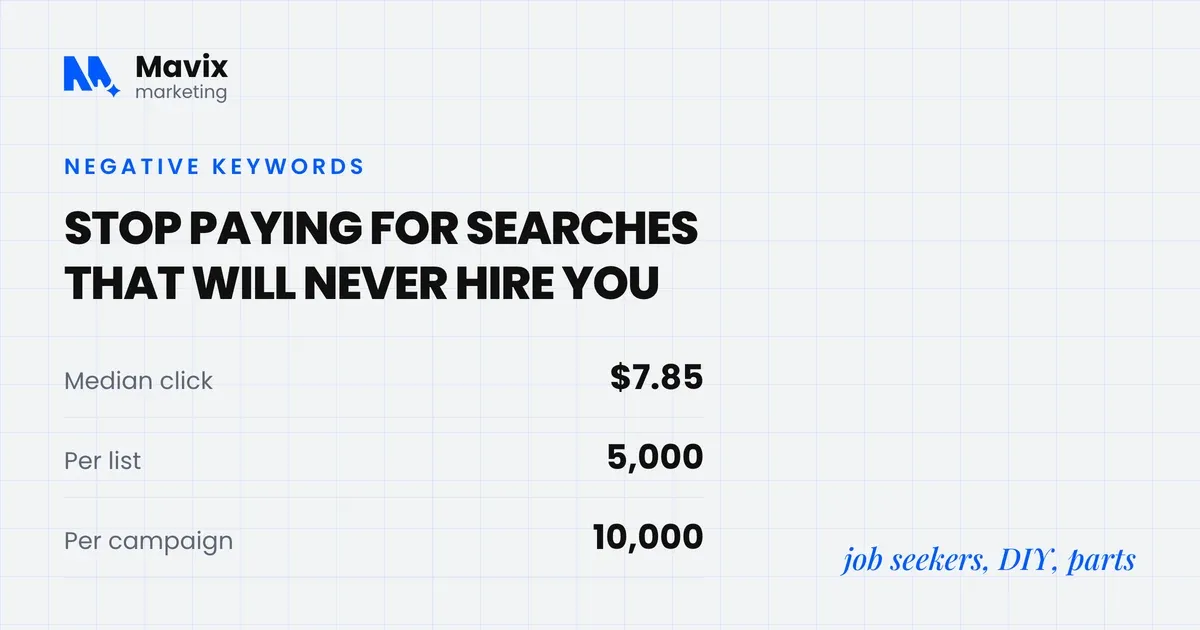
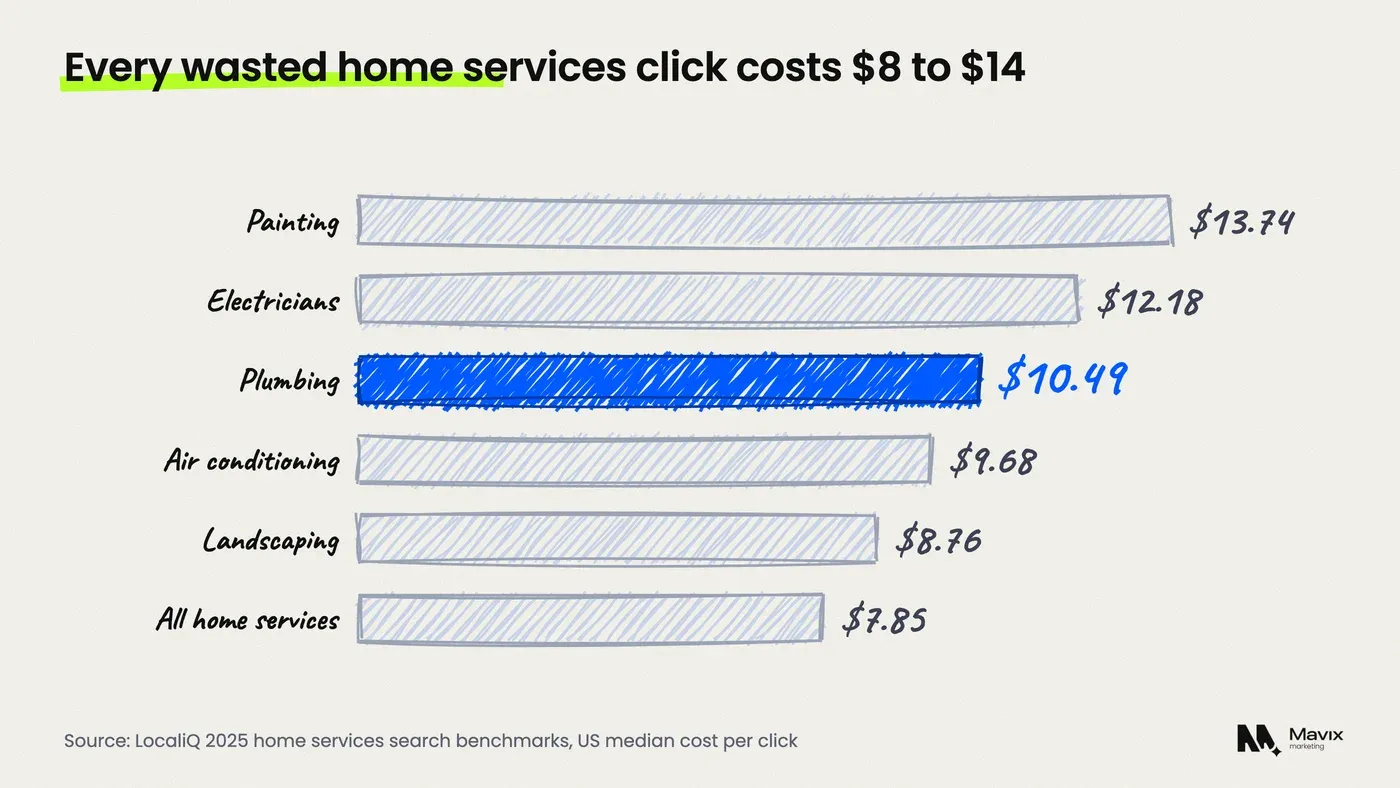
- Home services search clicks cost a median $7.85 in LocaliQ’s 2025 benchmarks, and up to $13.74 for painting, so every wasted click costs real money.
- The five groups to block first are jobs and training, do-it-yourself, parts and supplies, other trades or services, and areas you do not serve.
- Google says negative keywords do not match close variants or synonyms, so add plurals and other wordings yourself.
- An account can hold 20 negative keyword lists of up to 5,000 keywords each, and a campaign up to 10,000 negative keywords.
- Never add “free”, “cheap” or “cost” as broad negatives without thinking: they block people searching for a free estimate or a price, who often hire.
What is a negative keyword?
A negative keyword is a word or phrase you add to Google Ads so your ad does not show when a search contains it. If you add “jobs”, your plumbing ad stops showing for “plumber jobs near me”. You pay only for clicks, so each blocked search that would have been clicked is money kept.
Negative keywords use their own match types, and they behave differently from normal keywords. Google says negative keywords “won’t match to close variants or other expansions” (Google Ads Help). Blocking “job” does not block “jobs”, so add both.
| Negative match type | How you type it | Blocks | Does not block |
|---|---|---|---|
| Negative broad | plumbing jobs | “jobs in plumbing Dallas” (all words, any order) | “plumber jobs” (job word differs) |
| Negative phrase | “how to fix” | “how to fix a leaking tap” | “fix a leaking tap” |
| Negative exact | [water heater parts] | “water heater parts” only | “water heater parts near me” |
The table shows why most starter negatives should be single words in broad match, such as “jobs” or “salary”. They block any search containing that word. Use phrase and exact match for wordings where one of the words also appears in good searches.
Which negative keywords should every home service business add?
Five groups cover most of the waste in a home services account: jobs and training, do-it-yourself, parts and supplies, other trades or services, and places you do not work. Add the words below as broad match negatives in a shared list, then check each one against your own services before you apply it.
| Group | Starter negatives |
|---|---|
| Jobs and training | jobs, job, career, careers, hiring, salary, wage, pay rate, apprentice, apprenticeship, school, course, training, certification, license exam, resume, indeed |
| Do-it-yourself | diy, “how to”, yourself, tutorial, video, youtube, diagram, manual, instructions, reddit |
| Parts and supplies | parts, supply, supplies, wholesale, home depot, lowes, amazon, catalog, “for sale” |
| Information only | definition, meaning, “what is”, history, symptoms of, code requirements |
| Wrong service | rental, rent, used, auction, toy, game, software (and any service you do not offer) |
The table is a start, not a finished list. “How to” in phrase match blocks “how to unclog a drain” without blocking “drain cleaning near me”. “Reddit” and “youtube” catch people looking for advice threads and videos. Words in quotes go in as phrase match.
Each trade then needs its own additions:
- Plumbing: fittings, pex, putty, “plumbing code”, snake rental, plumbing supply, “plumbing parts”.
- HVAC: filter, filters, thermostat manual, “ac unit for sale”, window unit, portable, refrigerant price.
- Electrical: wire gauge, “wiring diagram”, breaker box parts, electrician salary, “electrical code”.
- Roofing: shingles for sale, “roofing nailer”, “roofing calculator”, roofing jobs, metal roofing supplier.
- Pest control: spray, traps, bait, “pest control products”, “do it yourself pest control”.
- Cleaning: cleaning jobs, “cleaning products”, “cleaning supplies”, vacuum, recipe.
If you do commercial work only, add “residential” and “home”. If you do homes only, add “commercial” and “industrial”. The same goes for services you do not offer, such as “installation” for a repair-only business. Our pages on Google Ads for plumbers and Google Ads for HVAC companies show how these lists fit into a full account.
How do you build a negative keyword list from your search terms?
Build it from the search terms report, which shows the actual searches that triggered your ads. Google describes it as “a list of search terms that a significant number of people have used”, and some low-volume searches are left out (Google Ads Help). Read it, find the searches that will never hire you, and add the word that makes them wrong.
- Open the search terms report for the last 30 days and sort by cost, highest first.
- Mark each search as a buyer, a maybe or never. A buyer is someone who could book you this week.
- For each “never”, find the word that makes it wrong. In “how to replace a water heater element”, the word is “element” or the phrase “how to”.
- Add that word, not the whole search. One word such as “element” blocks hundreds of future searches, while the full search blocks one.
- Check the word against your good searches before saving. Search your keyword list and recent buyer searches for it.
- Add it to the right level: the shared list if it applies everywhere, or one campaign if it is only wrong there.
- Write the date and reason in a sheet, so you can undo a negative that turns out to cost jobs.
Searches that cost money and never become leads are a common reason an account gets clicks but no calls. The post on Google Ads clicks with no leads works through the others.
How much do irrelevant clicks cost a home service business?
At home services click prices, irrelevant clicks add up quickly. LocaliQ’s 2025 benchmarks, from 3,211 US home services campaigns, put the median click at $7.85, with plumbing at $10.49 and electricians at $12.18 (LocaliQ). Every job seeker or do-it-yourself click costs the same as a homeowner with a burst pipe.
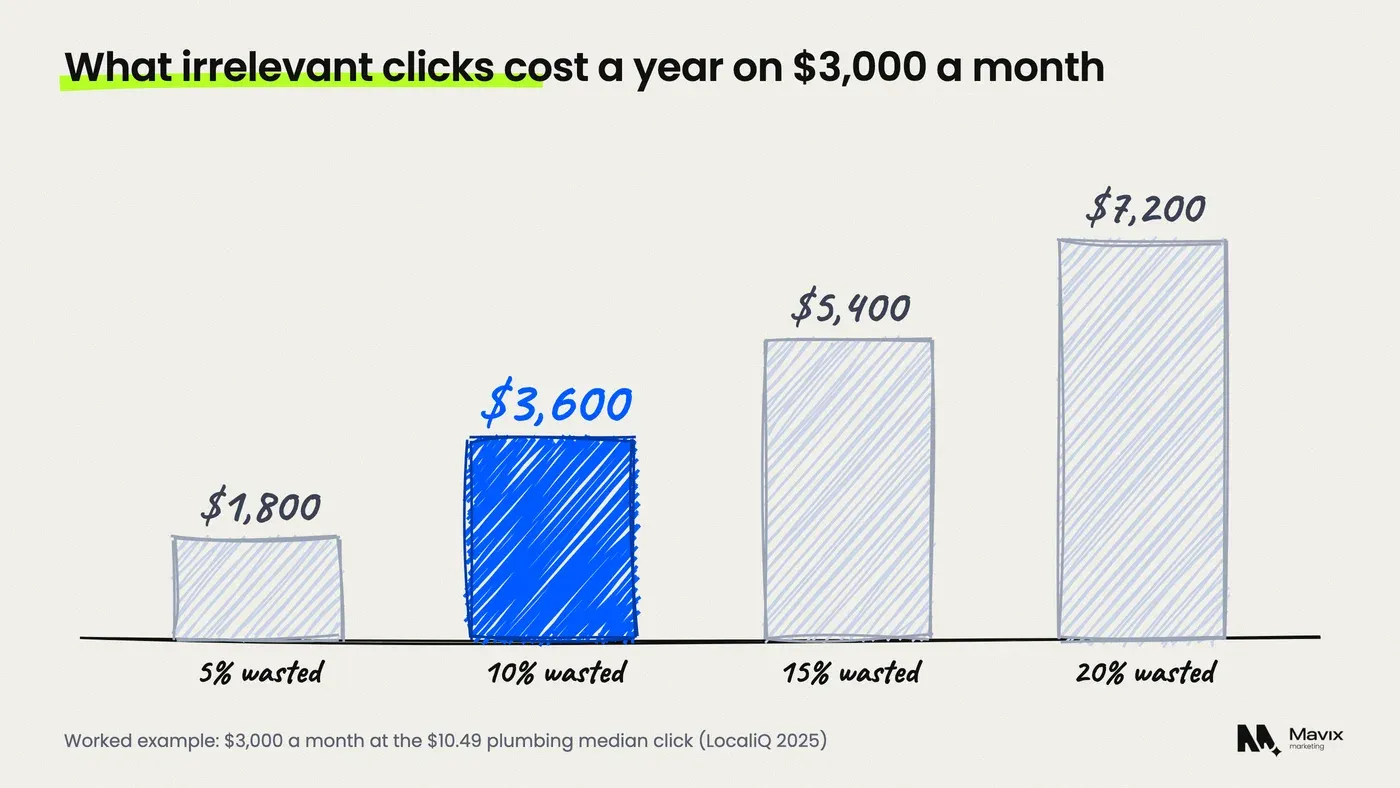
A worked example for a plumber spending $3,000 a month at the $10.49 median click price. The share of wasted clicks is an assumption for the sum:
- $3,000 divided by $10.49 buys about 286 clicks a month.
- If 1 in 10 of those clicks comes from a job seeker, a do-it-yourself search or a parts buyer, that is about 29 clicks.
- 29 clicks at $10.49 is about $300 a month, or $3,600 a year, with no chance of a job.
- At the median plumbing conversion rate of 7.63 percent in the same report, that $300 would have bought about two more leads.
The same sum at other waste shares: 5 percent wasted is $1,800 a year, 15 percent is $5,400 and 20 percent is $7,200.
The real share depends on your keywords and match types. Broad match keywords pull in far more loosely related searches, which the post on Google Ads match types explains. Our plumbing Google Ads budget guide shows how those lost leads change the cost of a booked job.
Where should negative keywords go in your account?
Put negatives that are wrong for every campaign in a shared negative keyword list, and negatives that are only wrong for one service at campaign level. Google allows 20 negative keyword lists per account, 5,000 keywords per list and 10,000 negative keywords per campaign (Google Ads Help). Most small accounts never come near those limits.
| Level | Use it for | Example |
|---|---|---|
| Shared negative keyword list | Words wrong for the whole business | jobs, salary, diy, parts, wholesale |
| Campaign | Words wrong for one service | “installation” in a repair campaign |
| Ad group | Steering searches between ad groups | “tankless” in the standard water heater ad group |
| Performance Max campaign | Blocking waste in Search and Shopping placements | the same shared list, applied to the campaign |
Ad group negatives stop two ad groups competing for the same search. In Performance Max, Google says negative keywords apply “to Search and Shopping inventory only”, and you can apply an existing negative keyword list to the campaign (Google Ads Help). They do not stop display or video placements. The trade-offs between the two campaign types are in Performance Max vs Search campaigns.
If your account has grown messy, with negatives scattered everywhere, that is one of the first things our Google Ads management team sorts out.
Which negative keywords block paying customers?
The negatives that hurt most are the ones that sound like bargain hunters but are not. “Free” as a broad negative blocks “free estimate roof repair”, one of the best searches a roofer can buy. “Cost” and “price” block people asking what a job costs, who are often close to booking. “Cheap” blocks homeowners on a budget who still pay.
Other common mistakes:
- Blocking a word you sell. “Repair” in an account that does repairs, or “emergency” when you take emergency calls. Check each new negative against your services list.
- Blocking a word inside a good phrase. A broad negative “water” stops a plumber’s ads for “water heater repair”.
- Adding the full search instead of the bad word. It blocks one search and leaves the next hundred.
- Never checking again. Your services change, and a negative added two years ago may now block work you do.
- Blocking competitors without thinking. Searches for another company’s name can be cheap and convert, or expensive and useless. Decide on your own data.
Review the full negative keyword list every few months, and remove anything that no longer fits. The Google Ads audit checklist includes this check with the others.
Questions people ask about negative keywords for home services
How often should I check search terms for new negative keywords?
Check weekly for the first month of a new campaign, then every two to four weeks. New campaigns and new keywords bring the most surprises. Once the list has caught the common waste, a monthly review usually finds only a few new words, unless you add broad match keywords or a new service.
Should I use negative keywords with Performance Max?
Yes. Google lets you add negative keywords to a Performance Max campaign, either one at a time or by applying an existing negative keyword list. They only apply to Search and Shopping inventory, so they will not stop display or video placements, but they block the same job and do-it-yourself searches that waste money in search ads.
Can too many negative keywords hurt my Google Ads?
Yes. Google warns that too many negative keywords may reduce how many customers your ads reach. The risk is not the count but the words: a few broad negatives such as “free”, “cost” or “repair” can block more good searches than hundreds of specific ones. Check each new negative against your services and recent buyer searches.
Do I need to add misspellings to my negative keywords?
No. Google says negative keywords automatically account for casing and misspellings. You do need to add plurals and synonyms yourself, because negatives do not match close variants. Add “job” and “jobs”, “career” and “careers”, and other wordings of the same idea, such as “salary” and “pay rate”.
Should I add “free” as a negative keyword?
Usually not as a broad negative. Many homeowners search for a free estimate or a free quote, and those searches can be some of the best you buy. If people searching for free services are wasting money, add specific phrases instead, such as “free service” or “for free”, and keep the searches that mention estimates and quotes.
Can I copy a negative keyword list from another business?
You can use one as a starting point, but check every word before applying it. A list built for a roofer may block words a plumber sells, and a list built for a commercial contractor may block residential searches. The words that matter most come from your own search terms report.
The bottom line
Add the starter groups this week as a shared list, check each word against the services you sell, and then read your search terms report every week for a month. The list that saves the most money is the one built from your own searches, not one copied from someone else.
If you suspect your ads are paying for searches that never hire, get your Google Ads account checked for free. You get a written list of the searches wasting money and the negatives that would stop them, usually within one working day.
Free review
Want this looked at on your own site?
Send the address. A person reads it and writes back with the two or three things that would move your enquiry number first. Free, and yours to keep whether you hire us or not.