Facebook ads or Google Ads for a local business? Compare the cost of a booked job, not the cost of a lead
Facebook leads cost less than Google leads in most trades, but they book less often. The break-even sum by trade, and when a local business should run both.
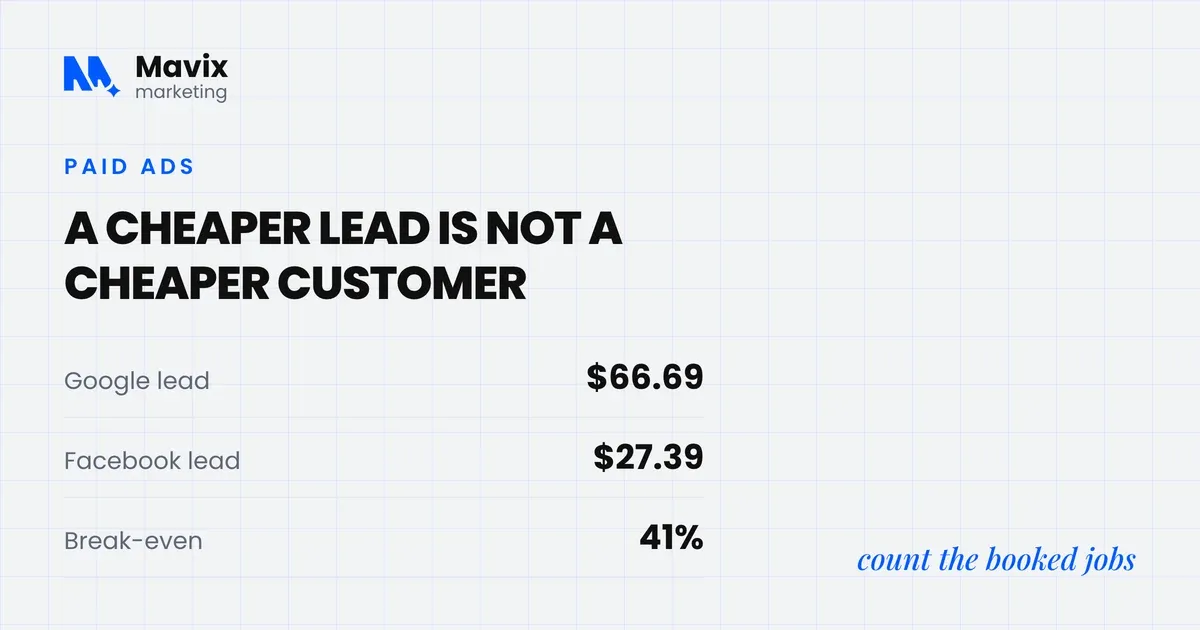
Google Ads is the better first spend for most local service businesses, because it reaches people already searching for the job. Facebook leads are cheaper, $27.39 against $66.69 on average in LocaliQ’s 2026 benchmarks, but they come from people who were not looking. A Facebook lead only wins if it books at more than about 41 percent of the rate a Google lead does.
This page is for owners of trades, clinics and other local businesses deciding where the next ad dollar goes. It sets out the two platforms side by side, the cost per lead by trade, a break-even sum you can run on your own numbers, and the cases where Facebook should come first.
The short version
- Google Ads shows your ad to people who type a search, so it catches demand that already exists. Facebook ads show to people scrolling, so they create demand that did not exist an hour ago.
- LocaliQ’s 2026 benchmarks put the average Google Ads lead at $66.69 and the average Facebook lead at $27.39.
- For home and home improvement businesses the gap is $90.92 on Google against $42.95 on Facebook. A Facebook lead must book at 47 percent of the Google rate or better to cost less per job.
- Facebook is not cheaper everywhere: beauty and personal care leads cost $50.91 on Facebook against $39.25 on Google in the same benchmarks.
- Run both only once Google covers your core searches and you can answer every lead fast.
What is the difference between Facebook ads and Google Ads?
Google Ads is Google’s ad system that shows your ad when someone searches for words you have chosen, such as “water heater repair near me”. Facebook ads are Meta’s ads, shown in the Facebook and Instagram feeds to people picked by location, age and interests. One answers a question someone just asked. The other interrupts someone who was doing something else.
That one difference decides most of what follows. A Google searcher has a problem today. A Facebook viewer may have the problem next spring, or never. Google’s own help pages describe keywords as what decides which searches show your ad, with broad match reaching related searches and exact match reaching searches with the same meaning (Google Ads Help). Facebook has no keyword at all.
| Google Ads (search) | Facebook ads | |
|---|---|---|
| Who sees it | People searching for the job | People in your area scrolling a feed |
| What triggers it | A search that matches your keyword | Meta’s choice of who is likely to respond |
| Demand | Captures demand that exists | Creates demand that did not |
| Typical lead | A phone call or form from your site | A form filled in without leaving Facebook |
| Best at | Urgent and planned jobs people search for | Offers, seasonal work, visual results, new areas |
| Main risk | High click prices in busy trades | Cheap leads who do not answer the phone |
The table shows why a lower cost per lead on Facebook does not settle anything. The two platforms sell different kinds of leads, so the only fair comparison is what each one costs per booked job.
Which is cheaper per lead, Facebook ads or Google Ads?
Facebook ads are cheaper per lead in most trades. LocaliQ’s 2026 Facebook benchmarks put the average lead from a leads campaign at $27.39 (LocaliQ Facebook benchmarks). Its 2026 search benchmarks put the average Google Ads lead at $66.69 (LocaliQ search benchmarks). The search figures come from campaigns on Google Ads and Microsoft Ads.
| Business category (LocaliQ) | Google Ads cost per lead | Facebook cost per lead |
|---|---|---|
| All industries | $66.69 | $27.39 |
| Home and home improvement | $90.92 | $42.95 |
| Dentists and dental services | $72.97 | $61.56 |
| Real estate | $102.51 | $13.74 |
| Health and fitness | $67.36 | $27.11 |
| Personal services | $54.60 | $38.09 |
| Beauty and personal care | $39.25 | $50.91 |
The table shows Facebook ahead on lead price in six of the seven rows, and behind in beauty and personal care. Real estate has the widest gap, which fits how people use each. Home sellers rarely search “sell my house” until late, but they will fill in a home value form they see in a feed.
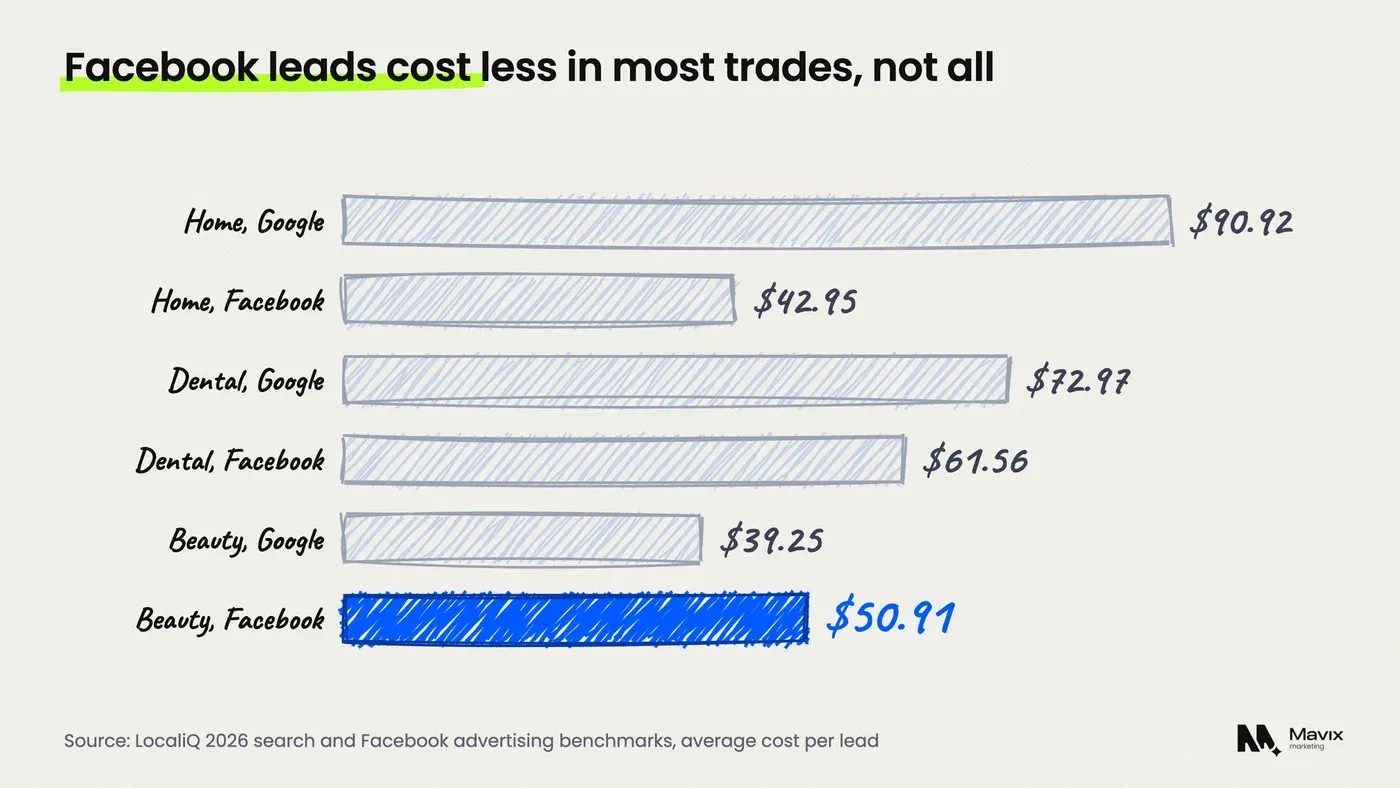
Two cautions. LocaliQ’s Facebook page does not state its sample size or dates, and the two reports use different campaign sets, so treat the gap as a direction, not a precise figure. And your own account beats any benchmark. The Facebook and Instagram ad cost guide and the Google Ads cost per lead benchmarks explain what moves each number.
Why a cheaper Facebook lead can cost you more per job
A Facebook lead is a person who tapped an ad and sent a form that Facebook often fills in from their profile, sometimes in a few seconds. A Google lead is usually a person who searched, read your page and then called. The first is cheaper to buy and harder to reach. What you pay for in the end is the booked job, and that is cost per lead divided by the share of leads that book.
A worked example for a home improvement business, using the LocaliQ medians and two assumed booking rates:
- Google: $90.92 a lead, and 1 in 2 leads books. That is $181.84 per booked job.
- Facebook: $42.95 a lead, and 1 in 5 leads books. That is $214.75 per booked job.
- Facebook, if 3 in 10 leads book: $143.17 per booked job.
On $2,000 a month, Google buys about 22 leads and 11 jobs. Facebook buys about 47 leads and 9 jobs at the lower booking rate, or 14 jobs at the higher one. The booking rate is the whole argument, and it is a number only your call log can give you. A lead tracking spreadsheet with a “booked” column is enough to find it.
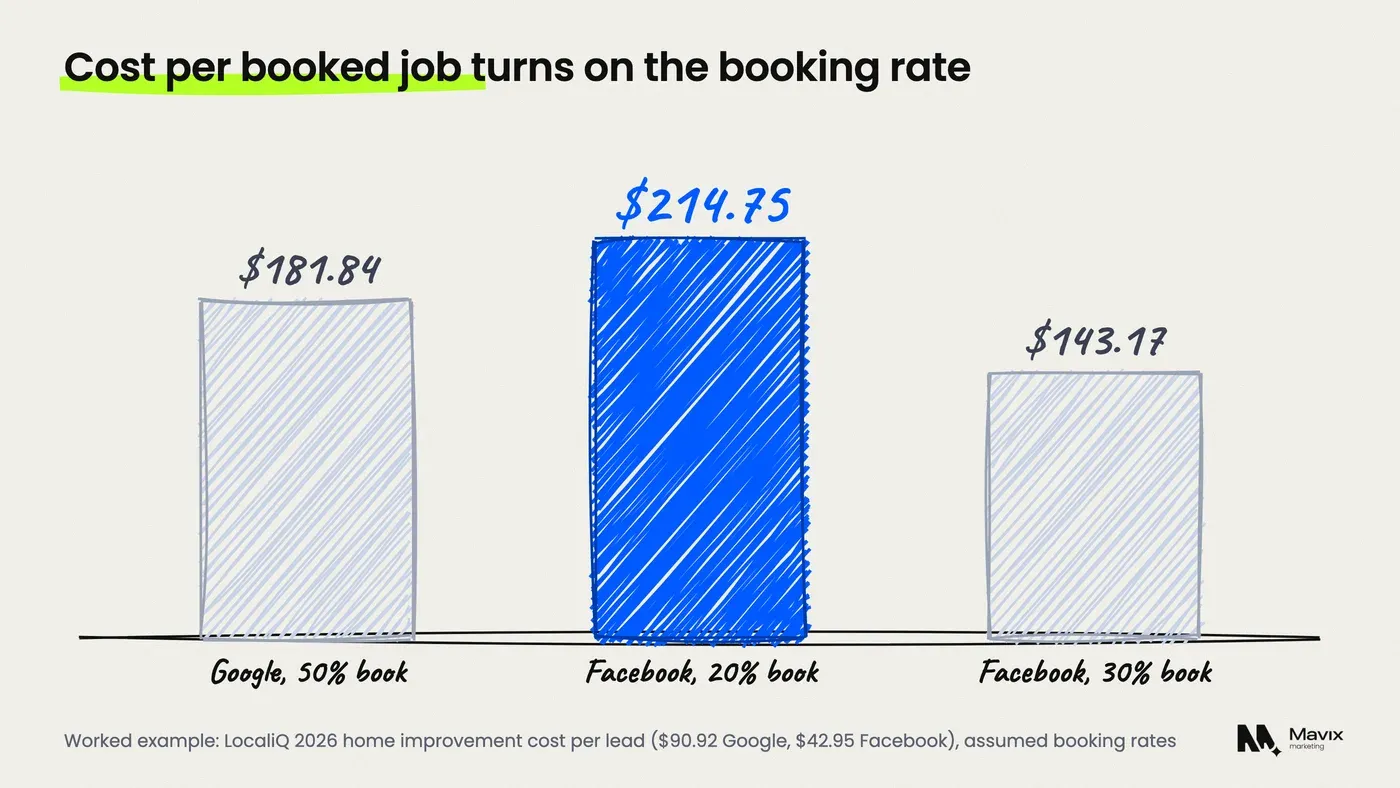
The booking rate moves the answer more than the lead price does.
How often does a Facebook lead have to book to beat Google?
Divide the Facebook lead price by the Google lead price. The result is the share of your Google booking rate a Facebook lead must reach to cost the same per job. With LocaliQ’s 2026 averages that is $27.39 divided by $66.69, or 41 percent: if half your Google leads book, Facebook leads must book at least about 1 in 5 to break even.
| Business category | Facebook lead price as a share of Google | If half of Google leads book, Facebook leads must book at least |
|---|---|---|
| Real estate | 13% | 7% |
| Health and fitness | 40% | 20% |
| All industries | 41% | 21% |
| Home and home improvement | 47% | 24% |
| Personal services | 70% | 35% |
| Dentists and dental services | 84% | 42% |
| Beauty and personal care | 130% | 65% |
The table shows where Facebook has room to spare and where it does not. In real estate a Facebook lead can book far less often and still win. In dental, Facebook leads cost nearly as much as Google leads, so they need to book almost as well, which is a hard ask for people who were not looking for a dentist.
To run it on your own account:
- Take your Google cost per lead and booking rate from the last 90 days.
- Multiply them out to get your Google cost per booked job.
- Divide a Facebook test’s cost per lead by that figure. The answer is the booking rate Facebook leads must reach.
- Run Facebook for a month, call every lead within minutes, and count how many book.
When should a local business start with Google Ads?
Start with Google Ads when people search for what you do at the moment they need it. That covers most trades: plumbing, HVAC, roofing, electrical, pest control, locksmiths and emergency dental. Someone with a leaking pipe does not wait for an ad to appear in their feed. They search, and they call someone from the first page of results.
Google also wins when the job is big and the buyer compares, such as a roof or a kitchen. A searcher reads your page, checks reviews and calls when ready, so the lead arrives warm. The main cost is click price: LocaliQ’s 2025 home services benchmarks put plumbing at a median $10.49 a click and roofing at $10.70 (LocaliQ home services benchmarks).
For many home service businesses, Local Services Ads, where Google charges per lead instead of per click (Local Services Help), sit alongside search ads. The Local Services Ads vs Google Ads comparison covers how to split between them.
When should Facebook ads come first?
Facebook should come first when nobody searches for what you sell yet, or when the result is easy to show in a picture. Examples are a new med spa treatment, a seasonal offer such as gutter cleaning before winter, a home value check for a real estate agent, a gym opening, or a landscaper’s before and after. Facebook reaches a lot of people: 70 percent of US adults say they use it, according to Pew Research Center’s 2026 social media fact sheet.
Three limits matter for local businesses:
- Housing and some other ads are restricted. Meta requires ads about housing, employment and financial products in the US to run as a Special Ad Category with approved targeting options (Meta advertising standards). Real estate agents lose some of their audience choices.
- Form leads go cold fast. People forget they filled the form. Calling within minutes matters more on Facebook than anywhere, which is the subject of speed to lead.
- The creative wears out. A Facebook ad shown to the same local audience for weeks stops working, so you need new pictures and offers regularly.

If Facebook is your first spend, decide early whether the ad sends people to a Facebook form or your own page. The trade-offs are set out in Meta lead ads vs a landing page.
Should a local business run Facebook ads and Google Ads together?
Run both once Google Ads covers the main searches for your service and area and you still have budget and capacity. The two do different jobs: Google catches people with a problem today, and Facebook puts your name in front of people before the problem arrives, so they recognise it when they do search. Splitting a small budget across both too early starves each one of data.
A sensible order for most service businesses:
- Google Ads on your core searches, with calls tracked as conversions.
- Local Services Ads if your trade qualifies.
- Facebook retargeting, meaning ads shown only to people who already visited your site, at a small budget.
- Facebook ads to cold local audiences with a specific offer, judged on cost per booked job against your Google figure.
A PPC management service runs this order for you and reports both platforms on the same booked-job number. If you are still deciding whether paid ads are worth it at all, is Google Ads worth it for a small business works through that question first.
Mistakes that make one platform look better than it is
Most “Facebook does not work” and “Google is too expensive” verdicts come from comparing the wrong numbers. These are the ones to check before you move money.
- Comparing cost per lead. A form lead and a phone call are not the same thing. Compare cost per booked job.
- Counting form fills Facebook reports as leads. Count the ones that answered the phone.
- Judging after a week. Both platforms need a few weeks and a few dozen leads before the numbers settle.
- Different areas. A Google campaign on a 10 mile radius and a Facebook campaign on a whole metro are not a fair test.
- No call tracking on Google. If calls from ads are not recorded as conversions, Google looks worse than it is. The Google Ads management checks start there.
Questions people ask about Facebook ads vs Google Ads
Are Facebook ads cheaper than Google Ads?
Per click and per lead, usually yes. LocaliQ’s 2026 figures put the average Facebook lead at $27.39 against $66.69 for Google Ads. Per booked job, it depends on how often your Facebook leads book. If they book at less than about 41 percent of your Google rate, the cheaper lead ends up costing you more per customer.
Do Facebook ads work for plumbers and HVAC companies?
They work for planned work and offers, not for emergencies. A tune-up special before winter, a water heater replacement offer or a maintenance plan can do well on Facebook. A burst pipe or a broken furnace at night is a search, so Google Ads and Local Services Ads should get the emergency budget first.
How much should a local business spend to test Facebook ads?
Enough to get a few dozen leads in a month, so the booking rate means something. At LocaliQ’s 2026 home improvement average of $42.95 a lead, 30 leads cost about $1,300. A test that brings five leads cannot tell you whether Facebook works for you, only whether those five people happened to answer.
Which is better for a new local business with no reviews?
Google Ads usually, because the searcher is already looking and needs only a reason to call. Facebook can help a new business get known in its area, but strangers who see an unknown name in a feed tend to need more convincing. Spend part of the early effort on getting reviews, since both platforms convert better once you have them.
Can I run Facebook ads without a website?
Yes. Facebook lead ads use a form inside Facebook, so the person never visits a site. That makes them quick to start, but you lose the page that answers questions and filters out poor fits. Expect more leads who were only curious, and call them fast.
Is Instagram part of Facebook ads?
Yes. Facebook ads are run from Meta’s Ads Manager, and the same campaign can show on Facebook, Instagram or both. For most local service businesses there is no need to separate them at the start. Let the campaign show on both and check later which placement brings leads that book.
The bottom line
If people search for your service when they need it, put your first dollars into Google Ads and add Facebook later as a tested second channel. If they do not search for it yet, start with Facebook and a clear offer. Either way, make the decision on cost per booked job, using your own booking rate.
If you want to know which platform is cheaper for your business in practice, get your paid ads checked for free. You get a written comparison of your cost per booked job on each platform and where the next dollar should go, usually within one working day. The ads pricing page shows what managing both costs.
Free review
Want this looked at on your own site?
Send the address. A person reads it and writes back with the two or three things that would move your enquiry number first. Free, and yours to keep whether you hire us or not.