How to get more Google reviews: when to ask, what to send, and the two habits Google bans
Asking for Google reviews the wrong way can freeze your profile. When to ask, how to send the link or QR code, and what Google and the FTC actually ban.
Ask every customer for a Google review when the job is done, using the link or QR code from your Google Business Profile, and keep asking every week instead of in bursts. Google bans two habits most review schemes rely on: any incentive for a review, and asking only the customers you expect to be happy.
This page is for owners of local service businesses who know reviews bring calls but get few of them. It covers what Google and the FTC allow, when and how to ask, how many reviews a month to aim for, and what happens to a profile that breaks the rules.
The short version
- Google’s review policy bans incentives of any kind, asking only happy customers, discouraging negative reviews and reviews from staff or anyone with a conflict of interest.
- The FTC rule allows incentives that do not depend on the review being positive, but Google does not, so Google’s stricter rule is the one to follow.
- Google can stop a profile receiving new reviews, hide its existing ones, and show shoppers a warning that fake reviews were removed.
- In BrightLocal’s 2026 survey of 1,002 US adults, 78 percent had been asked for a review in the past year and 65 percent wrote one after being asked.
- Local SEO experts in Whitespark’s 2026 survey ranked a steady flow of reviews over time 14th of all local pack factors, ahead of review keywords at 36th.
Why do Google reviews matter for a local business?
Reviews affect both whether you show up and whether you get the call. Google says review count and score feed prominence, one of its three local ranking factors, and that “more reviews and positive ratings” can help your local ranking (Google Business Profile Help). Buyers read them before they call.
In BrightLocal’s Local Consumer Review Survey 2026, 97 percent of US consumers read reviews for local businesses, and 74 percent look for reviews written in the last three months (BrightLocal). A profile with 200 reviews and none since spring looks closed to that reader.
Whitespark’s 2026 Local Search Ranking Factors survey of 47 local SEO experts scored the review factors for the map results like this (Whitespark):
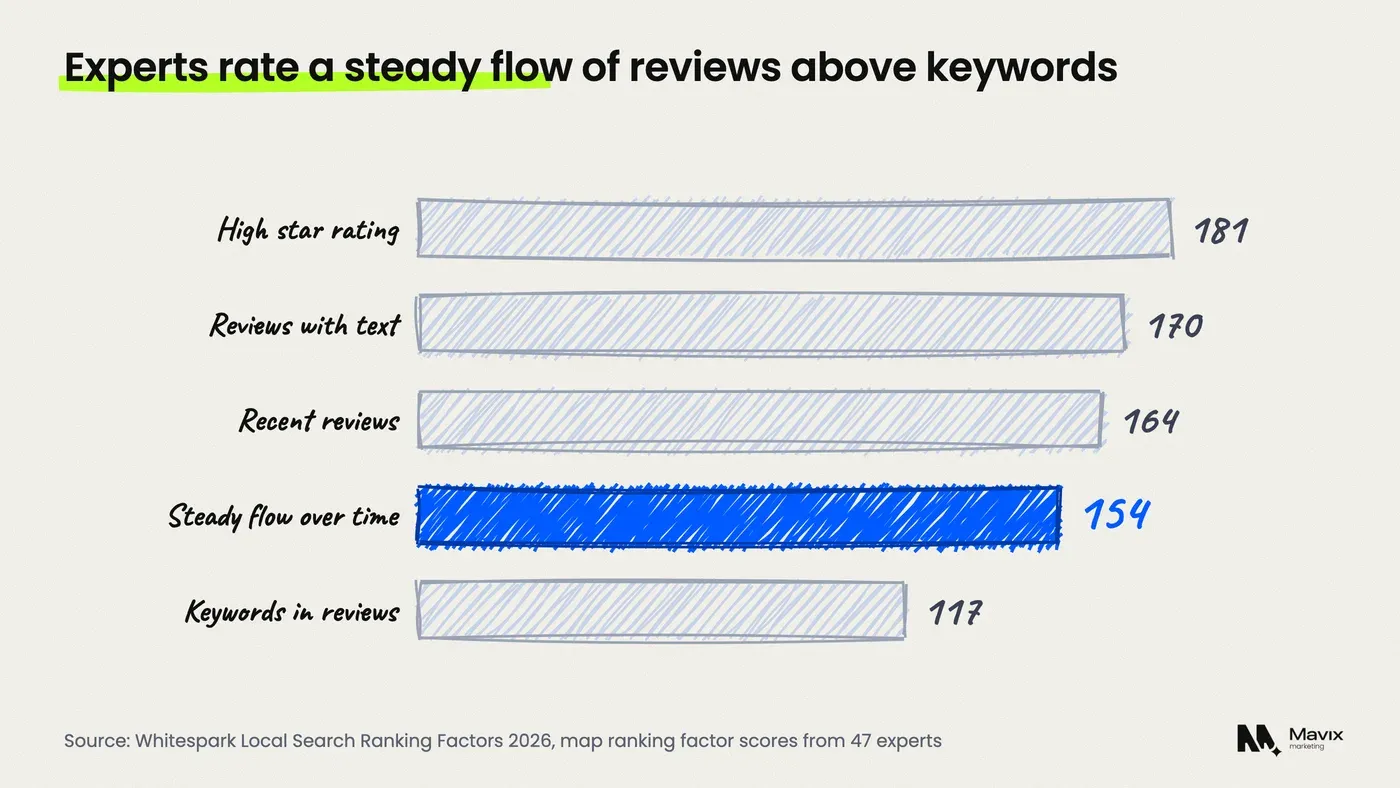
The chart shows that the basics outrank the tricks. A high rating, many written reviews, recent reviews and a steady flow all scored far above keywords in review text, which is the thing most review scripts push. These are expert opinions, not Google’s weights, and Google does not publish its weights. Reviews are one part of local SEO for service businesses, next to categories, distance and the website. The steps to get into the Texas map pack show where reviews sit in that order of work.
What does Google allow when you ask for reviews?
Google allows you to ask every customer for an honest review, by link, QR code, email, text or in person. Its Maps content policy forbids paying for reviews “directly or in kind”, content posted because of a business incentive, asking only for positive reviews, discouraging negative ones and reviews based on a conflict of interest (Google Maps content policy).
The FTC’s Consumer Reviews and Testimonials Rule, in force since October 21, 2024, covers some of the same ground with different lines (FTC).
| Practice | Google’s policy | FTC rule |
|---|---|---|
| Asking every customer for an honest review | Allowed | Allowed |
| A discount, gift or prize draw for leaving a review | Banned, whatever the review says | Allowed only if the reward does not depend on the review being positive |
| Asking only customers you think are happy (review gating) | Banned | No specific ban, but the FTC says it could still break the FTC Act |
| Reviews from staff, family or former staff | Banned as a conflict of interest | Must disclose the relationship |
| Fake reviews, bought reviews | Banned | Banned, with civil penalties for knowing breaches |
| Threats or legal pressure to remove a bad review | Banned as discouraging negative reviews | Banned as review suppression |
The table shows Google’s rules are the stricter ones on the two points that matter most, incentives and gating. A “10 percent off your next service for a review” card is legal under the FTC rule if any review qualifies, and it still breaks Google’s policy. Follow Google’s rules for Google reviews.
What happens if you break Google’s review rules?
Google removes the reviews and can restrict the whole profile. Its help page lists three restrictions it may apply for fake engagement: no new reviews or ratings for a set period, existing reviews unpublished for a set period, and a warning shown to shoppers that fake reviews were removed. Google says it emails the owner before applying one (Google Business Profile Help).
The warning is the expensive part. A shopper comparing three plumbers sees a notice on yours and calls one of the other two. The profile loses the bought reviews and the trust at the same time.
When is the best time to ask for a Google review?
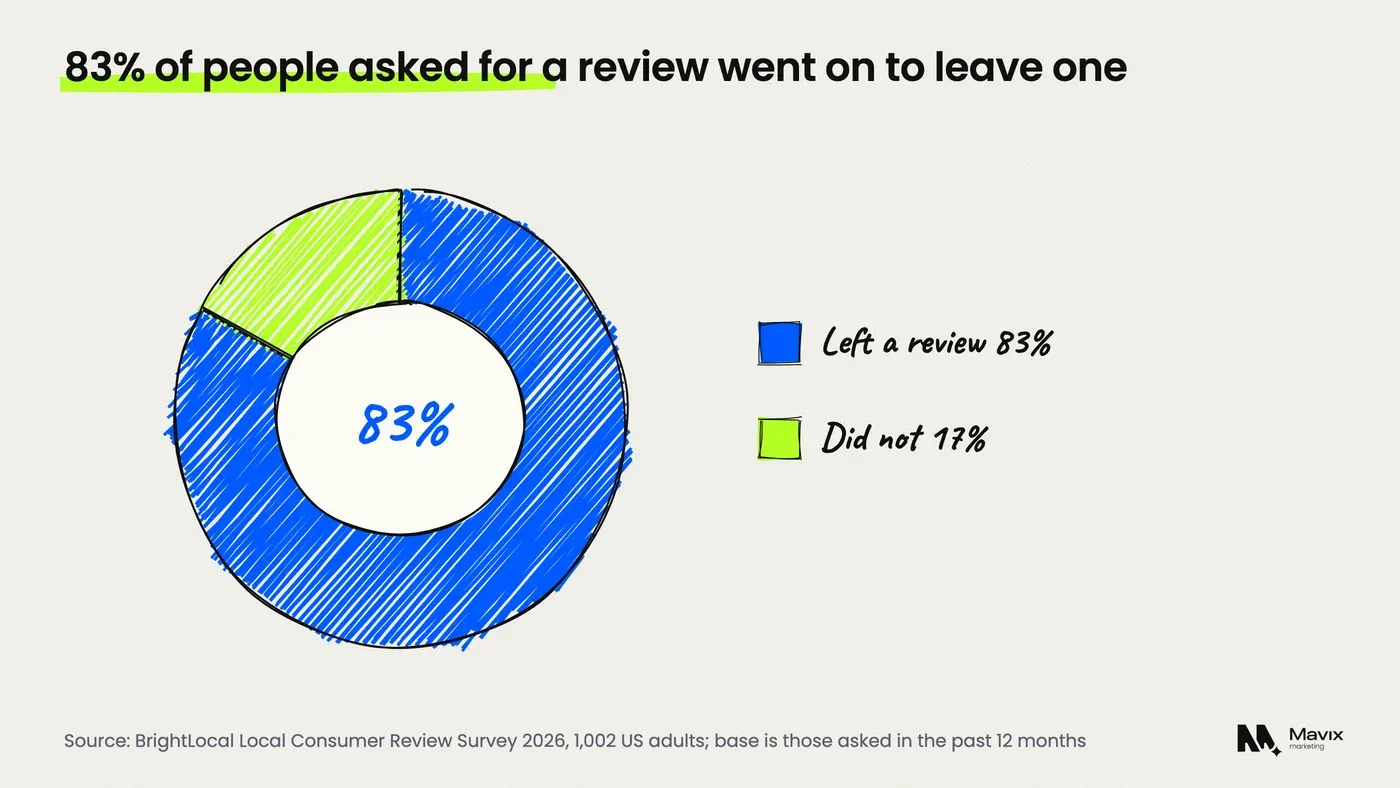
Ask at the moment the customer feels the result: when the heating comes back on, when the patient walks out pain-free, when the keys change hands. BrightLocal’s 2026 survey found 83 percent of people who were asked for a review went on to leave one in the year, so the ask itself does most of the work.
Good moments by trade:
- Plumbers, HVAC, electricians: on site, when the job is tested and working, followed by a text within the hour.
- Dentists and med spas: at the front desk on the way out, with a text the same day. Local SEO for dental practices covers the rest of a practice’s map listing.
- Cleaners and landscapers: after the first visit, and again after a visit the customer comments on.
- Lawyers and real estate agents: at the close of the matter or the sale, by email from the person who did the work.
Do not ask before the bill is settled or while a complaint is open. Fix the problem first, then ask the same way you ask everyone else.
How do you send customers a Google review link or QR code?
Create the link and QR code inside your Business Profile and send the link the same day as the job. Google’s steps: open your profile, choose Read reviews, then Get more reviews, and copy the link or download the QR code (Google Business Profile Help). The QR code can only be made in a computer browser.

- Make the link once. Copy it from Get more reviews and save it where your team can paste it.
- Send it by text. A short message with the link, from a named person, works for most trades.
- Print the QR code on invoices, leave-behind cards and the front desk.
- Add the link to receipt emails and your job-complete email.
- Track who was asked in your job list or a lead tracking spreadsheet, so nobody gets asked twice and nobody is skipped.
A text that follows the rules: “Hi [first name], it’s [your name] from [business]. Thanks for having us out today. If you have a minute, an honest review helps other people in [town] find us: [review link]”. It asks for honesty, names no star rating and offers nothing in return. Customers need to be signed in to a Google account to post, so the link works best on phones where they already are (Google Business Profile Help).
How many Google reviews do you need each month?
Enough to keep a new review arriving every week or two, because recency and a steady flow both scored in the top 14 map factors in Whitespark’s 2026 survey. The number depends on your job count and how many asked customers follow through, which you only learn by tracking it.
A worked example with assumed response rates. Count your own for a month and replace them:
| Jobs a month | 1 in 10 asked leave one | 1 in 5 asked leave one | 1 in 3 asked leave one |
|---|---|---|---|
| 20 | 2 | 4 | 7 |
| 40 | 4 | 8 | 13 |
| 80 | 8 | 16 | 27 |
The table shows why asking every customer beats a review push twice a year. A company with 40 jobs a month that asks everyone gets four to thirteen reviews a month, spread out, which is the steady flow the experts rate. A push that asks 200 old customers in a week gives a burst, then nothing.
Should you reply to every Google review?
Yes, to every one, good and bad. Google’s tips page for review requests recommends replying and keeping replies short and relevant, with no promotions. In BrightLocal’s 2026 survey, 89 percent of consumers said they expect businesses to respond to reviews.
For a good review, thank them by name and mention the job in plain words. For a bad one, reply once, calmly, offer to fix it offline, and do not argue the details in public. Our guide on how to respond to negative reviews has worked replies for the hard cases.
Review mistakes that cost you rankings or the whole profile
Most review problems come from tactics sold as shortcuts. Each one below breaks Google’s policy or wastes the effort:
- Discounts or prize draws for reviews. Banned by Google, even when the review can say anything.
- Gating. Software that asks “were you happy?” and sends only the yes answers to Google is selective solicitation.
- Staff and family reviews. A conflict of interest under Google’s policy, including former employees.
- Bought reviews. Removed, and the profile can be restricted with a public warning.
- Bursts. Asking a whole list in one week, then stopping, works against the steady flow that ranks.
- Wrong profile. A business with several locations should send each customer the link for the branch that served them.
When reviews are fine and the profile still does not appear, the cause is usually elsewhere. Work through why a Google Business Profile is not showing and the local SEO checklist.
Questions people ask about getting Google reviews
Can I offer a discount for a Google review?
No. Google’s policy bans content posted because of an incentive, and its help pages name free or discounted goods and services as an example. The FTC rule would allow a reward that does not depend on the review being positive, but Google is stricter, and Google decides what stays on your profile. Thank customers after a review, not in exchange for one.
Can I only ask happy customers for reviews?
No. Google’s policy forbids selectively asking for positive reviews, which is what review gating does. The FTC rule has no specific ban on gating, but the FTC says it could still break the FTC Act depending on the facts. Ask every customer the same way, and deal with unhappy ones by fixing the problem.
Can employees leave Google reviews for the business?
No. Google treats reviews from current or former staff as a conflict of interest and removes them. The same applies to family members and business partners. Employees can help by asking customers for reviews and sharing the link, which is allowed and usually the most effective step.
Can I get a bad Google review removed?
Only if it breaks Google’s content policy, for example spam, a conflict of interest or offensive content. A genuine negative review stays, however unfair it feels. Report one that breaks policy from your Business Profile, then reply to it calmly so the next reader sees your side.
How many Google reviews does a local business need?
There is no fixed number. You need enough that your rating and count compare well with the businesses beside you in the map results, plus a steady flow of new ones. In BrightLocal’s 2026 survey, 74 percent of consumers look for reviews from the last three months, so recent reviews matter as much as the total.
Do keywords in Google reviews help rankings?
A little, according to experts. Keywords in review text ranked 36th of the map factors in Whitespark’s 2026 survey, far below rating, review count and recency. Do not script the words customers use. Asking them to mention the service or town is fine; writing the review for them is not.
The bottom line
Stop running review drives and start asking every customer, every week, with the link from your own profile. Never pay for a review in any form, never filter who gets asked, and reply to everything. That gives you the steady flow of recent reviews that both shoppers and the map results reward.
If your profile has stalled at the same review count for months, get your local SEO checked for free. You get a written list of what is holding your map ranking back, reviews included, usually within one working day.
Free review
Want this looked at on your own site?
Send the address. A person reads it and writes back with the two or three things that would move your enquiry number first. Free, and yours to keep whether you hire us or not.