Is Google Ads worth it for a small business? The break-even sum, the minimum test, and when the answer is no
Google Ads pays when a new customer is worth more than it costs to win one. The break-even sum, 2026 click prices by industry, and the smallest fair test.
Google Ads is worth it for a small business when the profit from a new customer is bigger than the cost of winning that customer through ads. At LocaliQ’s 2026 averages, a click costs $5.42 and a lead $66.69. If one lead in three buys, each new customer costs about $200, and the question is whether yours is worth more.
This page is for owners who are deciding whether to start Google Ads, or wondering whether the money they spend now is paying back. It gives you the break-even sum, the click prices by industry, the businesses where the answer is no, and the smallest test that can give a fair answer.
The short version
- LocaliQ’s 2026 search benchmarks put the all-industry average at $5.42 a click, an 8.18 percent conversion rate and $66.69 a lead.
- The most you can pay per click and still break even is the profit from a new customer, times your close rate, times your conversion rate.
- Google’s own “$2 profit for every $1” figure is an average built from a 2009 auction model, not a forecast for your account.
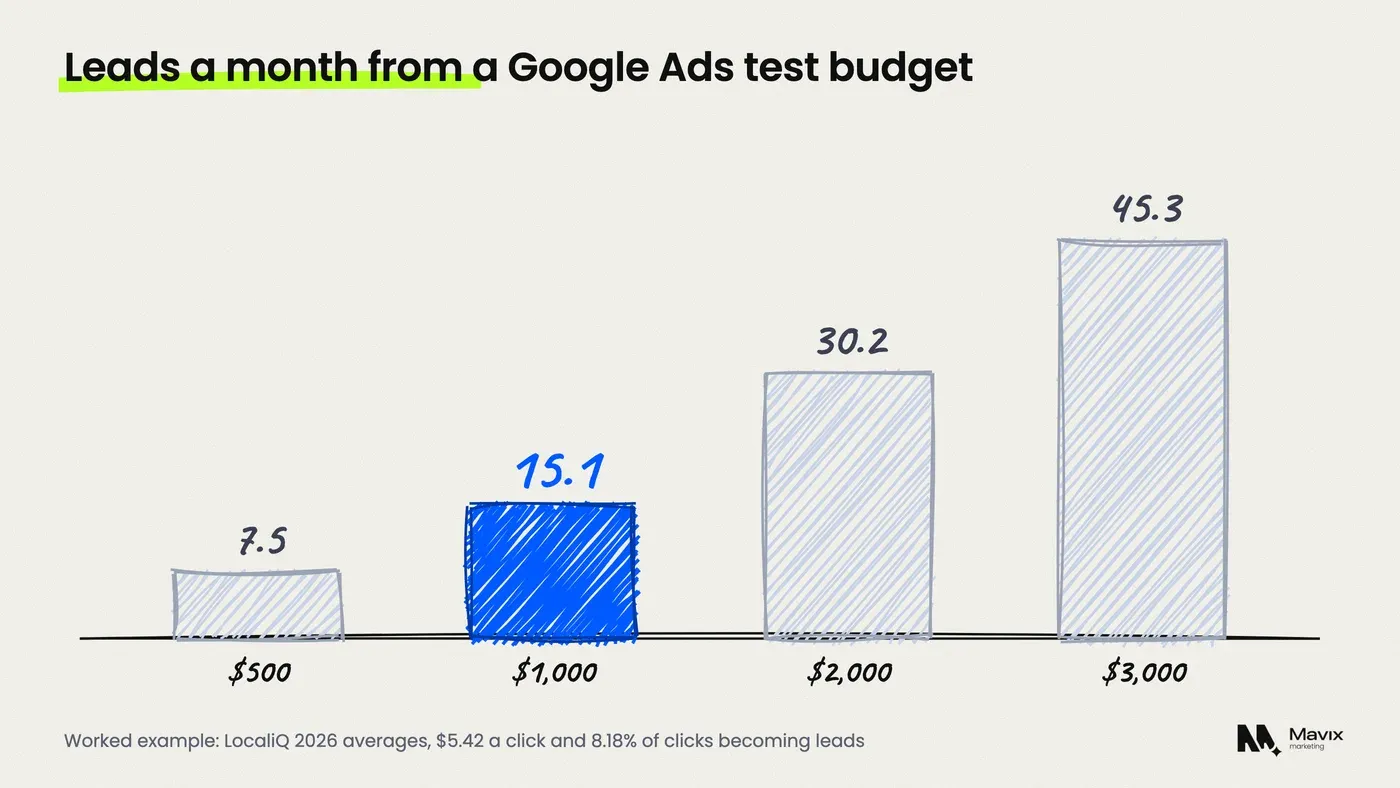
- At average prices, $1,000 a month buys about 185 clicks and 15 leads; $500 buys about 7 leads, too few to judge on.
- Google says a new bid strategy can take 1 to 2 conversion cycles to settle, so judge a test on a full month or more.
Is Google Ads worth it for a small business?
Yes, if your break-even click price is above what clicks cost in your trade, and no if it is below. The break-even click price is the most you can pay for one click before a new customer stops being profitable. LocaliQ’s 2026 benchmarks show the average click at $5.42 across industries (LocaliQ), so that is the first number to compare against.
Most “is it worth it” answers stop at pros and cons. That does not help you decide, because the answer depends on three numbers you already have or can count. They are what a customer is worth, how many enquiries you close, and how many site visitors enquire. The rest of this page turns those into a yes or a no.
How do you work out whether Google Ads will pay for you?
Work back from one customer to one click. Multiply the gross profit from a new customer by your close rate to get the most you can pay per lead. Then multiply that by your conversion rate to get the most you can pay per click. If the clicks in your trade cost less than that, Google Ads can pay.
- Profit from a new customer. The gross profit on the first sale, plus repeat sales if your records show customers come back. Use your invoices, not hope.
- Close rate. The share of enquiries that become paying customers. Count it from your call log or a lead tracking spreadsheet.
- Most per lead. Profit times close rate. At $300 profit and 1 in 3 closing, that is $100.
- Conversion rate. The share of ad clicks that call or fill in a form. LocaliQ’s 2026 all-industry average is 8.18 percent.
- Break-even click price. Most per lead times conversion rate. $100 times 8.18 percent is $8.18.
In that example, average clicks at $5.42 leave room, and Google Ads should pay. Break-even is the ceiling, not the target. You also want profit left after the ad cost, so aim well under it. The Google Ads ROI calculator runs the same sum with your figures.
What does Google Ads cost in your industry?
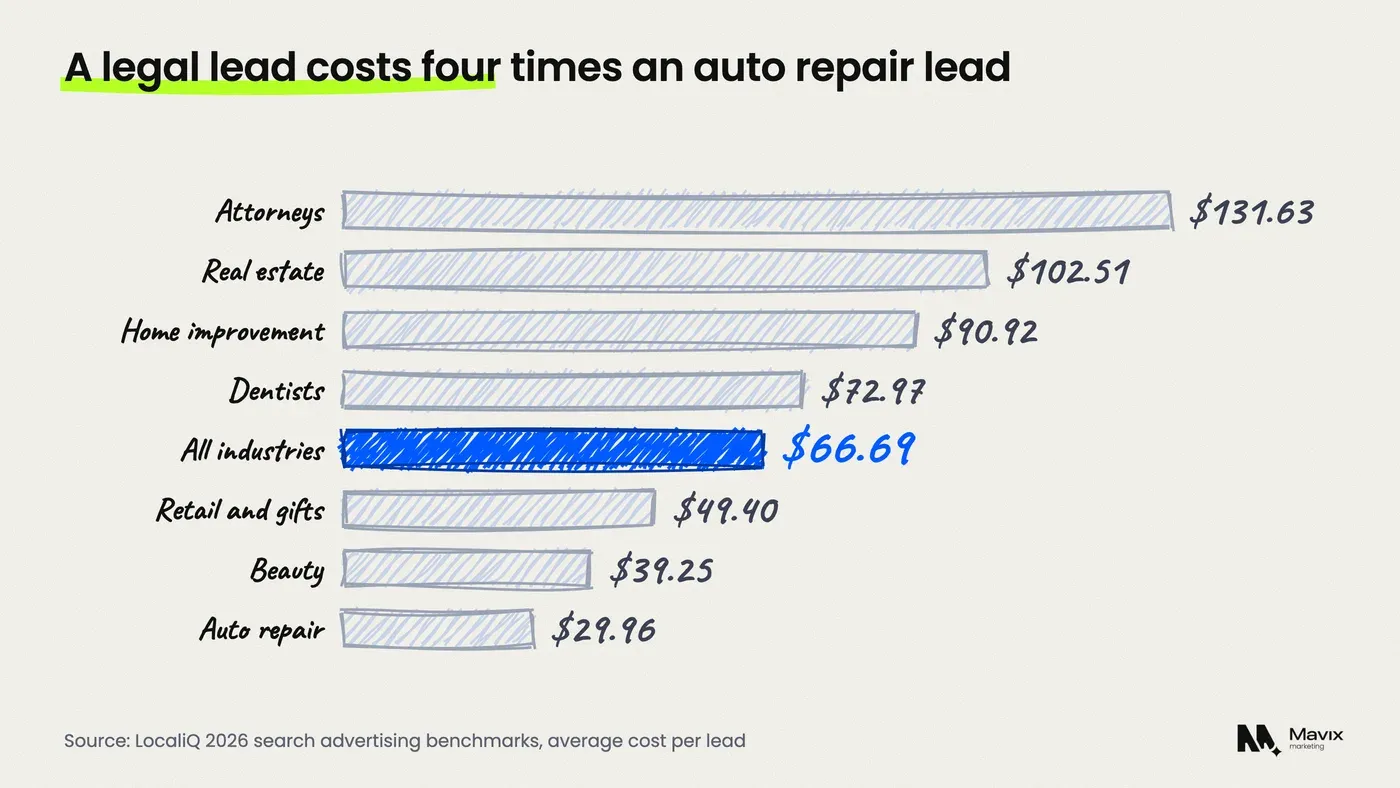
Click and lead prices differ by four times or more between industries. In LocaliQ’s 2026 benchmarks, a legal lead averaged $131.63 and an auto repair lead $29.96. The table shows the industries most small businesses fall into, so you can put your trade’s numbers into the sum.
| Industry (LocaliQ 2026) | Cost per click | Conversion rate | Cost per lead |
|---|---|---|---|
| Attorneys and legal services | $9.87 | 5.55% | $131.63 |
| Real estate | $3.22 | 3.70% | $102.51 |
| Home and home improvement | $8.33 | 8.05% | $90.92 |
| Dentists and dental services | $8.00 | 10.67% | $72.97 |
| Shopping, collectibles and gifts | $4.14 | 4.01% | $49.40 |
| Beauty and personal care | $4.62 | 10.35% | $39.25 |
| Restaurants and food | $2.05 | 8.05% | $30.57 |
| Automotive repair and service | $4.35 | 15.51% | $29.96 |
| All industries | $5.42 | 8.18% | $66.69 |
The table shows that a cheap click does not mean a cheap lead. Real estate clicks cost about 40 percent less than the average, but a 3.70 percent conversion rate makes the lead dearer than average. These are averages across LocaliQ’s own customers, so a busy city will cost more than a small town. More on what drives these prices is in how much Google Ads costs in 2026.
When is Google Ads not worth it?
Google Ads is not worth it when your break-even click price sits below the going rate, when nobody searches for what you sell, or when the business cannot handle the enquiries it buys. The first is arithmetic. The other two are about readiness, and they waste more small budgets than click prices do.
Here is the sum run for five example businesses. The profit and close rates are assumptions to show the method; the conversion rates and click prices are LocaliQ’s 2026 averages.
| Example business | Profit from a new customer (assumed) | Close rate (assumed) | Break-even click | Average click | Worth it on the first sale? |
|---|---|---|---|---|---|
| Auto repair shop | $250 | 1 in 2 | $19.39 | $4.35 | Yes, with room |
| Dental practice | $600 | 2 in 5 | $25.61 | $8.00 | Yes, with room |
| Law firm | $3,000 | 1 in 5 | $33.30 | $9.87 | Yes |
| Home improvement | $400 | 2 in 5 | $12.88 | $8.33 | Yes, but thin |
| Restaurant | $15 | 3 in 10 | $0.36 | $2.05 | No, unless guests return |
The table shows why one answer does not fit all. A restaurant loses money on the first visit at average click prices, so Google Ads only works if regulars come back, and Google Maps does more of the work. A home improvement firm can pay, but has little room for wasted clicks.
The other cases where the answer is no, for now:
- No search demand. A new kind of product that nobody searches for yet. Google Ads only shows when someone searches.
- No tracking. If calls and forms are not counted, you cannot tell a working campaign from a failing one. Start with the tracking setup checklist.
- Nobody answers. Ads that ring a phone nobody picks up buy calls for a competitor.
- A weak page. If visitors cannot see your price range, area and phone number in seconds, the conversion rate in your sum will not happen.

Why Google’s “$2 for every $1” is not your number
Google says businesses make an average of $2 in profit for every $1 spent on Google Ads, and $8 once organic search clicks are counted. Its methodology page says the $2 figure comes from Hal Varian’s 2009 paper on online ad auctions. The $8 adds five organic clicks for each ad click, valued at 70 percent of an ad click (Google Economic Impact).
That is a model of the whole economy, built to estimate Google’s total economic impact. It is not a promise about any one account. Your return depends on your margins, your close rate and how well the account is run.
The proof that it can work comes from a real account, not an average. One San Antonio store’s account recorded 6.45 in conversion value for every 1 spent, at $4.77 a conversion, after its tracking was rebuilt. The period behind those totals was not recorded, and the San Antonio case study gives the detail. The same arithmetic, done badly, can return less than it costs.
What is the minimum budget to test Google Ads?
Enough to buy about 15 to 20 leads in a month, which at LocaliQ’s 2026 average of $66.69 a lead is roughly $1,000 to $1,350. With fewer leads, one good or bad week decides the result. Check your own trade’s lead price in the industry table and multiply it by the leads you need.
| Monthly test budget | Clicks at $5.42 | Leads at 8.18% | Customers if 1 in 3 buys | Average daily budget |
|---|---|---|---|---|
| $500 | 92 | 7.5 | 2.5 | $16 |
| $1,000 | 185 | 15.1 | 5.0 | $33 |
| $2,000 | 369 | 30.2 | 10.1 | $66 |
| $3,000 | 554 | 45.3 | 15.1 | $99 |
The table shows that a $500 test produces two or three customers, which cannot tell luck from a working campaign. Google bills against an average daily budget and can spend up to 30.4 times it in a month (Google Ads Help), so decide the monthly figure and divide by 30.4. If $500 is truly the limit, running Google Ads on a small budget covers how to narrow it to the searches most likely to buy.
How long before you know if Google Ads is working?
Give a test at least a full month, and longer if customers take weeks to decide. Google says a bid strategy’s “Learning” label never lasts more than 7 days. Performance can still take 1 to 2 conversion cycles to settle, and low daily budgets or narrow targeting slow that down (Google Ads Help).
A conversion cycle is the time from a click to an enquiry. For a locksmith that is minutes. For a kitchen fitter it can be weeks. Check the account in this order:
- Week one: read the search terms report and block the searches that will never buy.
- End of month one: work out your cost per lead and compare it with the most per lead from your sum.
- End of month three: work out your cost per paying customer, which is the number that answers the question.
If clicks arrive and enquiries do not, the problem is usually the page or the tracking, not the channel. Work through why Google Ads clicks turn into no leads before deciding Google Ads does not work for you. A structured check of the first months is what Google Ads for small businesses is set up to do.
Questions people ask about whether Google Ads is worth it
How much does Google Ads cost a small business per month?
There is no fixed price, because you set the budget and pay per click. At LocaliQ’s 2026 average of $66.69 a lead, a test that buys 15 leads a month costs about $1,000. Lawyers pay about twice that per lead and auto repair shops less than half. Our ads management pricing shows what an agency adds on top.
Is Google Ads better than SEO for a small business?
They do different jobs. Google Ads brings enquiries from the day it starts and stops when you stop paying. SEO takes months to build and keeps working without a click price. Many small businesses start with Google Ads for cash flow while SEO builds. The trade-offs are set out in SEO or Google Ads first.
Can a small business run Google Ads without an agency?
Yes, if someone has a few hours a week to read the search terms report, add negative keywords and check that calls are tracked. The common failure is setting it up once and leaving it. An agency earns its fee when the time saved and the waste cut are worth more than the management fee.
What return should I expect from Google Ads?
Expect a cost per paying customer below the profit that customer brings, with enough left over to be worth the effort. Google’s average of $2 profit per $1 is a model across all advertisers, not a target. Set your own target from the break-even sum, and judge the account on cost per customer, not clicks.
Why does Google Ads work for my competitor and not for me?
Usually because of what happens after the click. A competitor with a faster reply, better reviews or a clearer page turns more clicks into customers, so they can pay more per click and still profit. Compare close rates and page speed before blaming the budget.
Should I stop Google Ads if the first month loses money?
Not on the first month alone. Google says performance can take 1 to 2 conversion cycles to settle, and early weeks include searches you will later block. Stop if, after cutting waste, your cost per paying customer is still above the profit a customer brings by the end of month three.
The bottom line
Do the sum before you spend a dollar: profit per customer, times close rate, times conversion rate, gives your break-even click price. If it sits well above your trade’s average click, run a full-month test sized for at least 15 leads. If it sits below, fix your close rate or offer first, because no amount of budget makes a losing sum pay.
If you want the sum run on your own numbers, get a free Google Ads check. You get your break-even click price, a test budget that can give a real answer, and a written list of what to fix first, usually within one working day.
Free review
Want this looked at on your own site?
Send the address. A person reads it and writes back with the two or three things that would move your enquiry number first. Free, and yours to keep whether you hire us or not.