
Dental SEO: the treatment pages, trust signals, profiles and reviews that bring new patients from Google
Dental SEO that brings new patients: treatment pages, the trust Google expects on health pages, profiles for each dentist, and review replies that stay legal.
Dental SEO wins new patients when four things line up. You need a page for each treatment you want more of and a Google Business Profile set up the way Google’s rules allow for each dentist. You also need a steady flow of reviews answered without breaking patient privacy, and pages that show which dentist stands behind them. Google holds health pages to a higher standard of trust than most topics.
This page is for practice owners and office managers who want more new patients from Google without paying for every one. It covers the pages to build, the trust signals Google expects, the profile rules for practices with several dentists, review replies, and what the same patients cost through Google Ads.
The short version
- Google says pages on health topics “must be highly accurate and consistent with established expert consensus”, and that trust is the most important part of E-E-A-T.
- Google’s profile rules let each public-facing dentist have their own Business Profile, named with the dentist’s name only, beside one profile for the practice.
- A Dallas dental practice paid $10,000 to settle a HIPAA complaint over patient details it put in replies to Yelp reviews, according to the California Dental Association.
- LocaliQ’s 2026 benchmarks put a dental lead from Google Ads at an average $72.97, so 20 new patients a month cost about $2,900 in ad spend if half of leads book.
- Google’s spam policy names pages aimed at specific cities that funnel visitors to one page as doorway abuse.
What is dental SEO?
Dental SEO is the work that makes a practice show up when nearby people search Google for a dentist or a treatment, in both the map results and the regular results below them. It covers the website’s treatment pages, the Google Business Profile, reviews, and the trust signals Google looks for on health content.
The map results and the regular results reward different things. The map results lean on the Business Profile, distance and reviews. The regular results lean on the website pages. A practice needs both, because a patient searching “dental implants cost” may never look at the map, and one searching “emergency dentist” may never scroll past it. The map side is covered in depth on our local SEO for dentists page.
Which pages does a dental website need to win new patients?
One page for each treatment you want more of, written for the patient deciding, not for other dentists. A single “Services” page listing twenty treatments cannot rank for any of them. Start with the treatments that bring the most value per patient or the most urgent searches, such as implants, clear aligners and emergency care.
| Treatment page | What the patient searches | What the page must answer |
|---|---|---|
| Dental implants | dental implants cost, implants near me | Price range, how many visits, financing, who is a candidate |
| Clear aligners | invisalign cost, clear braces for adults | Price range, treatment length, aligners vs braces |
| Emergency dentist | emergency dentist open now, tooth pain | Same-day slots, hours, what counts as an emergency, phone number first |
| Veneers and whitening | veneers cost, teeth whitening | Price range, how long they last, real before and after photos with consent |
| Children’s dentistry | pediatric dentist, kids dentist | Age you see from, first visit, insurance |
The table shows that most of what patients search is cost, time and fear. A page that answers those plainly, with your own price ranges, gives Google something to rank and gives the patient a reason to book. Our dental SEO service builds these pages in order of what each treatment is worth to the practice.
To build each page:
- Answer the main question in the first lines. Price range, time, and whether it hurts.
- Show the dentist who does it, with their name, qualifications and a link to their bio.
- Add your own photos. Real treatment rooms and staff, and before and after images only with patient consent.
- List insurance and financing on the page, not only on a separate page.
- Add structured data. Google says to use the most specific LocalBusiness type possible (Google Search Central), and schema.org has a Dentist type for it.
- Put the phone number and booking button where a phone user sees them without scrolling.
Why do dental pages need stronger trust signals?
Google treats health as a “Your Money or Your Life” topic, where content “could significantly impact the health, financial stability, or safety of people.” For these topics, Google says pages “must be highly accurate and consistent with established expert consensus”. It also says trust is the most important part of E-E-A-T, its shorthand for experience, expertise, authoritativeness and trust (Google Search Central).
In practice, that means the patient and Google can both see who stands behind each page. Google asks whether pages carry a byline where one might be expected, and whether that byline leads to the author’s background. It treats invented names, AI-made headshots and false credentials as deception.
The trust checklist for a dental site:
- A bio page for each dentist with their degree (DDS or DMD), where they trained, state licence and memberships.
- “Written by” or “Reviewed by” a named dentist on treatment pages, with the date it was last checked.
- Real photos of the dentists, team and building. Stock photos of smiling strangers in white coats do the opposite.
- Clear contact details: address, phone, hours and the practice’s legal name in the footer.
- No promises of results such as “pain-free guaranteed”. Health claims need to match expert consensus.

How should a practice with several dentists set up Google Business Profile?
One profile for the practice, plus one for each public-facing dentist who patients can contact directly at that address during stated hours. Google’s guidelines say a practitioner’s profile title should include only the practitioner’s name, not the practice name, and that support staff should not create their own profiles (Google Business Profile Help).
| Situation | What Google’s guidelines say to do |
|---|---|
| A practice with several dentists | A profile for the practice, and optional profiles for each public-facing dentist, named with the dentist’s name only |
| A solo dentist under a practice brand | One shared profile, named “Brand: Dentist name” |
| A dentist with several specialities | One profile only, not one per speciality |
| Hygienists, assistants, front desk | No profiles of their own |
| The practice name | The real-world name on the sign and stationery, with no added keywords, city names or taglines |
The table shows that “more profiles” is not a strategy. Individual profiles can help a well-known dentist show up for their own name, but they can also split reviews between profiles. Ask patients to review the profile that matches who they saw, and plan before a dentist leaves, because the guidelines page does not say what happens to their profile.
Pick the primary category that fits the practice best, such as Dentist, Cosmetic dentist or Orthodontist, and do not add categories only as keywords, which Google’s guidelines also forbid.
How do reviews help a dental practice, and what can you say in a reply?
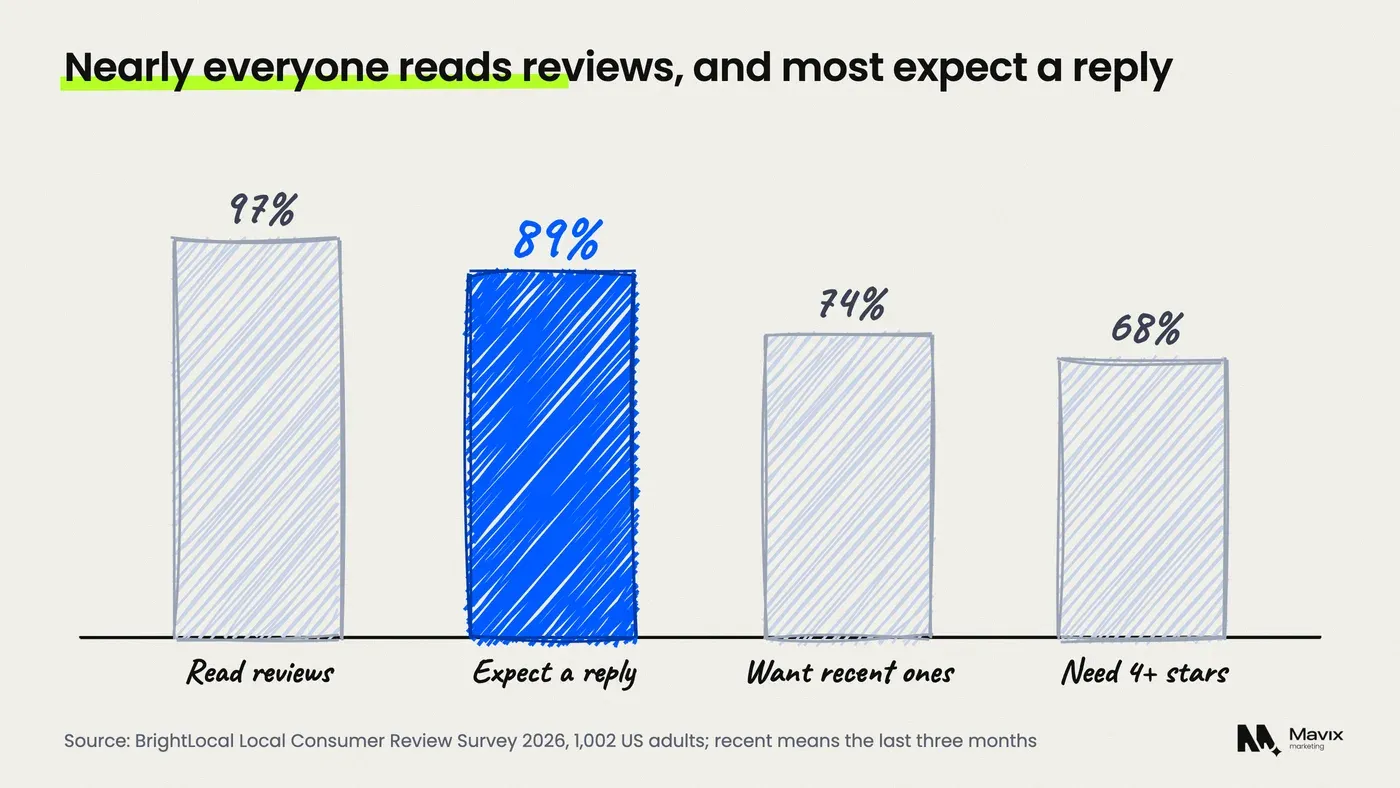
Reviews decide which practice a new patient calls. In BrightLocal’s 2026 survey of 1,002 US adults, 97 percent read reviews for local businesses and 68 percent need a rating of four stars or more. Also, 89 percent expect businesses to respond (BrightLocal). The reply is where dental practices get into trouble.
A practice that is a HIPAA covered entity cannot reveal patient information in a public reply without the patient’s written authorization. Elite Dental Associates in Dallas paid $10,000 and accepted two years of monitoring after replies on its Yelp page disclosed patients’ names and health details, the California Dental Association reported in October 2019.
Safe reply rules:
- Never confirm the reviewer is a patient. No names, dates, treatments or insurance.
- Keep it general. “We are sorry to read this. Please call the practice manager on [number] so we can talk it through.”
- Thank good reviews the same way, without mentioning the treatment.
- One person replies, using a written policy, so a tired dentist does not reply at 11pm.
How to ask for reviews without breaking Google’s rules is covered in how to get more Google reviews.
Should a dental practice make a page for every nearby town?
No, not as copies with the town name swapped. Google’s spam policy lists “multiple domain names or pages targeted at specific regions or cities that funnel users to one page” as doorway abuse (Google Search Central). A practice with one location ranks in nearby towns through its profile, reviews and treatment pages.
A practice with several locations should give each one its own page and its own Business Profile, with that location’s dentists, hours, parking, photos and reviews. Those pages are useful to a patient choosing a branch, which is the test that separates a location page from a doorway. The method is set out in our post on service area pages.
What does a new patient cost from Google Ads compared with SEO?
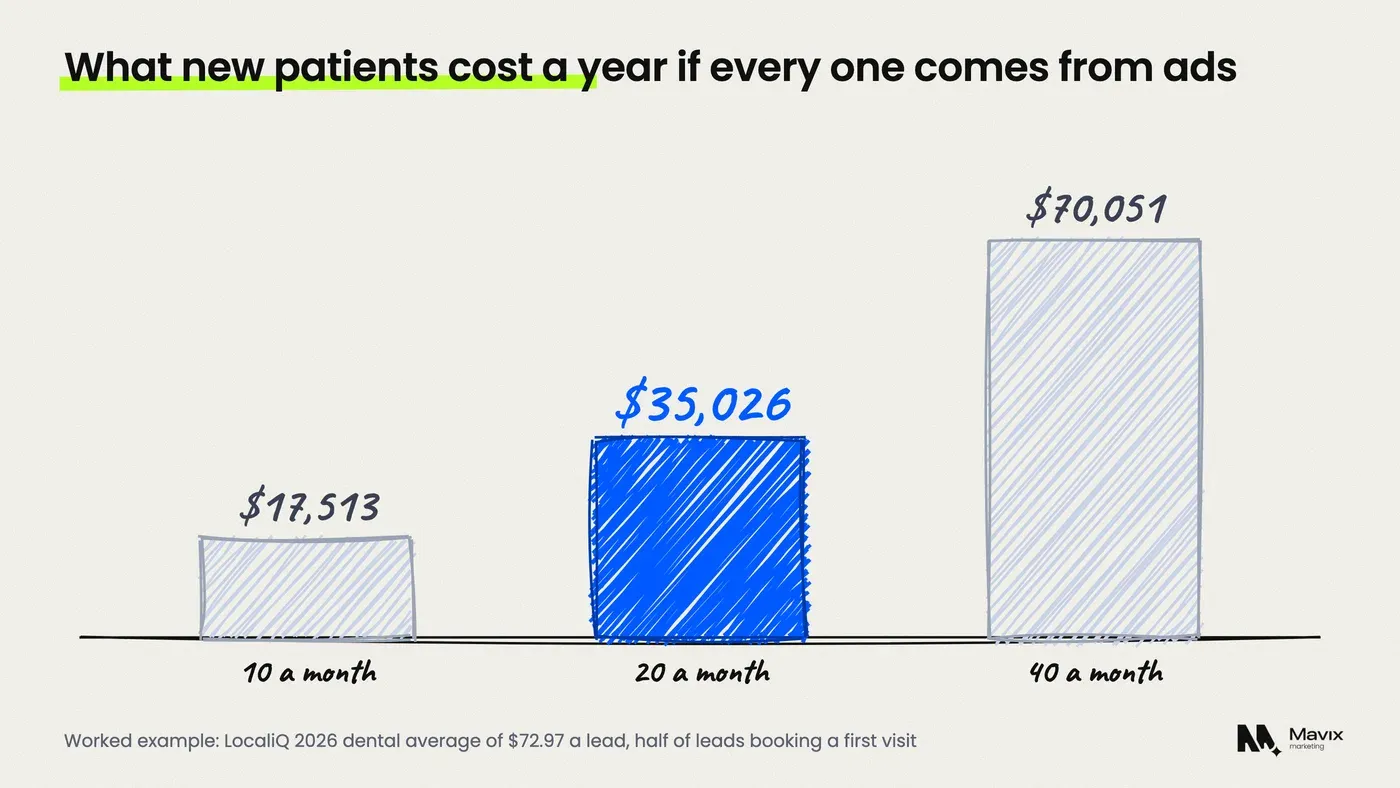
A dental lead from Google Ads averaged $72.97 in LocaliQ’s 2026 benchmarks, at $8.00 a click and a 10.67 percent conversion rate (LocaliQ). If half of those leads book a first visit, each new patient costs about $146 in ad spend, every time.
| New patients a month | Ad spend a month (half of leads book) | Ad spend a year |
|---|---|---|
| 10 | $1,459 | $17,513 |
| 20 | $2,919 | $35,026 |
| 40 | $5,838 | $70,051 |
The table shows what SEO is competing with. Patients who arrive from the map and the regular results cost no click price, so the value of dental SEO is roughly the ad spend it replaces, minus what the SEO work costs. Most practices still run both: Google Ads for treatments that need patients now, SEO for the demand that builds over months. The paid side is covered in Google Ads for dentists.
Where dental SEO goes wrong
Most failed dental SEO comes from shortcuts or from expecting results too soon:
- Expecting it in weeks. New pages often take months to rank. See how long SEO takes before judging it.
- Copied treatment pages from a template or a supplier, the same text on hundreds of practice sites.
- Fake authority. Stock photos presented as your team, or articles credited to a dentist who never read them.
- Keyword-stuffed profile names such as “Smile Dental Best Dentist Houston”, which Google’s guidelines forbid and can lead to suspension.
- Bought or filtered reviews, which Google can remove and penalise.
For the market behind these numbers, the dental marketing statistics for 2026 collect the sourced figures in one place.
Questions people ask about dental SEO
How long does dental SEO take to bring new patients?
Expect the first movement in the map results within a few months if the Business Profile and reviews were weak, and longer for treatment pages in a competitive city. There is no fixed timeline, because it depends on how strong nearby practices are. Judge it on new patient calls and bookings from Google each month, not on rankings alone.
How much does dental SEO cost?
Costs depend on the number of locations, how many treatment pages need writing and how competitive the city is. Compare the monthly fee with what the same new patients would cost through Google Ads, at about $146 each on LocaliQ’s 2026 averages if half of leads book. Our SEO pricing page shows what each level includes.
Should every dentist in the practice have a Google Business Profile?
Only public-facing dentists whom patients can contact directly at the practice during set hours, according to Google’s guidelines. Each profile should use the dentist’s name only. Profiles can help a dentist who patients search for by name, but they split reviews, so decide deliberately rather than creating them for everyone.
Can a dental practice reply to patient reviews on Google?
Yes, and it should reply to all of them, but without any patient information. Do not confirm the person is a patient or mention treatment, dates or insurance. The Elite Dental Associates settlement in 2019 came from replies that did exactly that. Keep replies short and move the conversation to a phone call.
Does a dental practice need a blog for SEO?
Not first. Treatment pages, dentist bios and the Business Profile bring more new patients than blog posts. A blog helps later when it answers real patient questions, such as how long an implant takes to heal, and links to the treatment page, written or reviewed by a named dentist.
What is the difference between dental SEO and local SEO?
Local SEO is the map side: the Business Profile, reviews, categories and listings. Dental SEO covers that plus the website: treatment pages, dentist bios, structured data and the trust signals Google expects on health pages. A practice that only does local SEO misses patients who research treatments before they pick a dentist.
The bottom line
Build one strong page for each treatment you want more of and put a real dentist’s name and credentials behind it. Set up profiles the way Google’s rules allow, and reply to every review without a single patient detail. Then measure it against what the same patients would cost in ads. That number tells you what dental SEO is worth to your practice.
If your practice ranks on the map but new patients are not booking treatments, get your dental SEO checked for free. You get a written list of the pages, profile fixes and review steps that would bring more new patients, usually within one working day.
Free review
Want this looked at on your own site?
Send the address. A person reads it and writes back with the two or three things that would move your enquiry number first. Free, and yours to keep whether you hire us or not.