Google Ads Quality Score: what the three parts measure, how to raise each one, and when to ignore the number
Quality Score is a 1 to 10 diagnosis Google says is not used in the auction. What each of its three parts means, how to fix a low one, and when to leave it.
Google Ads Quality Score is a 1 to 10 rating for each keyword that compares your ads and landing page with other advertisers on the same searches. Google calls it a diagnostic tool and says it is not an input in the ad auction. Use it to find weak ads and pages, then judge keywords on cost per lead, not on the score.
This page is for owners of local businesses who run Google Ads, or pay someone to, and have seen low numbers in the Quality Score column. It explains the three parts, what each one changes, how to raise a low one, and the myths that send people chasing the wrong thing.
The short version
- Quality Score runs from 1 to 10 per keyword and is built from three parts: expected click-through rate, ad relevance and landing page experience.
- Each part is rated above average, average or below average against other advertisers whose ads showed for the same search over the last 90 days, according to Google.
- Google says Quality Score “is not an input in the ad auction”. The auction uses real-time quality signals that the score summarises.
- Higher ad quality can win a higher position at a lower price, and you only pay what is needed to beat the advertiser below you.
- A keyword with a low score and a low cost per lead is a good keyword. Fix the parts, but never pause a keyword that makes you money because of its score.
What is Quality Score in Google Ads?
Quality Score is a rating from 1 to 10 that Google shows for each keyword in a Search campaign. Google describes it as “a diagnostic tool meant to give you a sense of how well your ad quality compares to other advertisers” (Google Ads Help). A higher score means your ad and page look more useful to people searching that keyword than most competitors’ do.
You see it by adding the Quality Score columns to the keywords view in your account. A dash instead of a number means there are not enough searches that exactly match the keyword to give a score yet. That is common in small local accounts, where many keywords get a handful of searches a month.
Quality Score applies only to keywords in Search campaigns. Performance Max and Display campaigns have no Quality Score, and neither do individual ads.
What are the three parts of Quality Score?
Quality Score is built from three parts, each rated above average, average or below average. Expected click-through rate is how likely your ad is to be clicked when shown. Ad relevance is how closely the ad matches the intent behind the search. Landing page experience is how relevant and useful the page is to people who click, according to Google’s Quality Score help page.
| Part | What Google measures | What usually causes “below average” | First fix |
|---|---|---|---|
| Expected click-through rate | How likely your ad is to be clicked for this keyword | A generic ad, no price or offer, an ad that does not mention the service searched | Put the service and a reason to call in the first headline |
| Ad relevance | How closely the ad matches what the searcher wants | One ad group holding unrelated keywords, such as “drain cleaning” and “water heater install” | Split the ad group so each one has one service |
| Landing page experience | How relevant and useful the page is after the click | Sending every ad to the homepage, slow pages on mobile, no clear way to call | Send each ad group to the page for that service |
The table shows that each part points at a different thing to change. Expected click-through rate is about the ad text. Ad relevance is about how the account is grouped. Landing page experience is about the website.
Does Quality Score affect what you pay per click?
Indirectly, yes. Google says Quality Score itself is not used in the auction, but the same quality signals it summarises feed Ad Rank, which decides whether and where your ad shows. Ad Rank uses your bid, the quality of your ads and landing page, Ad Rank thresholds, the search context and the expected impact of assets (Google Ads Help).
Better quality lowers cost through how the price is set. Google says your actual cost per click is often less than your maximum bid. You you only pay what is needed to clear the Ad Rank thresholds. You also need to beat the Ad Rank of the competitor just below you (Google Ads Help). The same page on Ad Rank says you can “win a higher position at a lower price” with highly relevant keywords and ads.
Google publishes no table of how much a higher score saves you per click.
Tables that say a score of 10 cuts your cost per click in half, or a score of 1 multiplies it, come from tool vendors and agency blogs, not from Google. None publishes a method you can check. Treat them as rough illustrations at best.
How do you raise each part of Quality Score?
Fix the part rated below average first, and change one thing at a time so you can see what worked. Google’s own advice is in its page on using Quality Score to improve performance. Group keywords into tight themes and write ads that match the search. Make the landing page deliver what the ad promised.
- Group keywords by service. One ad group per service you sell: “emergency plumber”, “drain cleaning”, “water heater repair”. Google’s example is separate groups for “engagement rings” and “wedding bands”. This is the biggest lever on ad relevance. Keyword clustering shows how to sort a list into groups.
- Write the ad for that group. Put the service in the first headline, then a reason to choose you: a price, a response time, a guarantee, a review count. Specific ads raise expected click-through rate.
- Send each ad group to its own page. A drain cleaning ad should land on a drain cleaning page with a phone number at the top. Google says the exact search phrase does not need to appear word for word on the page. The page just needs to be about it. Landing pages for Google Ads covers what that page needs.
- Make the page fast and easy on a phone. Google lists mobile-friendliness and loading speed among the landing page fixes.
- Cut searches that do not fit. Keywords that match unrelated searches drag click-through rate down. Check the search terms report and add negative keywords for home services.
- Wait before judging. The ratings compare the last 90 days, so a change takes weeks to show. Check again after a month.
What is a good Quality Score?
A good Quality Score is one where none of the three parts is rated below average, because Google does not publish a target number or how the parts add up to the score. Read the three ratings, not the total. And the best test of a keyword is still whether it brings leads at a cost you can afford, whatever the number.
Expected click-through rate is judged against other advertisers on the same search, and click-through rates differ a lot by trade. LocaliQ’s 2025 home services benchmarks, across 3,211 US campaigns, put the median click-through rate at 4.97 percent for plumbing and 10.04 percent for window cleaning (LocaliQ). A plumber with a 6 percent click-through rate may be doing well; a window cleaner with the same rate may not.
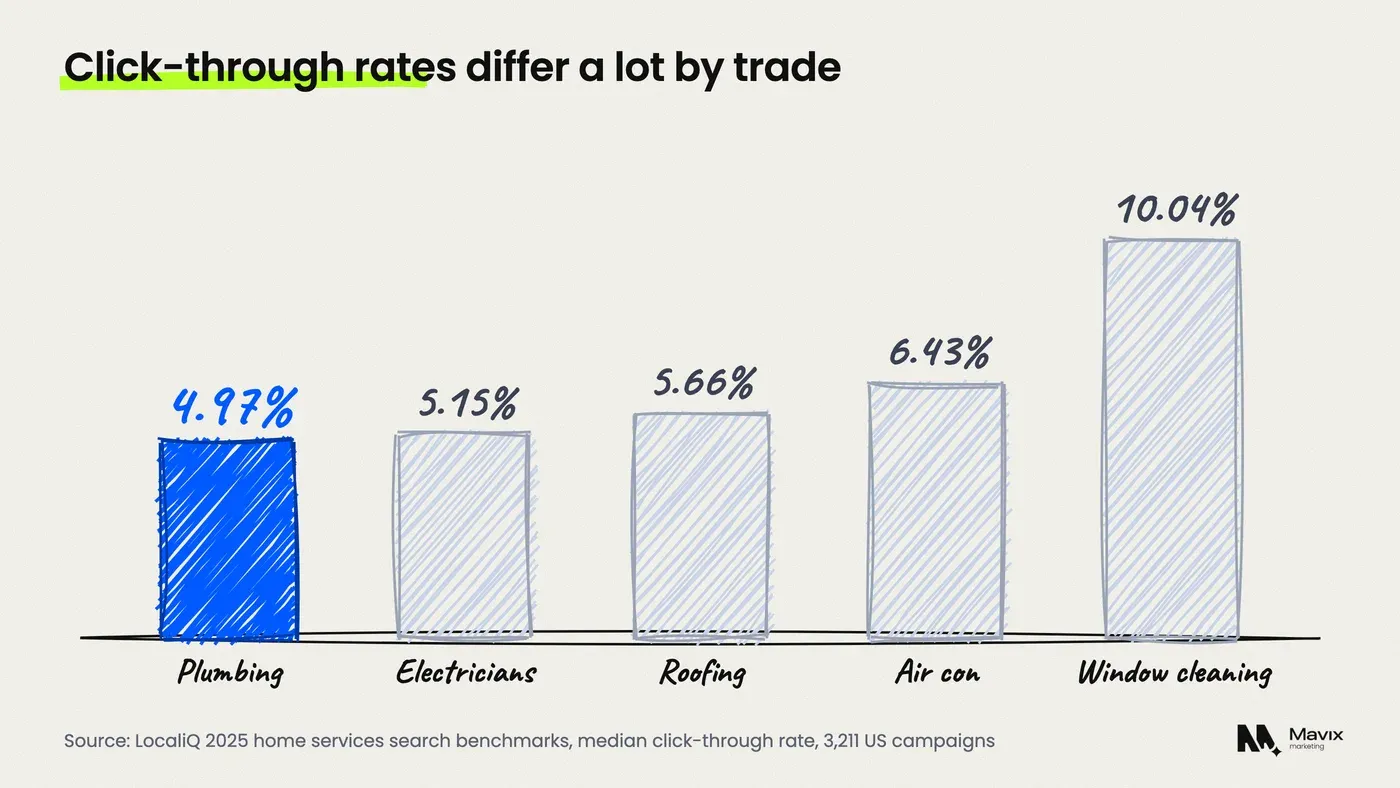
That is why comparing your score with a friend’s in another trade tells you nothing. The score is relative to the advertisers you compete with on your searches.
When should you ignore Quality Score?
Ignore it when the keyword brings leads at a cost per lead you are happy with. Google says plainly that “Quality Score is not a key performance indicator”, and its improvement guide calls it a general indicator of where to focus “rather than a score to be optimized”. A score measures how your ad compares with others. It does not measure whether the clicks turn into jobs.
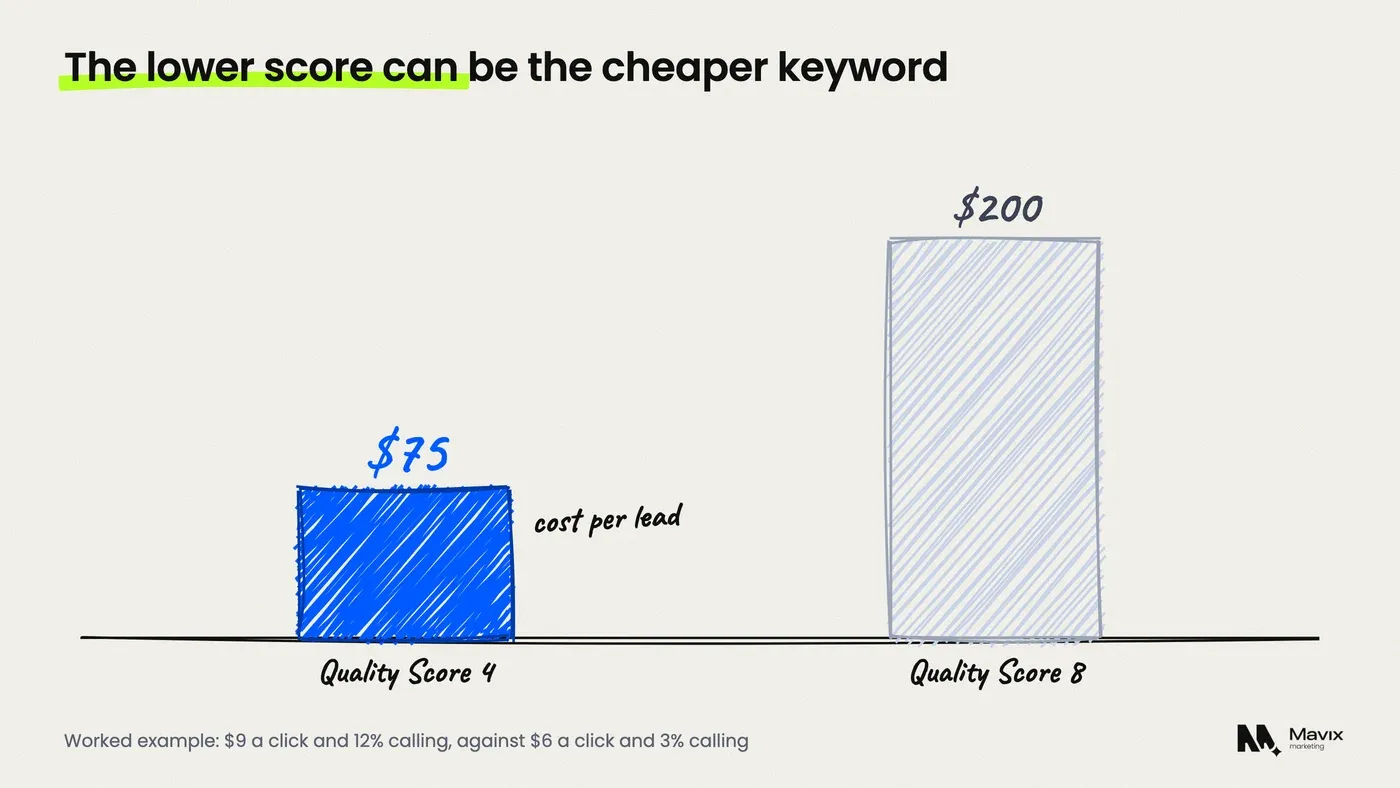
A worked example with two keywords in the same plumbing account:
- Keyword A has a Quality Score of 4. Clicks cost $9 and 12 percent of clicks call. That is $9 divided by 0.12, or $75 a lead.
- Keyword B has a Quality Score of 8. Clicks cost $6 and 3 percent of clicks call. That is $6 divided by 0.03, or $200 a lead.
Keyword A is the better keyword by a wide margin, despite the lower score. A searcher typing “burst pipe plumber now” may click fewer ads than one typing “how to fix a pipe”, but far more of them call. Pausing Keyword A to tidy the score would cost you leads.
Also ignore it when the score shows a dash or swings on tiny volume. A keyword with 30 searches a month does not have enough data for the score to mean much. Judge the ad group instead. If clicks arrive and calls do not, the score is rarely the reason: work through why Google Ads clicks do not turn into leads.
Common Quality Score myths
Most bad advice about Quality Score comes from treating it as the thing Google uses to price your clicks. It is a summary of past performance on exact searches, shown to help you. These are the myths that cost local advertisers the most.
- “Quality Score decides my ad position.” Google says it is not an input in the auction. Ad Rank is worked out in real time from your bid and quality signals at that moment.
- “My Ad Strength rating is my Quality Score.” No. Google says Ad Strength is a feedback tool for responsive search ads and is not used to calculate Ad Rank, Quality Score or auction wins (Google Ads Help).
- “Pause every keyword under 5.” Only if it also has a poor cost per lead. Many low-score keywords convert well.
- “The keyword must be repeated on the landing page.” Google says the exact phrase does not need to appear word for word. The page must be about the service.
- “A score of 10 halves my cost per click.” Google publishes no such figure.
A Google Ads audit checklist puts Quality Score in its place: one check among many, below tracking and search terms. To see what a change in cost per lead is worth to you, run it through the Google Ads ROI calculator.
Your account may show low scores across the board and you may not know where to start. A Google Ads management service can restructure the ad groups and pages in order of what costs you most.
Questions people ask about Google Ads Quality Score
Why does my keyword show a dash instead of a Quality Score?
A dash means there have not been enough searches that exactly match that keyword to calculate a score. It is common for local businesses with small search volumes and for new keywords. Google suggests broadening the match type, explained in Google Ads match types, or choosing keywords with more searches. A dash does not stop the ad showing or mean anything is wrong.
How long does it take to improve Quality Score?
Expect weeks, not days. The three parts are rated against other advertisers over the last 90 days, so a new ad or landing page needs enough fresh impressions and clicks to move the average. Make one change, give it about a month of normal traffic, and then compare. Small local keywords with few searches move slowest.
Does Quality Score affect Performance Max campaigns?
No. Quality Score exists only for keywords in Search campaigns. Performance Max, Display and video campaigns have no Quality Score column. Ad and landing page quality still matter in those campaigns, because a clear, relevant page helps any ad that sends traffic to it, but there is no 1 to 10 number to read.
Is there an account-level Quality Score?
Google shows Quality Score only per keyword, in the keywords view of your account. It does not show an account score. A tidy, well-grouped account tends to have better scores across the board because each ad matches its keywords and page, not because of a hidden account grade.
Can a high bid make up for a low Quality Score?
Partly. Ad Rank uses both your bid and your ad quality, so a higher bid can win a position a low-quality ad would otherwise lose. You pay for it, though, since a weaker ad has to bid more to beat a stronger one below it. Raising quality is usually the cheaper route over a few months.
Should I hire someone just to improve Quality Score?
No. Hire for cost per lead and booked jobs, not for a score. An account manager who reports better Quality Scores but no change in lead cost has improved a diagnostic number. Ask for the cost per lead before and after any change, by keyword and ad group.
The bottom line
Read Quality Score as a list of which ads and pages to fix first, starting with any part rated below average. Group keywords by service, write each ad for its group and send it to its own page. Then judge every keyword on cost per lead, and keep the low-score ones that make you money.
If your account is full of low scores and you want to know which ones cost you, get your Google Ads account checked for free. You get a written list of the ad groups, ads and pages to fix, in order of what they are costing you, usually within one working day. The ads pricing page shows what ongoing management costs.
Free review
Want this looked at on your own site?
Send the address. A person reads it and writes back with the two or three things that would move your enquiry number first. Free, and yours to keep whether you hire us or not.