Speed to lead: how fast you must answer a new enquiry, what the studies found, and simple ways to get there
Most businesses take hours to answer a web lead. What six sources found about response time, what a slow reply does to your cost per job, and the fixes.
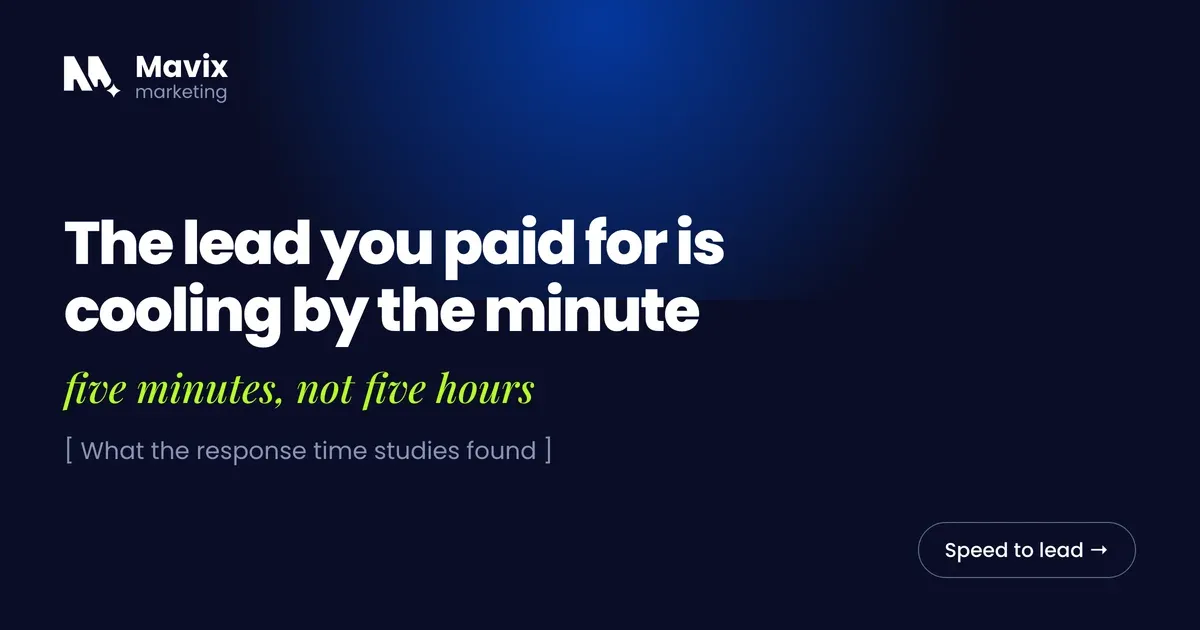
Answer a new web lead within five minutes if you can, and within the hour at the latest. An InsideSales and MIT study of over 15,000 leads found the odds of reaching a lead fell 100 times between a five minute and a thirty minute call back. A 2011 Harvard Business Review audit found only 37 percent of firms replied within an hour.
This page is for owners and office managers of local businesses who pay for leads through ads, a website or a directory. It sets out what each study measured and how big its sample was. It also covers what a slow reply does to your cost per booked job, and the simple setups that get a reply out in minutes.
The short version
- In the InsideSales and MIT Lead Response Management study, the odds of contacting a web lead were 100 times higher at five minutes than at thirty. The odds of qualifying it were 21 times higher.
- A 2011 Harvard Business Review audit of 2,241 US companies found 37 percent answered a web lead within an hour, 23 percent never answered, and the average reply among the rest took 42 hours.
- A secret-shopper test of 466 US home services companies by Valve+Meter found 40 percent never replied to a service request within five days.
- Invoca’s 2026 home services benchmarks found only 52 percent of inbound calls were answered by a person.
- Google ranks Local Services Ads partly on your responsiveness and average response time, and says missed calls may count against you.
What is speed to lead?
Speed to lead is the time between a person sending you an enquiry and your first real contact with them, by phone, text or message. It is measured in minutes from the moment the form arrives, not from when someone opens the inbox. A business can have a speed to lead of four minutes on weekdays and fourteen hours over a weekend.
The reason it matters is simple. A person who fills in a form for a plumber, a roofer or a dentist has usually sent the same request to two or three others. A 2026 survey for the call answering firm Moneypenny covered 2,000 consumers and 500 building trade companies. In it, 83 percent of US consumers said they choose the business that responds first (Contracting Business). That is a vendor survey, so treat the exact figure with care, but the direction matches every study below.
How fast should you respond to a new lead?
Within five minutes is the target the research supports, and within one hour is the outer limit. The InsideSales and MIT study found the odds of contacting a lead dropped by over 10 times in the first hour, and the odds of qualifying it by over 6 times. It also found that after 20 hours, extra call attempts made reaching the lead less likely, not more (Lead Response Management study).
For a local service business, five minutes in practice means:
- a phone alert the second a form arrives, not an email someone checks at lunch
- one named person, or a rota, who calls every new lead
- an automatic text that tells the person you have the request and when you will call
- a second and third call attempt if the first goes to voicemail
The hour limit matters more than it looks. Most of the harm in the research happens inside the first hour, so a reply at 50 minutes and a reply the next morning are not equally bad. The next morning is far worse.
What do the speed to lead studies actually say?
Six sources are quoted most often, and they measure different things. Two are research studies of lead data, one is an audit of how fast companies reply, and one is a secret-shopper test in home services. One is call data from a tracking platform, and one is Google’s own ranking policy. None of them measured booked jobs directly, which is a limit worth keeping in mind.
| Source | Sample | What it found |
|---|---|---|
| InsideSales and MIT Lead Response Management study (2007) | Over 15,000 web leads and 100,000 call attempts at six companies, three years of data | Odds of contact 100 times higher at 5 minutes than 30; odds of qualifying 21 times higher |
| Harvard Business Review, Oldroyd, McElheran and Elkington (2011) | Test leads sent to 2,241 US companies; 1.25 million leads at 42 companies | 37% replied within an hour, 23% never; firms replying within an hour nearly 7 times as likely to qualify the lead |
| Valve+Meter secret-shopper test | Service requests sent to 466 US home services companies, tracked for five days | 40% never replied; 95% did not reply within five minutes; 85% did not try a second call |
| Invoca home services benchmarks (2026) | Calls tracked on Invoca’s platform across nine home services segments | 52% of calls answered by a person; 55% of businesses do not ask the caller to book |
| Moneypenny survey (2026) | 2,000 consumers and 500 building trade companies | 83% of US consumers choose the business that responds first |
| Google Local Services Ads ranking policy | Google’s published ranking factors | Responsiveness and average response time affect ad ranking |
The table shows the same pattern from every angle: most businesses reply slowly or not at all, and the ones that reply fast do better. The two research studies used “qualified”, meaning a real conversation with someone ready to buy, not a booked job.
The Harvard Business Review audit is the one most often misquoted. Its authors found firms that tried to contact a lead within an hour were nearly seven times as likely to qualify it as firms that tried an hour later. They were more than 60 times as likely as firms that waited 24 hours or more (Harvard Business Review). The “five minutes, 100 times” figure comes from the earlier InsideSales and MIT study, not from this one.
How fast do home services businesses actually reply?
Slowly, and often not at all. In Valve+Meter’s secret-shopper test, service requests went to 466 US home services companies of all sizes and the replies were timed for five days. Forty percent never replied, 95 percent did not reply within five minutes and 71 percent did not reply within an hour (Valve+Meter study). Valve+Meter is a marketing firm, so read it as a test with a stated method, not a census.
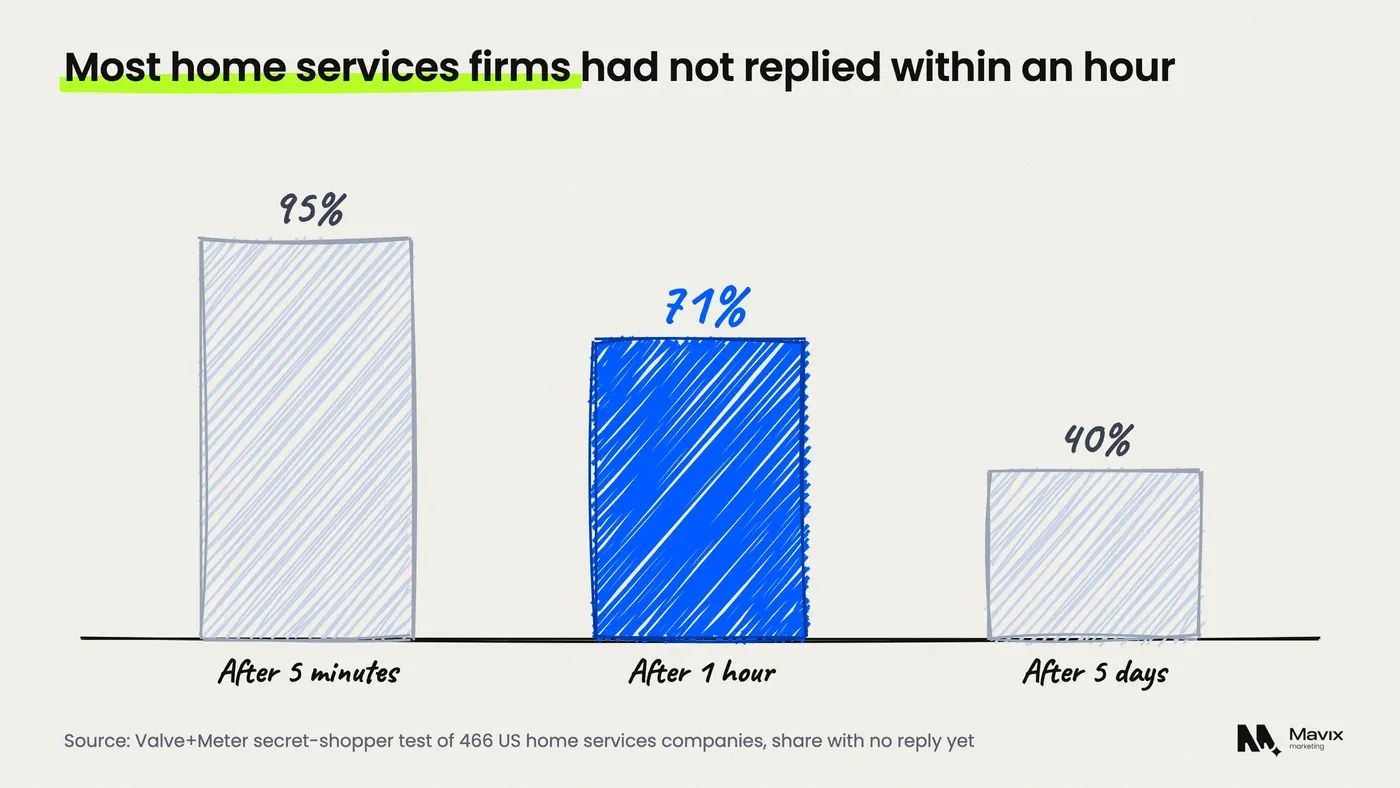
The same test found 85 percent of companies did not try a second call, and the fastest reply came in 2 minutes while the slowest took 5 days, 19 hours and 9 minutes. The gap between the best and the worst is the opportunity: the fast firms are taking jobs the slow ones paid to generate.
Phone calls leak too. Invoca’s 2026 home services benchmarks found 52 percent of inbound calls were answered by a person. The rate rose to 65 percent when calls under 15 seconds were left out. Answer rates ranged from 32 to 74 percent across its nine segments (Invoca). The cost of those unanswered calls is the subject of what missed calls cost a local business.
What does a slow reply cost you?
A slow reply costs you the share of leads that would have booked and went to a competitor instead, and you have already paid for every one of them. The simplest way to see it is cost per booked job: what you spend on leads, divided by the jobs they turn into. When slow replies cut your booking rate, your cost per job rises even though your ad spend stays the same.
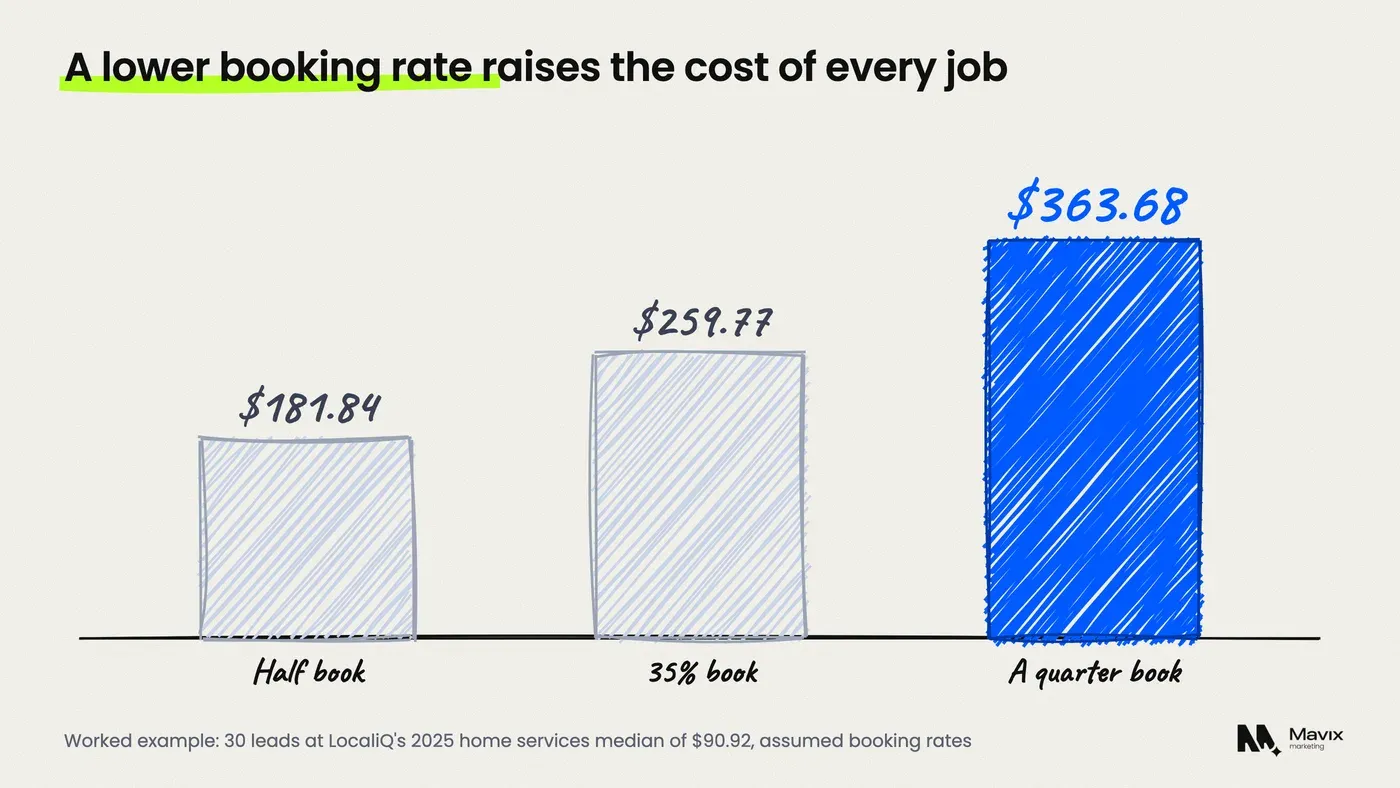
A worked example for a home services business buying leads from Google Ads at LocaliQ’s 2025 home services median of $90.92 a lead (LocaliQ), with 30 leads a month:
- 30 leads at $90.92 cost $2,727.60 a month.
- If 1 in 2 leads books, that is 15 jobs at $181.84 each.
- If slow replies drop that to 35 in 100, it is 10.5 jobs at $259.77 each.
- If they drop it to 1 in 4, it is 7.5 jobs at $363.68 each.
The booking rates here are assumptions for illustration. No study above measured how much a one-hour delay cuts bookings for your trade, and the answer will differ by job. What the arithmetic shows is the shape: halving the booking rate doubles what each job costs you, with no change to the ads.
Put your own numbers through the lead generation calculator, and track the first-reply time next to each lead in a lead tracking spreadsheet. After a month you will see your own curve.
Before raising ad spend, check how fast the leads you already pay for get a reply.
How does response time affect Google Local Services Ads?
Google uses it to rank your ad. Google’s Local Services help lists “your responsiveness to customer inquiries and requests” as a ranking factor and says missed calls may count against it. Average response time is also part of profile quality, beside your rating and reviews, and Google says higher quality profiles may rank higher and pay less per lead (Local Services Help).
That makes speed to lead a cost lever as well as a sales one. A slow business pays for the leads it loses and ranks lower for the next ones. Missed calls during your business hours can also be charged as leads. That happens if the caller stays on the line for more than 20 seconds, according to Google’s page on how Local Services leads work. For more on how these ads compare with search ads, see Local Services Ads vs Google Ads.
How can a small business answer leads faster?
Most of the gain comes from five setups that cost little and need no new staff. The aim is that every lead gets a human reply in minutes during working hours, and an honest automatic reply outside them. Set them up in this order, because each one depends on the one before it.
- Send every lead to a phone. Forms, Facebook lead ads and directory messages should trigger a text or app alert to the person who calls back, not just an email to a shared inbox.
- Send an automatic text. A short message such as “Thanks, this is Sam at the company. I will call you in the next 10 minutes” stops the person filling in the next form. Add a line on your form saying you will reply by text.
- Name who calls, and who covers. One person owns new leads each day, with a named backup for lunch, site visits and days off.
- Use a call-back cadence. Valve+Meter’s suggested pattern is calls at 1, 4 and 7 minutes, then 1 hour and 4 hours, then twice a day for the next few days. Stop when they answer or ask you to.
- Cover the hours you cannot. An answering service or a call forwarding rule for evenings and weekends, and ads scheduled to the hours someone picks up.
Measure it once a week: the median minutes from lead to first contact, and the share of leads never reached. If the form itself is losing people before they send it, start with the conversion audit checklist.
Which lead sources need the fastest reply?
Leads from forms people fill without much thought need the fastest reply, because they cool quickest. A Facebook lead ad form can be sent in seconds without leaving the app, and the person may not remember you an hour later. A caller who searched, read your reviews and rang is warmer, but if the call is missed they will usually ring the next business on the list.
| Lead source | How it arrives | Target first reply | Main risk |
|---|---|---|---|
| Phone call from ads or Google Business Profile | Live call | Answer it live | Missed calls and voicemail |
| Local Services Ads message or call | Google app or call | Under 5 minutes | Lower ad rank if slow |
| Website form | Email or CRM | Under 5 minutes | Sits in an inbox |
| Facebook lead ad form | Meta Leads Center or CRM | Under 5 minutes | Person forgets they asked |
| Directory or marketplace lead | Platform message | Under 5 minutes | Sent to several firms at once |
The table shows that only the phone call has a natural alert. Every other source needs you to build one. If your Facebook leads go cold, the choice between a form and a page is covered in Meta lead ads vs a landing page. The wider comparison of the two platforms is in Facebook ads vs Google Ads for a local business.
When speed to lead is not the problem
Speed helps only when the leads are real and the reply is good. If most of your enquiries are spam, people outside your area or people looking for something you do not sell, answering them faster changes little. Fix the targeting first: if ads bring clicks and no real enquiries, work through why Google Ads clicks do not turn into leads.
Two more limits. The famous studies are old: the InsideSales work is from 2007 and the Harvard Business Review audit from 2011, and both looked mainly at sales leads, not trades. And a fast reply that does not ask for the booking wastes the speed. Invoca’s 2026 data found 55 percent of home services businesses did not ask callers to buy or book. Speed gets you the conversation. What you say in it gets the job.
A lead generation service that tracks first-reply time beside cost per lead shows both sides of this in one report. You can then see whether the leak is in the ads or in the follow-up.
Questions people ask about speed to lead
Is the five minute rule for leads real?
It comes from the InsideSales and MIT Lead Response Management study, which looked at over 15,000 leads. It found the odds of contacting a lead were 100 times higher when called within five minutes than within thirty. It measured contact and qualification, not sales, and it is from 2007. The direction has held in every later study, so treat five minutes as a target, not a law.
What is a good average lead response time?
Under five minutes during business hours is good, and under one hour is the minimum worth accepting. In the Harvard Business Review audit of 2,241 companies, only 37 percent replied within an hour and the average among those that replied at all was 42 hours. A business that replies in minutes is ahead of most of its market.
Does an automatic email count as responding to a lead?
It helps, but it is not the same as contact. An automatic email or text tells the person you have their request and stops them feeling ignored. The research measured real contact, meaning a conversation. Use the automatic reply to buy a few minutes, then call. A text tends to be seen faster than an email.
How many times should you call a new lead?
More than once. Valve+Meter’s home services test found 85 percent of companies did not try a second call. A sensible pattern is three tries in the first ten minutes, then one after an hour, then twice a day for a few days. The InsideSales and MIT study found extra calls after about 20 hours started to hurt contact rates, so front-load the attempts.
What should I do with leads that come in at night?
Send an automatic text straight away saying when you will call, and call first thing when you open. If night calls are urgent work, such as burst pipes or no heat, use an answering service or a forwarding rule to a phone on call. Schedule ads for emergency work only to the hours someone can pick up.
Does response time affect my Google ranking?
For Local Services Ads, yes. Google lists responsiveness and average response time among the factors that rank your ad, and says missed calls may count against you. For the normal map results and Google Business Profile, Google does not list response time as a ranking factor, but slow replies still cost you the jobs.
The bottom line
Measure your real response time this week, from form to first conversation, before you spend another dollar on leads. If it is over an hour, fix the alert, the owner and the call-back pattern first. Faster replies are the cheapest way to lower your cost per booked job.
If you want to know how many of the leads you pay for are going cold, get your lead flow checked for free. You get your real first-reply time, the share of leads never reached and the fixes in order, usually within one working day. The conversion optimization service covers the form and the page if the leak starts there.
Free review
Want this looked at on your own site?
Send the address. A person reads it and writes back with the two or three things that would move your enquiry number first. Free, and yours to keep whether you hire us or not.