Local SEO vs SEO: the map pack, the organic results, and which one your business should pay for first
Local SEO wins the map results near your customers; SEO wins the list of websites below. What each one ranks on, what it costs, and which your business needs.
Local SEO is the work that gets a business into Google’s map results for searches near its customers. SEO, meaning search engine optimization, is the work that gets a website into the ordinary list of results below. A business that serves a place, such as a plumber or a dentist, needs local SEO first. A business that sells to anyone, anywhere, needs SEO.
This page is for owners who have been quoted for “SEO” or “local SEO” and want to know which one they are paying for and which one they need. It covers what each one ranks on, how the two overlap, what each costs, and a table by business type.
The short version
- Google ranks local results on relevance, distance and prominence, and says there is no way to pay for a better local ranking.
- In Whitespark’s 2026 survey of 47 local search experts, the top map pack factor was the primary Google Business Profile category. The top local organic factor was a dedicated page for each service.
- A service business with customers in one area should start with local SEO: the Google Business Profile, reviews and a page for each service.
- An online store or a business selling nationwide gains little from the map pack and needs SEO: content, technical health and links.
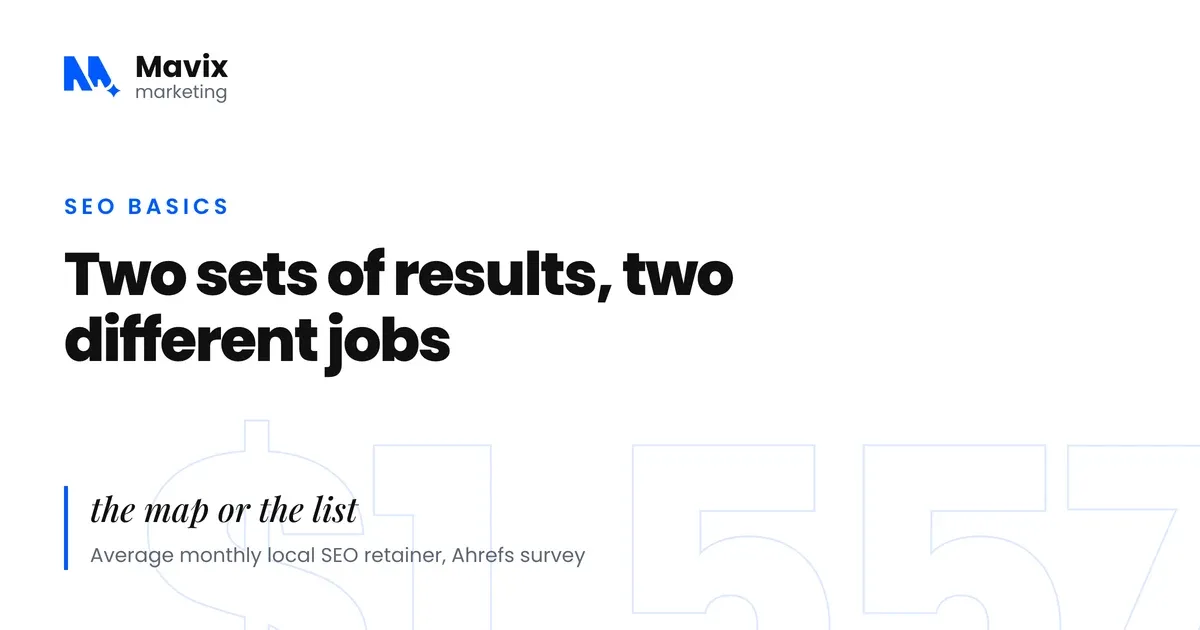
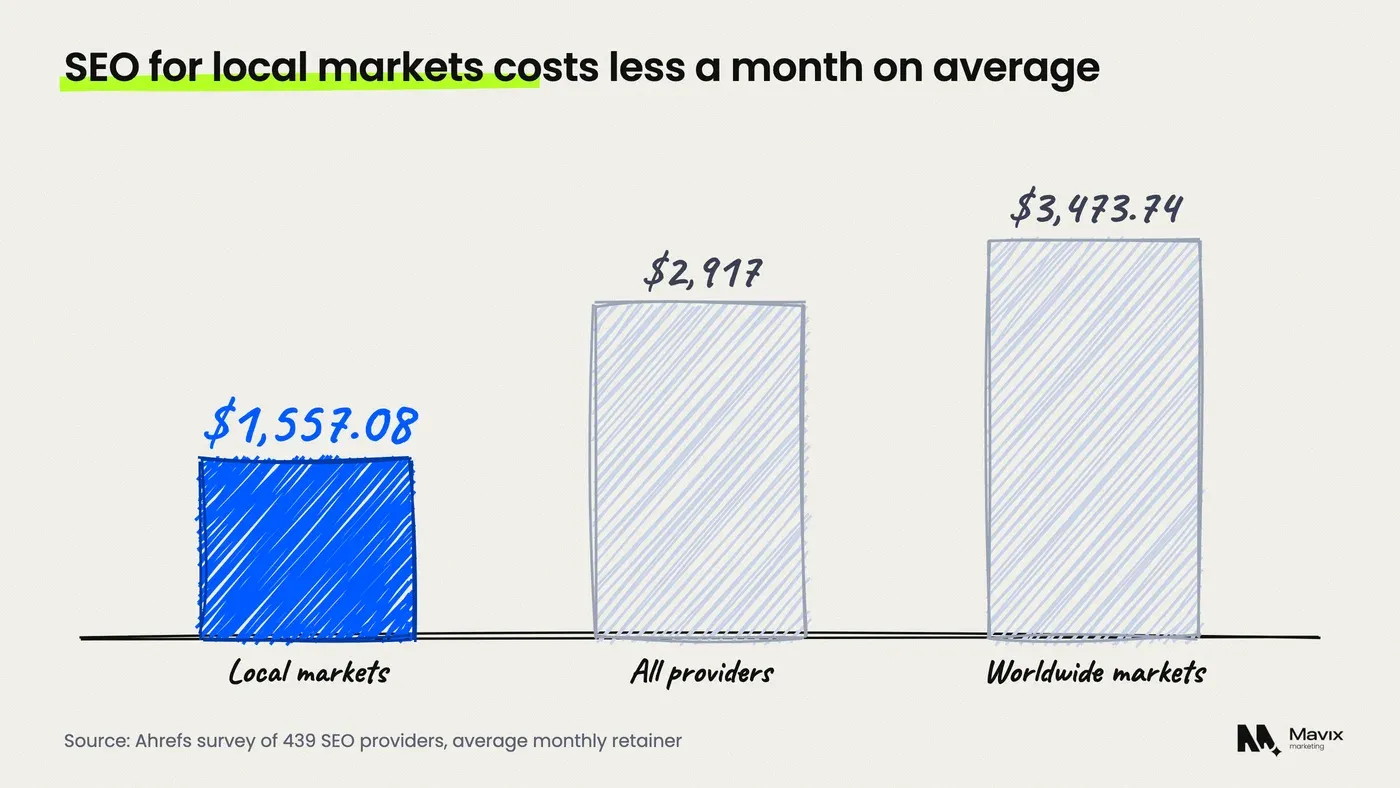
- Ahrefs’ survey of 439 SEO providers found those serving local markets charged an average $1,557 a month, against $3,473.74 for those serving worldwide markets.
What is the difference between local SEO and SEO?
Local SEO aims at the map results, the block of businesses with a map that Google shows for searches like “dentist near me” or “plumber Austin”. SEO aims at the organic results, the list of web pages under it. Local SEO works mostly on your Google Business Profile and reviews. SEO works mostly on your website: its pages, its speed and the links pointing to it.
| Local SEO | SEO | |
|---|---|---|
| Where you appear | The map pack and Google Maps | The organic list of web pages |
| Who sees it | Searchers near you or naming your area | Anyone searching the topic |
| Main asset | Your Google Business Profile | Your website |
| What moves it | Category, distance, reviews, profile details, local pages | Content, technical health, links |
| Who needs it most | Businesses that serve a place | Businesses that sell beyond one area |
| Typical result | Calls, direction requests, website visits | Website visits and enquiries |
The table shows two different jobs that share one website. Local SEO is the narrower one, focused on a place and a profile. SEO is the wider one, focused on pages and topics.
How does Google rank businesses in the map pack?
Google ranks local results on three things: relevance, distance and prominence. Relevance is how well your Business Profile matches the search. Distance is how far you are from the person searching. Prominence is how well known the business is, including how many sites link to you and how many reviews you have, according to Google Business Profile Help.
Google also states that “there’s no way to request or pay for a better local ranking”. Ads can appear above the map results, but they do not change where your profile ranks in them.
Distance is the factor you cannot change, which is why a business ranks well near its address and fades a few miles away. Local SEO works on the other two: a profile that matches what people search, and enough reviews and mentions to make the business look established. If your profile does not appear at all, start with why a Google Business Profile is not showing.
What ranks you in the map pack, and what ranks you in organic results?
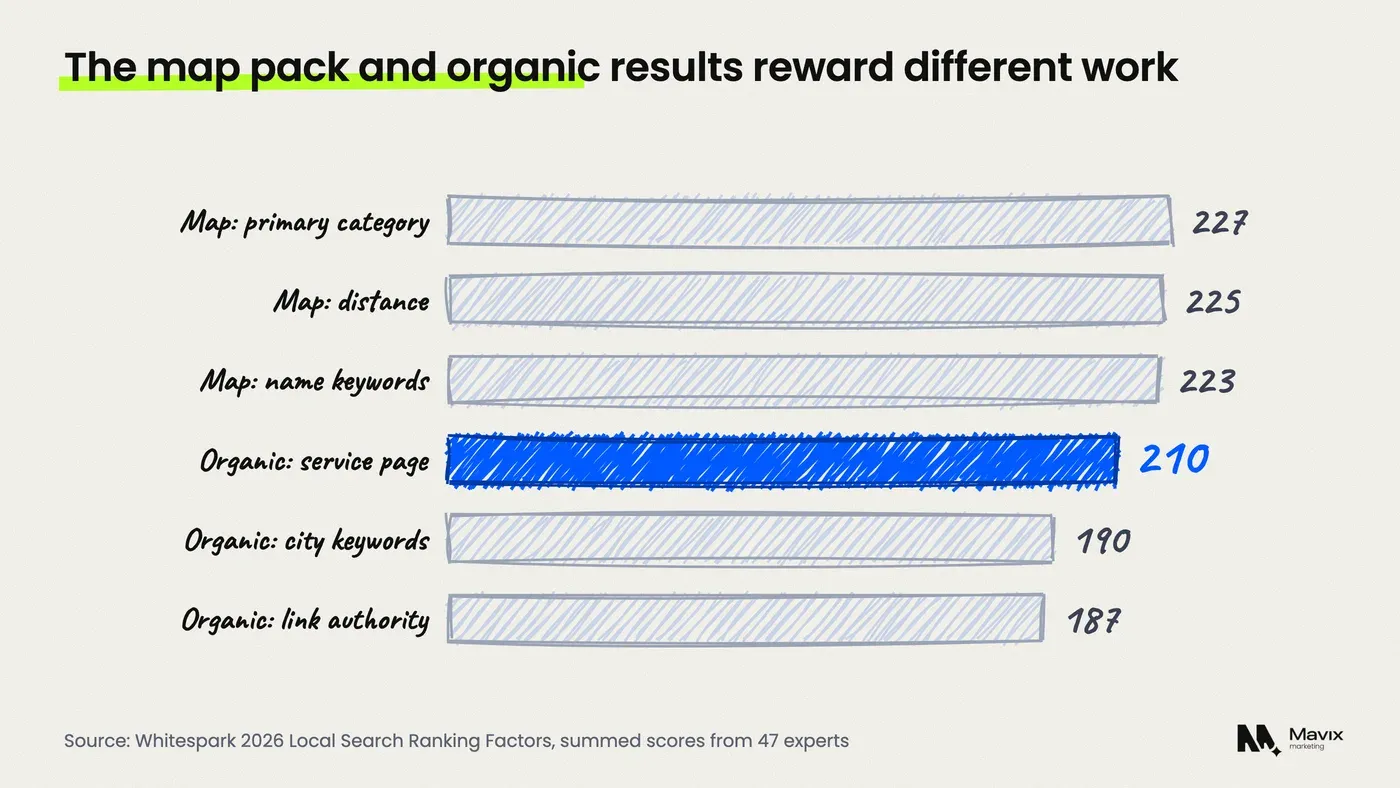
Different things. Whitespark’s 2026 Local Search Ranking Factors survey, in which 47 local search experts scored 187 factors, put Google Business Profile details and distance at the top for the map pack, and website pages and links at the top for local organic results (Whitespark). The scores are expert opinion, not Google data, but the split is consistent.
| Rank | Top map pack factors (score) | Top local organic factors (score) |
|---|---|---|
| 1 | Primary Google Business Profile category (227) | A dedicated page for each service (210) |
| 2 | Distance from the searcher (225) | City or neighborhood keywords in the content (190) |
| 3 | Keywords in the business name (223) | Quality and authority of links to the site (187) |
| 4 | Physical address in the city searched (213) | Keywords in the title tag of the page the profile links to (179) |
| 5 | Business open at the time of search (189) | Links from sites in the same industry (175) |
The table shows almost no overlap in the top five. The map pack rewards the profile and where you are. Organic results reward pages and links. A business can rank first on the map and nowhere in the list below, or the other way round.
One warning about factor 3. Keywords in the business name help, but Google’s guidelines say your name should reflect your real-world business name and that adding unnecessary information “could result in the suspension of your Business Profile” (Google Business Profile guidelines). Change your real name if you want the keyword in it. Never add it only on Google.
Which one does your business need?
If customers come to you, or you go to them within an area, you need local SEO first. If customers buy from you wherever they are, you need SEO and can skip the map. Most local service businesses end up needing both, but the order matters when the budget is small, because the map results usually bring calls sooner.
| Business type | Start with | Why |
|---|---|---|
| Plumber, HVAC, roofer, electrician, pest control | Local SEO | Searches are local and urgent; the map pack takes the first clicks |
| Dentist, med spa, clinic, gym | Local SEO | People choose by distance, reviews and opening hours |
| Law firm or accountant in one city | Both, local first | Map results for “near me”, service pages for specific questions |
| Business with several branches | Local SEO per branch, plus SEO | Each branch needs its own profile and page |
| Online store shipping nationwide | SEO | No map pack for most product searches |
| Software, consulting or online service | SEO | Buyers are not choosing by distance |
The table shows that the question is where your customers are, not how big you are. A one-person locksmith needs local SEO. A ten-person online store does not.
For a store, ecommerce SEO covers product and category pages. For several branches, SEO for multiple locations covers how to give each one a profile and page without them competing.
Where do local SEO and SEO overlap?
They overlap on your website. The page your Google Business Profile links to counts in both, and in Whitespark’s survey keywords in that page’s title tag and headings were among the top local organic factors. Service pages, internal links and a fast site help the map pack indirectly and the organic results directly.
The work that sits in both:
- Service pages. One page per service you sell, named the way customers search. Whitespark’s experts ranked this the top local organic factor.
- Area pages. A page per town or district you serve, with real detail about the work there. Service area pages covers how to write them without copying text across towns.
- Links. Links from local and industry sites feed Google’s prominence for the map and authority for organic results.
- Reviews. Mainly a map pack factor, but they also give your pages words customers use.
Local-only work is the profile itself: category, hours, photos, services, review replies and local citations, meaning listings of your name, address and phone number on other directories. SEO-only work is the wider content and technical side, such as articles for questions people search, site structure and fixing crawl errors. A local SEO service covers the profile work together with the shared website pages, so the two are not paid for twice.
How much do local SEO and SEO cost?
Local SEO usually costs less, because the job is narrower. Ahrefs surveyed 439 SEO providers and found that those serving local markets charged an average $1,557.08 a month, against $3,473.74 for providers serving worldwide markets. The most common retainer across all providers was $501 to $1,000 a month (Ahrefs). Ahrefs’ averages assume each provider charges the top of its price band, so they lean high.
What changes the price is competition and area, not the label. Local SEO for one dentist in a small town is a small job. Local SEO for a roofer covering a whole metro, with many towns and strong competitors, is close to the cost of full SEO. The local SEO cost guide and how much SEO costs break both down, and SEO pricing shows the packages.
When local SEO is not enough
Local SEO is not enough when your best customers search for things the map pack does not show. Questions like “how much does a new roof cost” or “do I need a permit for a water heater” bring up web pages, not map results. A business that only works on its profile misses those searches, and the customers behind them often call the business whose page answered them.
It is also not enough when distance works against you. If your office is at the edge of your service area, the map pack will favour competitors closer to the searcher. Strong service and area pages can still win organic results across the whole area, where distance matters far less.
Three signs you need SEO as well:
- Your profile ranks well near the office but you get few calls from the towns you most want.
- Competitors’ blog posts and guides appear for the questions customers ask you.
- Your website gets little traffic beyond people searching your business name.
Results also take time on both sides. How long SEO takes sets out what to expect month by month.
Questions people ask about local SEO vs SEO
Is local SEO part of SEO?
Yes. Local SEO is a branch of SEO focused on searches with a place in them, either named or implied by the searcher’s location. It adds work SEO does not cover, mainly the Google Business Profile, reviews and directory listings. Most local SEO also includes some website work, because the page your profile links to counts too.
Do I need a website for local SEO?
You can appear in the map pack with only a Google Business Profile, but it is harder to rank and harder to convert. Whitespark’s experts ranked several website factors, such as keywords in the linked page’s title tag, among the top local organic factors. A simple site with one page per service gives the profile something to point to.
Can a service-area business without an office do local SEO?
Yes. Google’s guidelines say a service-area business should hide its address from customers, and it can still rank in the map pack. Distance is still part of the ranking, so it tends to rank best around the location it verified with. Service and area pages on the website help it reach the rest of the area through organic results.
Which is faster, local SEO or SEO?
Local SEO usually moves sooner, because fixing a profile, category and reviews can change map rankings without waiting for new pages and links to build up. Organic SEO for competitive terms tends to take longer, because pages and links build up over time. Neither is instant, and anyone promising first place in weeks is guessing.
Does Google Ads help local SEO?
No. Google says there is no way to pay for a better local ranking, and ads do not change where your profile appears in the map results. Ads can sit above the map pack and bring calls while local SEO builds, which is why many local businesses run both for a while.
Should a small business do local SEO itself?
The profile basics, yes: the right category, full hours and services, photos and replies to every review. That costs time, not money. The website work, links and tracking are where most owners get stuck. The local SEO checklist sets out every step in order, so you can decide which ones to hand over.
The bottom line
If your customers are within driving distance, put your first SEO money into local SEO: the profile, reviews and a page for each service. Add wider SEO when the map pack is working and the questions customers search are going to competitors. If you sell beyond one area, skip the map and go straight to SEO.
If you want to know which one your business needs, get your local search visibility checked for free. You get a written list of where you rank on the map and in the results below, and what to fix first, usually within one working day. For the wider website side, see the SEO service.
Free review
Want this looked at on your own site?
Send the address. A person reads it and writes back with the two or three things that would move your enquiry number first. Free, and yours to keep whether you hire us or not.