Roofing Google Ads cost: what a lead really costs, and what a signed roof costs after it
Roofing leads from Google Ads cost a median $228. See what that means per signed roof, storm versus retail campaigns, Local Services Ads and lead filters.
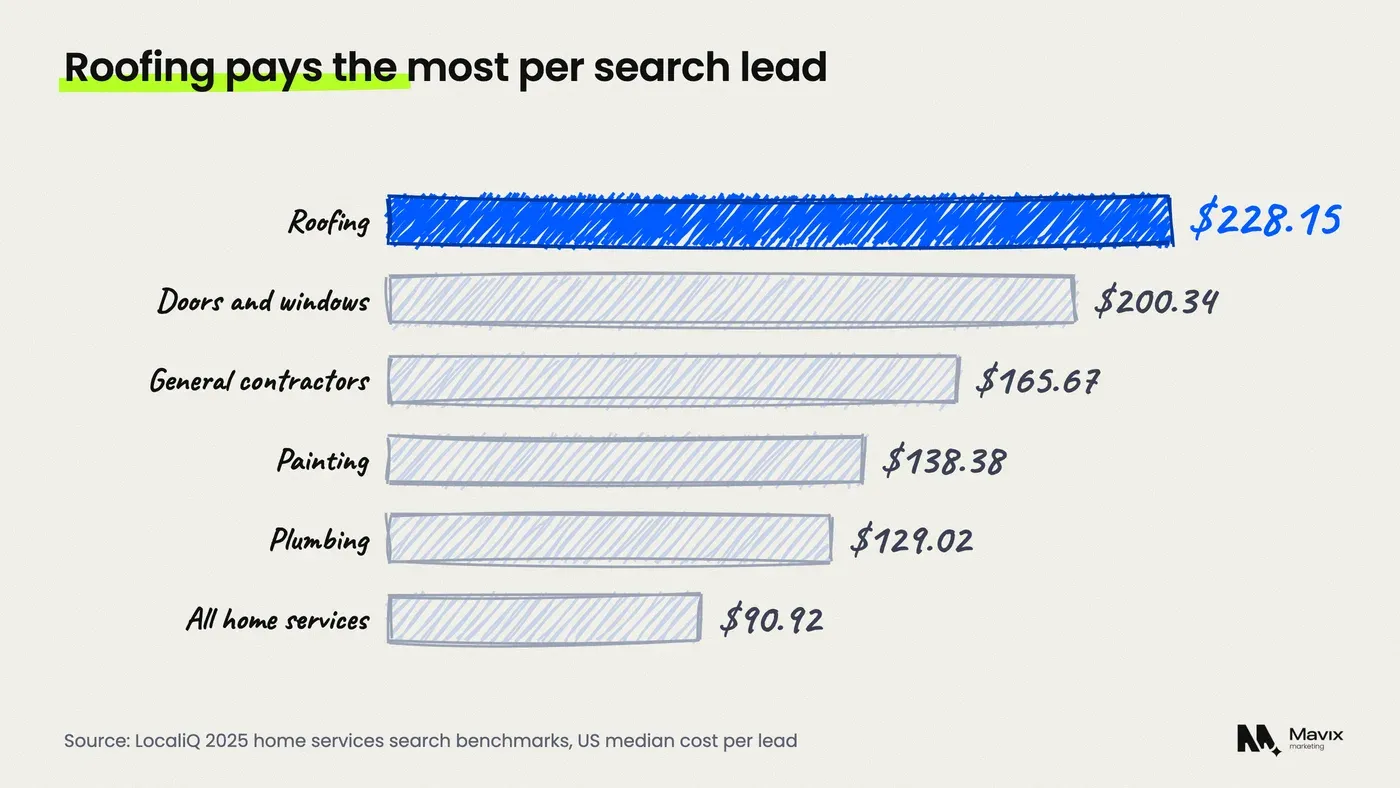
A roofing lead from Google search ads cost a median $228.15 in LocaliQ’s 2025 home services benchmarks, the highest of 16 home services trades. The click itself is not unusual at $10.70. What makes roofing expensive is that only 3.70 percent of clicks become a call or form, about half the home services rate.
This page is for roofing company owners who run Google Ads or are thinking about it. It turns the lead price into a cost per signed roof and splits storm work from retail replacement. It also compares Local Services Ads and lists the filters that stop you paying for leads that never become jobs.
The short version
- Roofing and gutter advertisers paid a median $10.70 a click and $228.15 a lead in LocaliQ’s 2025 benchmarks, across 3,211 US home services campaigns.
- The roofing conversion rate was 3.70 percent, against 7.33 percent for all home services, so the gap is in the page and the offer, not the bid.
- If half your leads book an inspection and one inspection in three signs, a $228.15 lead becomes a $1,369 signed roof.
- Storm work and retail replacement need separate campaigns, budgets and ad copy, because the searcher, timing and job value differ.
- In Texas, advertising that you will pay or waive a homeowner’s insurance deductible is a Class B misdemeanor under Business and Commerce Code section 27.02.
How much does a roofing lead cost on Google Ads?
A roofing lead cost a median $228.15 on Google search ads in LocaliQ’s 2025 report, which measured 3,211 US home services campaigns from April 2024 to March 2025 (LocaliQ). The median click cost $10.70 and the median conversion rate, the share of clicks that call or send a form, was 3.70 percent.
| Measure | Roofing and gutters | All home services |
|---|---|---|
| Cost per click | $10.70 | $7.85 |
| Click-through rate | 5.66% | 6.37% |
| Conversion rate | 3.70% | 7.33% |
| Cost per lead | $228.15 | $90.92 |
The table shows where the money goes. A roofing click costs about a third more than the home services median, but a roofing lead costs two and a half times more. That is the conversion rate at work: half as many clicks turn into enquiries.
LocaliQ reports medians to reduce the pull of outliers, so $10.70 divided by 3.70 percent ($289) does not match the published $228.15. Use the published lead figure as the benchmark and your own account for everything else.
For every roofing number with its source, see roofing marketing statistics for 2026. For why a benchmark lead price is a mirror and not a target, read Google Ads cost per lead benchmarks.
What does a signed roof cost from Google Ads?
A signed roof costs your cost per lead divided by two rates you already track: the share of leads that book an inspection, and the share of inspections that sign. At the $228.15 LocaliQ median, with half of leads booking and one inspection in three signing, each signed roof costs $1,368.90 in ad spend. Neither rate has a published roofing benchmark, so count yours.
The worked example, step by step:
- $228.15 per lead divided by 50 percent booking gives $456.30 per inspection.
- $456.30 divided by one in three signing gives $1,368.90 per signed roof.
- If one in two inspections signs instead, the signed roof costs $912.60.
- If one in five signs, it costs $2,281.50.
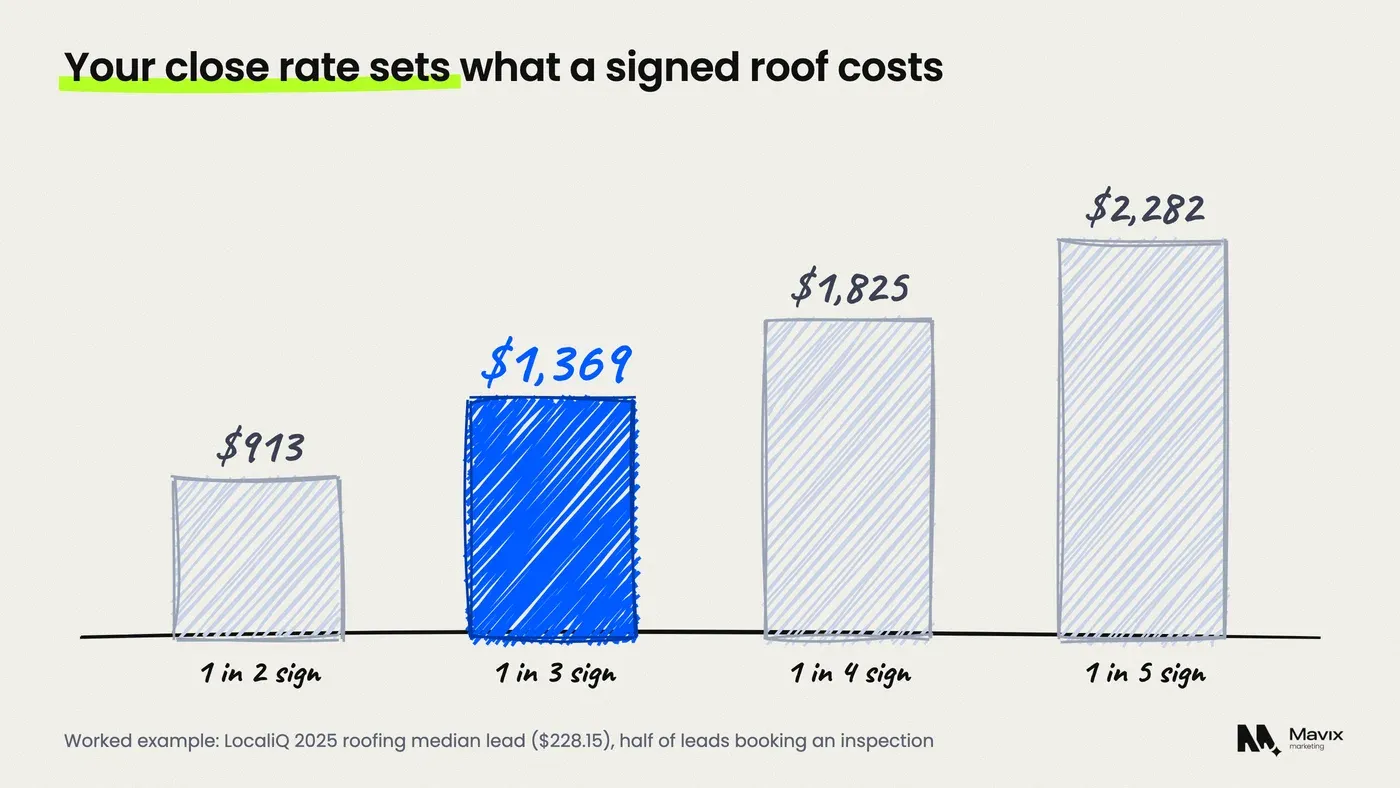
The close rate moves the cost of a roof more than the click price does, and it is the number you control. A rep who reaches the homeowner the same day and leaves a written quote at the inspection changes the sum more than any bid change. Our post on speed to lead covers the callback side.
How much can a roofer afford to pay per lead?
The most you can pay per lead is the profit on one roof, times the share of it you will spend winning the job, times your booking rate, times your close rate. Work it out before you compare yourself with the $228.15 LocaliQ median, because a ceiling below that figure means a bigger budget only loses money faster.
Two worked examples. Both assume $4,000 of gross profit on a replacement, a quarter of that profit spent on getting the job, and half of leads booking an inspection. These are example figures; use your own.
| Inspections that sign | Most per signed roof | Most per inspection | Most per lead |
|---|---|---|---|
| 1 in 3 | $1,000 | $333 | $166.67 |
| 1 in 2 | $1,000 | $500 | $250.00 |
The table shows the same company on either side of the benchmark. Closing one in three, it can pay $166.67 a lead, well under the median, and search ads are a struggle. Closing one in two, it can pay $250, and the median works. Fix the close rate first, then the budget. Put your own figures through the lead generation calculator.
What does each monthly roofing budget buy?
At the $228.15 LocaliQ median, each $1,000 a month buys about four leads. With half booking an inspection and one in three signing, that is roughly one signed roof for every $1,400 of spend. The table runs the same arithmetic at four budget levels.
| Monthly budget | Clicks at $10.70 | Leads at $228.15 | Inspections (half) | Signed roofs (1 in 3) |
|---|---|---|---|---|
| $1,500 | 140 | 6.6 | 3.3 | 1.1 |
| $3,000 | 280 | 13.1 | 6.6 | 2.2 |
| $5,000 | 467 | 21.9 | 11.0 | 3.7 |
| $10,000 | 935 | 43.8 | 21.9 | 7.3 |
The bottom row is not the point; the top row is. At $1,500 a month a roofer gets one signed job, and one lucky or unlucky month says nothing about whether the campaign works. Judge it over a full quarter, and do not expect the next dollars to buy leads at the same price, because the first dollars go to the most urgent searches.
How should storm and retail roofing campaigns differ?
Storm work and retail replacement are different searches from different people, and one campaign cannot serve both. A storm searcher wants an inspection this week and often has an insurance claim. A retail searcher has an old roof and time to compare quotes. Run them as separate campaigns with separate budgets, keywords, ad copy and landing pages.
| Storm and insurance work | Retail replacement | |
|---|---|---|
| Typical search | hail damage roof inspection, storm roof repair | roof replacement cost, new roof estimate |
| Timing | Days after a storm, in a few ZIP codes | Year round, slower in winter |
| Budget | Short bursts, raised and lowered fast | Steady monthly amount |
| Offer | Free inspection, help with the claim paperwork | Written quote, financing, materials choice |
| Main risk | Clicks from outside the hit area, illegal deductible offers | Price shoppers and repair-only leads |
Storm demand is large but local. Texas recorded 902 hail events in 2025, the most of any state, out of 5,432 nationally, according to Triple-I citing NOAA’s Storm Prediction Center (Triple-I). Verisk data reported by Insurance Journal put US roof repair and replacement claim value at nearly $31 billion in 2024, up nearly 30 percent since 2022 (Insurance Journal).
Two settings matter most for a storm campaign. Target only the ZIP codes that were hit. Then set location targeting to Presence, which Google describes as reaching people actually in your chosen locations. The broader option also reaches people who have shown interest in them (Google Ads Help).
Watch the ad copy too. Texas Business and Commerce Code section 27.02 makes it an offense to advertise that you will pay, waive or rebate an insured homeowner’s deductible. It is punishable as a Class B misdemeanor (Texas Business and Commerce Code). Other states have their own rules, so check yours before an ad says “no out of pocket”.
The Google Ads for roofers page sets out how we split storm and retail campaigns in one account.
Are Local Services Ads cheaper for roofers?
Local Services Ads are Google’s pay-per-lead ads that sit above the search ads, and they are often cheaper per lead. They give you less control. You pay for each valid call or message instead of each click, and Google says the lead price varies by location, job type, lead type and bidding mode (Local Services Help). No primary source we opened publishes a roofing figure.
What a roofer should know before funding them:
- One price for very different jobs. You cannot write a keyword list that keeps repair calls out and replacement calls in, so a small leak repair can cost the same lead price as a full reroof.
- Missed calls can be charged. Google charges a missed call during business hours if the caller stays on the line more than 20 seconds, and treats voicemail the same way.
- Weekly budgets can run over. A single week can spend more than your average weekly budget, up to a monthly maximum of the weekly budget times the average weeks in a month.
For the full comparison, including the paperwork Google checks, read Local Services Ads versus Google Ads. Run both if you qualify, and compare the cost per signed roof from each, not the cost per lead.
Which filters stop roofing leads that never become jobs?
The cheapest lead to cut is the one that was never a roof job. Most waste in a roofing account comes from wrong searches, wrong areas and calls that are not real enquiries, and each has a setting that filters it.
- Negative keywords. Exclude searches for roofing jobs, salaries, DIY guides, tools and materials only. “Shingles” also pulls in people searching for the medical condition and its vaccine. Our list of negative keywords for home services is the starting point.
- Call length. Google Ads counts a call as a conversion only when it lasts longer than a minimum you set (Google Ads Help). Set it high enough that wrong numbers and sales calls do not count as leads.
- Form questions. Ask for the property address, the roof’s age and whether there is an insurance claim. Fewer forms arrive, and more of them are worth a truck roll.
- Ad schedule. Run ads only in the hours someone answers. A ringing phone at 9 pm is a lead paid for and handed to a competitor.
- Signed jobs as the goal. Record which leads signed and feed that back to Google Ads, so bidding learns from roofs, not from form fills.
If clicks arrive and the phone stays quiet, work through why Google Ads clicks bring no leads before changing the budget.
When Google Ads is the wrong spend for a roofer
Search ads struggle when your close rate leaves a ceiling below the median lead price, when nobody can answer the phone in office hours, or when the business only does small repairs. In those cases the money usually works harder in the map listing, where a click costs nothing.
A roofer with steady, recent reviews and a complete Google Business Profile wins storm and replacement calls without paying for each one. The local SEO for roofers guide covers that work, and the roofing local SEO page shows how we run it.
Questions people ask about roofing Google Ads costs
What is a good cost per lead for roofing Google Ads?
A good cost per lead is one that still leaves profit after your booking and close rates are applied. The LocaliQ 2025 median for roofing and gutters was $228.15, so a lead well below that is beating most accounts. Judge your own figure against the most you can pay per lead, which is profit per roof, times your marketing share, times your booking and close rates.
How much should a roofing company spend on Google Ads a month?
Spend what it costs to buy the signed roofs you want at a price your margin carries. At the $228.15 median lead and one signed roof in six leads, each roof costs about $1,369, so four extra roofs a month means about $5,500. Below about $1,500 a month you get too few leads to tell if the campaign works.
Why is the roofing conversion rate so low?
Roofing converted 3.70 percent of clicks into leads in LocaliQ’s 2025 data, about half the home services median, because the job is large and the homeowner compares. A roof is a five-figure decision for many households, so more people read, leave and come back. A clear inspection offer, visible reviews and a short form help more than a higher bid.
Do storm chasers drive up roofing click prices?
Out-of-town crews that arrive after a hail storm add bidders for the same storm searches in the same ZIP codes, which tends to raise click prices for a few weeks. No public dataset measures the effect. A local roofer should have the storm campaign built and paused before the season, so it can go live the morning after a storm.
Can I advertise that I will cover the insurance deductible?
Not in Texas. Business and Commerce Code section 27.02 makes it an offense to advertise or promise that you will pay, waive, absorb or rebate an insured homeowner’s deductible, and it is a Class B misdemeanor. Contracts of $1,000 or more paid from a claim also need a printed deductible notice. Other states have their own rules, so check before writing storm ads.
Should roofers use lead form ads or calls?
Use both and weigh them by what signs. Calls usually carry more intent, and Google lets you count only calls above a minimum length you choose. Forms work for homeowners researching after hours. Ask for the address and roof age on every form, and track which channel produces signed roofs, not which produces the most leads.
The bottom line
Do not judge a roofing campaign on cost per lead. Work out your booking and close rates, find the most you can pay per lead, and only then decide whether the $228 median is affordable. Split storm from retail work, set Presence targeting, and keep deductible promises out of every ad.
If you want that sum done on your own account, get your roofing Google Ads account checked for free. You get your real cost per signed roof and a list of what is wasting spend, usually within one working day.
Free review
Want this looked at on your own site?
Send the address. A person reads it and writes back with the two or three things that would move your enquiry number first. Free, and yours to keep whether you hire us or not.