Welcome email sequence: what to send in each of the five emails, and how many days apart
A five-email welcome sequence with send times, what each email says for a service business and a store, the benchmarks to judge it by, and what it is worth.
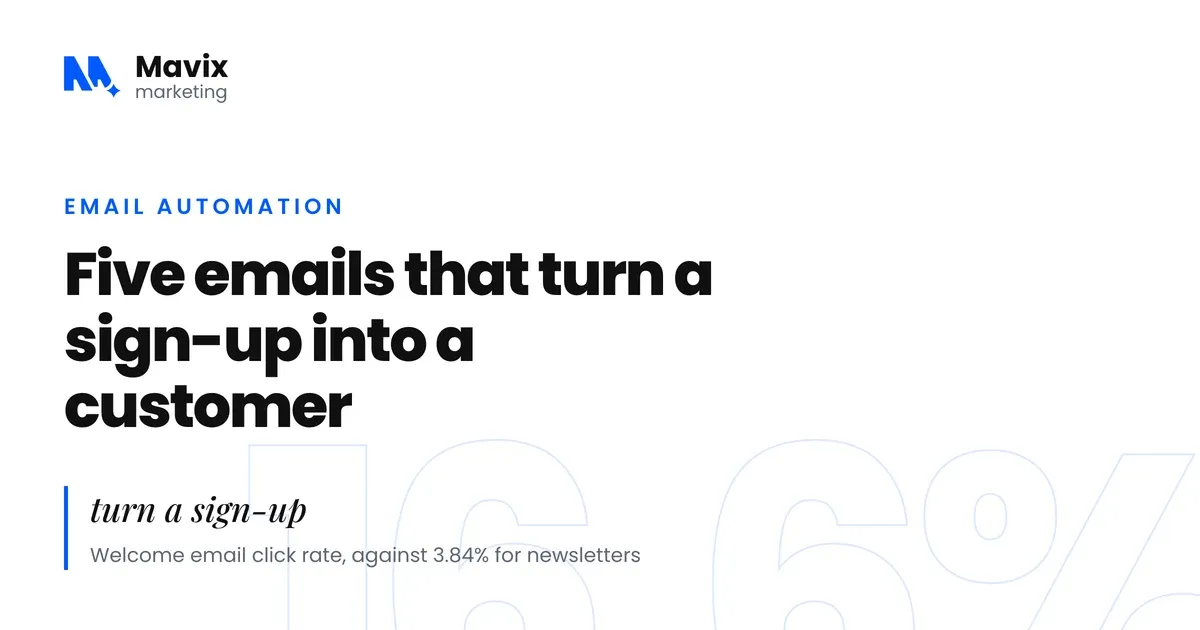
A welcome email sequence is four or five emails sent over about two weeks after someone joins your list. The first gives what they asked for straight away. Then come who you are, proof, one useful thing, and one clear offer. It is worth building first because welcome emails earned a 16.6 percent click-through rate against 3.84 percent for newsletters in GetResponse’s benchmarks.
This page is for owners of service businesses and small online stores who collect emails and then send nothing, or send one “thanks for subscribing” and stop. It gives the five emails, the day each one goes out, a version for each kind of business, the numbers to judge it by, and the checks to make before the first one sends.
The short version
- Send email one within minutes of sign-up and make it deliver exactly what was promised, nothing else.
- Five emails over 10 to 14 days is enough for most small businesses: deliver, introduce, prove, teach, offer.
- In GetResponse’s 2023 data, welcome emails had a 16.6 percent click-through rate, more than four times the 3.84 percent of newsletters.
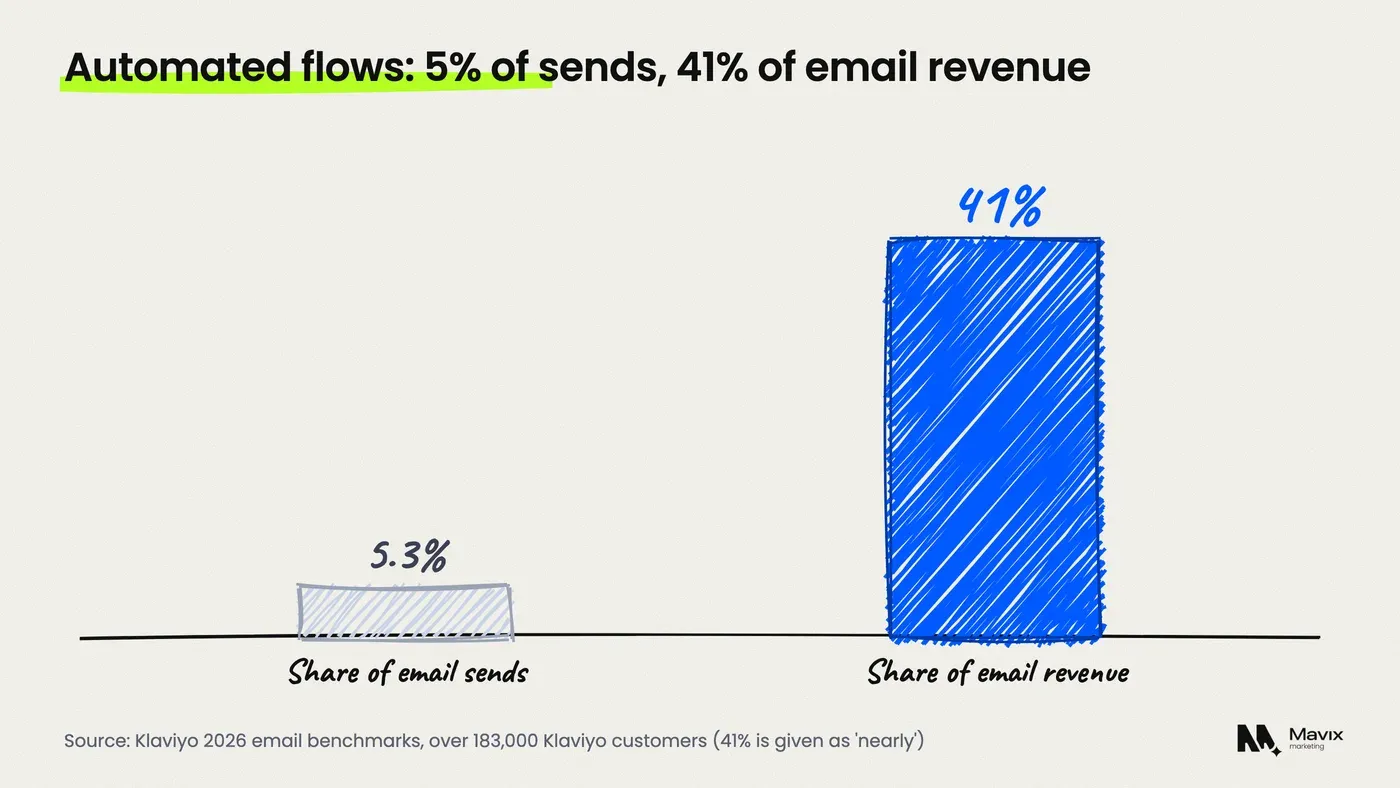
- In Klaviyo’s 2026 benchmarks, automated flows were 5.3 percent of email sends and produced nearly 41 percent of email revenue.
- Judge the sequence on clicks and bookings or orders, not opens, because Apple Mail downloads emails in the background whether or not anyone reads them.
What is a welcome email sequence?
A welcome email sequence is a set of automated emails that starts when a new contact joins your list and stops after a fixed number of messages. Each one has a single job. The trigger can be a newsletter sign-up, a price guide download, a quote request or a first account, and the person gets the same order of emails whatever day they arrive.
It differs from a newsletter in two ways. It is sent to one person at a time, at the moment their interest is highest, rather than to the whole list on a set day. And it is written once, then runs for years. That is why the numbers look so different. GetResponse analyzed more than 4.4 billion messages sent in 2023. It recorded an 83.63 percent open rate and 16.60 percent click-through rate for welcome emails, against 40.08 percent and 3.84 percent for newsletters (GetResponse).
What should each email in a welcome sequence say?
Each email in a welcome sequence does one job, in this order: deliver what was promised, say who you are, show proof, teach one useful thing, then make one offer. The order matters because each email earns the next. A reader who got the price guide they asked for is more likely to open the email that introduces you.
| Send | Its one job | Service business example | Store example | |
|---|---|---|---|---|
| 1 | Within minutes | Deliver the promise | The price guide or checklist they asked for | The discount code, plus best sellers |
| 2 | Day 2 | Who you are | Who runs the business, the area you cover, your license | Why the products exist, who makes them |
| 3 | Day 4 | Proof | Three reviews and one before and after job | Reviews, photos from customers |
| 4 | Day 7 | Teach one thing | “How to tell if your water heater is on its way out” | Sizing, care or how-to-use guide |
| 5 | Day 10 to 14 | One clear offer | Book a free estimate, with a date | The code expires, or a starter bundle |
The table shows the same five jobs with different content, which is the point: the structure transfers, the words do not. Each email carries one link or button that matches its job. Email two has no “book now” button. Email five has nothing else.
If you also send a regular newsletter, people in the welcome sequence should be held out of it until the sequence ends, or they get two emails on the same day from you.
When should each welcome email go out?
The first welcome email should go out within minutes of sign-up, and the rest one every two to three days over about two weeks. Klaviyo’s own guidance is to send the first email immediately and leave at least a day between the rest. It also says to match the length of the series to how long your customers usually take to buy (Klaviyo).
How to set the timing for your own business:
- Find your decision time. Look at a few recent customers. How many days passed between first contact and booking or buying? A drain clean is hours. A kitchen remodel is weeks. A $30 product is days.
- Fit the five emails inside it. If most people decide within a week, compress to days 0, 1, 3, 5 and 7. If they take a month, stretch the gaps and add an email between proof and offer.
- Send in their daytime. Set the platform to send in the contact’s time zone, between morning and early evening, so email one is the only one that arrives at night.
- Stop the sequence when they act. Anyone who books, buys or replies leaves the sequence. Nothing loses trust faster than a “still thinking about it?” email the day after someone paid.
How is a welcome sequence different for a service business?
A service business welcome sequence aims at one booked estimate or call, not at a sale inside the email. The person who downloaded your roof repair cost guide is weighing up who to trust in their area. So the emails lean on local proof, licenses, response times and named staff, and the offer is a specific next step with a time attached.
A store sequence aims at a first order, and the discount usually sits in email one because that is what the pop-up promised. The main risk is training people to wait for codes, so the later emails sell with reviews and product detail rather than a bigger discount.
Three differences in practice:
- Reply-to. For a service business, make every email reply-to a person who answers. A reply is a lead. Pair it with the habits in speed to lead, because a reply answered next morning has often gone to a competitor.
- The offer. A service offer is “book your free estimate this week, here are the slots”. A store offer is the code and its end date.
- What comes next. A service contact moves to a slower monthly newsletter. A store customer moves into emails sent after a sale, covered in our guide to the post-purchase email flow.
What results should a welcome email sequence get?
A healthy welcome sequence should get a click rate several times your newsletter’s, and in stores a conversion rate above one percent. Omnisend’s study of US brands’ 2024 emails put welcome emails at a 32.43 percent open rate and a 1.48 percent conversion rate (Omnisend). Platforms define their metrics differently, so compare yourself with one source at a time.
| Source and period | Measure | Welcome emails | Comparison |
|---|---|---|---|
| GetResponse, 2023 | Click-through rate | 16.60% | Newsletters 3.84% |
| GetResponse, 2023 | Open rate | 83.63% | Newsletters 40.08% |
| Omnisend, US brands 2024 | Open rate | 32.43% | Abandoned cart 49.04% |
| Omnisend, US brands 2024 | Conversion rate | 1.48% | Abandoned cart 2.34% |
| Klaviyo, 2026 | Click rate, all flows | 5.58% average | Campaigns 1.69% |
The table shows how far apart the platforms’ open rates are, which is one reason to stop reading them. Apple says Mail Privacy Protection downloads remote content in the background by default, regardless of whether you engage with the email (Apple). An open from an iPhone user is not proof of a reader. Clicks, replies, bookings and orders are.
Klaviyo’s 2026 benchmarks, drawn from over 183,000 of its customers, put the average flow click rate at 5.58 percent and the top 10 percent at 10.48 percent (Klaviyo). Your welcome emails should sit at or above the flow average, because they go to the freshest contacts you have.
What is a welcome sequence worth to a small store?
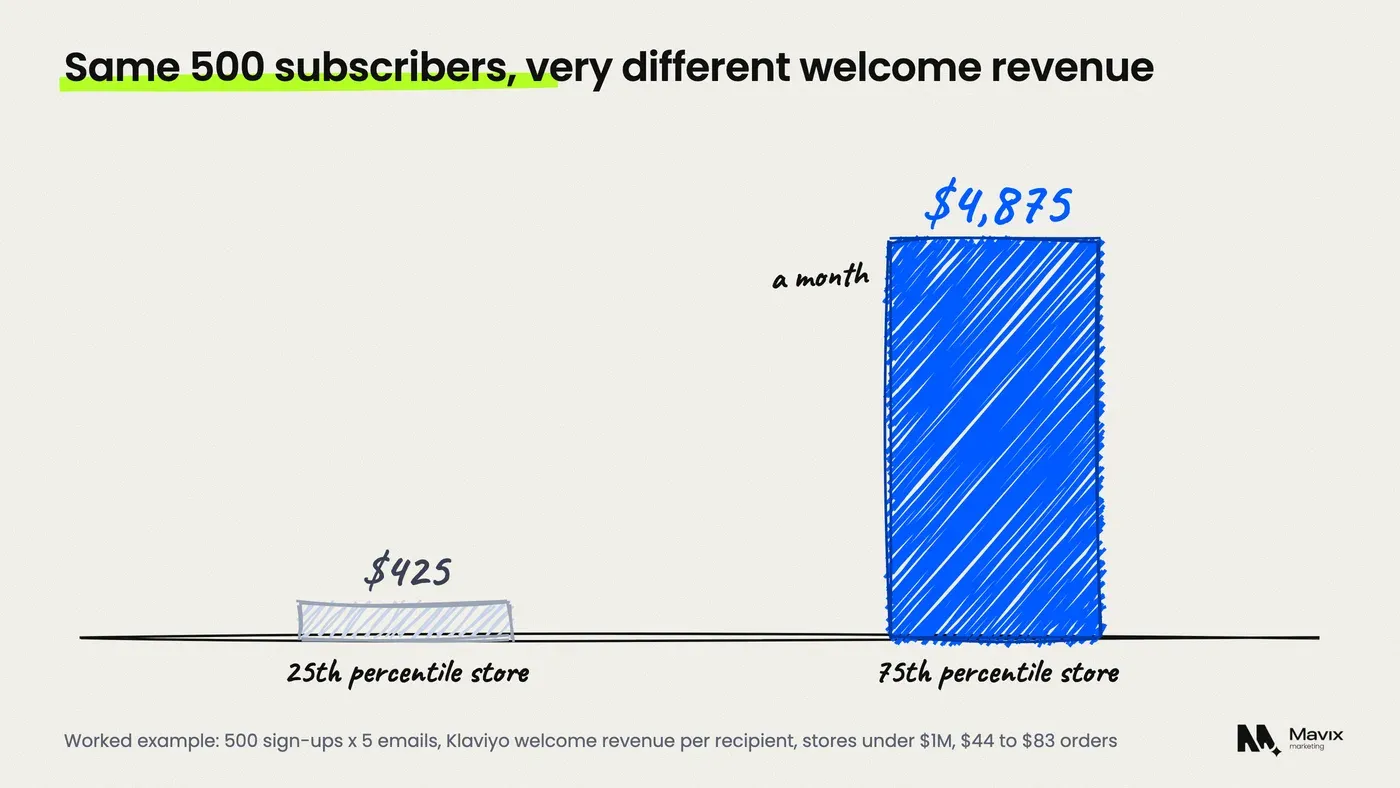
For a small store, a welcome sequence is worth its revenue per recipient times the welcome emails delivered each month. Klaviyo publishes that figure for welcome series by store size and order value. For stores under $1M a year with an average order of $44 to $83, the 25th percentile is $0.17 and the 75th percentile is $1.95 per delivered email (Klaviyo Help).
A worked example for a store with 500 new subscribers a month and a five-email sequence:
- 500 subscribers times 5 emails is 2,500 welcome emails delivered a month.
- At the 25th percentile, $0.17 times 2,500 is $425 a month.
- At the 75th percentile, $1.95 times 2,500 is $4,875 a month.
- The gap, $4,450 a month, is what better emails, timing and offers are worth to that store.
Higher order values earn more per email. In the same Klaviyo table, stores under $1M with orders over $291 reach $11.50 per delivered welcome email at the 75th percentile. A service business has no published equivalent, so count it in bookings. Say 40 people a month download your guide and 1 in 20 books an estimate. That is two estimates a month you were not getting. Put your own figures through the lead generation calculator.
What must be in place before the first welcome email sends?
Before a welcome sequence goes live, every email must carry your physical postal address and a working unsubscribe link, and your sending domain must be authenticated. The FTC’s CAN-SPAM guide requires a valid postal address in commercial email and says you must honor an opt-out within 10 business days (FTC).
The checks, in order:
- Permission. Only people who asked to hear from you enter the sequence. A bought or scraped list draws spam complaints, and Gmail asks senders to keep their reported spam rate below 0.30 percent.
- Authentication. Set up SPF, DKIM and DMARC on the domain you send from. Our post on email sender requirements has the steps.
- Unsubscribe. Google says senders of more than 5,000 messages a day to Gmail must support one-click unsubscribe and keep spam rates below 0.30 percent (Google Workspace Admin Help). Build it in from the start at any size.
- A test send. Send the whole sequence to yourself on a phone and a laptop. Check that every link works and the reply-to reaches a real inbox.
If your emails already land in spam, fix that before adding more, using how to get emails out of spam.
What mistakes make a welcome sequence fail?
Most welcome sequences fail for one of five reasons, and none of them is the subject line.
- A late first email. The guide arrives next morning, after the person has already found a competitor.
- Every email selling. Five offers in a row teach people to ignore you. One offer, at the end, after the proof.
- No stop rule. Customers who already booked keep getting “ready to book?” emails.
- Too long a gap to the newsletter. The sequence ends and nothing follows for two months, so the next email looks like spam.
- Judging on opens. Apple’s background downloads make a dead sequence look healthy.
A welcome sequence is not worth building if you collect fewer than a handful of emails a month and have no plan to collect more. Fix the sign-up first. Our guide to building an email list for a local business covers where the addresses come from.
When a sequence is in place, the email marketing pricing page shows what it costs to have the full set of flows built and run. Email automation for small businesses covers what a done-for-you setup includes.
Questions people ask about welcome email sequences
How many emails should a welcome sequence have?
Four or five is the right length for most small businesses. That is enough to deliver the promise, introduce yourself, show proof, teach one thing and make one offer, without the later emails feeling like nagging. Lengthen it only if your customers take weeks to decide, and add a second proof or teaching email rather than a second offer.
Should the first welcome email include a discount?
It should if the sign-up form promised one, because email one must deliver exactly what was promised. If the form promised a guide, send the guide and leave the offer for the final email. Stores that lead with a discount should sell the later emails on reviews and product detail, so subscribers do not learn to wait for codes.
How soon after sign-up should a welcome email arrive?
Within minutes. The person has just given you their address and is still thinking about the problem that made them sign up. A welcome email that arrives the next day competes with whatever they found in the meantime. Set the automation to trigger on sign-up, not on a daily batch, and test it by signing up yourself.
Can I write a welcome sequence for a service business with no products?
Yes, and it often works better than a store’s because the decision is bigger. Replace product emails with proof and knowledge: the jobs you have done, the reviews you have earned, the license you hold, and one guide that helps the reader judge the problem. The offer is a booked estimate or call with a named person, not a discount.
What should come after the welcome sequence ends?
A regular newsletter for people who have not bought or booked, and follow-up emails after a sale or booking for people who have. The gap between the last welcome email and the next message should be no more than about two weeks. If nothing follows for months, the next email you send will look unfamiliar and draw more spam complaints.
Do welcome emails need an unsubscribe link?
Yes. Under the FTC’s CAN-SPAM guidance, commercial emails need a clear way to opt out and a valid physical postal address, and opt-outs must be honored within 10 business days. Welcome emails that promote your business count as commercial. A one-click unsubscribe also protects your sender reputation, because people who cannot leave press the spam button instead.
The bottom line
If you collect emails and send nothing back, build the five emails before anything else in your email marketing. Set email one to deliver the promise within minutes and put the only offer in email five. Stop the sequence the moment someone acts. Then judge it on clicks and bookings or orders after its first full month.
If you would rather have the sequence written and wired up for you, get a free review of your welcome emails. You get a written list of what to change in each email, its timing and its setup checks, before anything more goes to your list.
Free review
Want this looked at on your own site?
Send the address. A person reads it and writes back with the two or three things that would move your enquiry number first. Free, and yours to keep whether you hire us or not.