Google Ads for dentists: what a new patient costs, and how implant and general campaigns differ
Dental clicks cost $8.00 and leads $72.97 in 2026 benchmarks. What that means per booked new patient, implants against general care, and what to track.
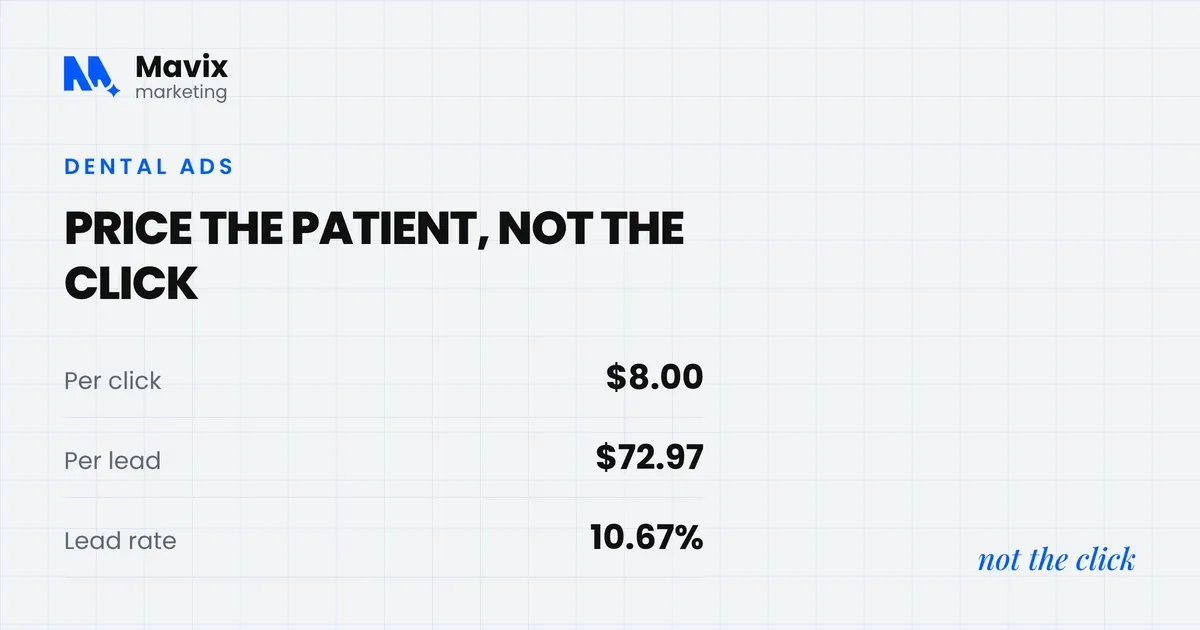
A new dental patient from Google Ads costs about $146 at 2026 benchmark prices if half your leads book. LocaliQ’s 2026 benchmarks put dental search ads at $8.00 a click, a 10.67 percent conversion rate and $72.97 a lead. Divide the lead price by the share of leads who book and attend, and that is your cost per new patient.
This page is for practice owners and office managers who run Google Ads, or are being sold them, and want to know whether the numbers work. It covers the benchmarks, the cost per patient sum, how implant campaigns differ from general dentistry, the health policy rules that limit dental targeting, and what to track.
The short version
- Dental search ads cost $8.00 a click, converted at 10.67 percent and cost $72.97 a lead in LocaliQ’s 2026 benchmarks, against $5.42, 8.18 percent and $66.69 across all industries.
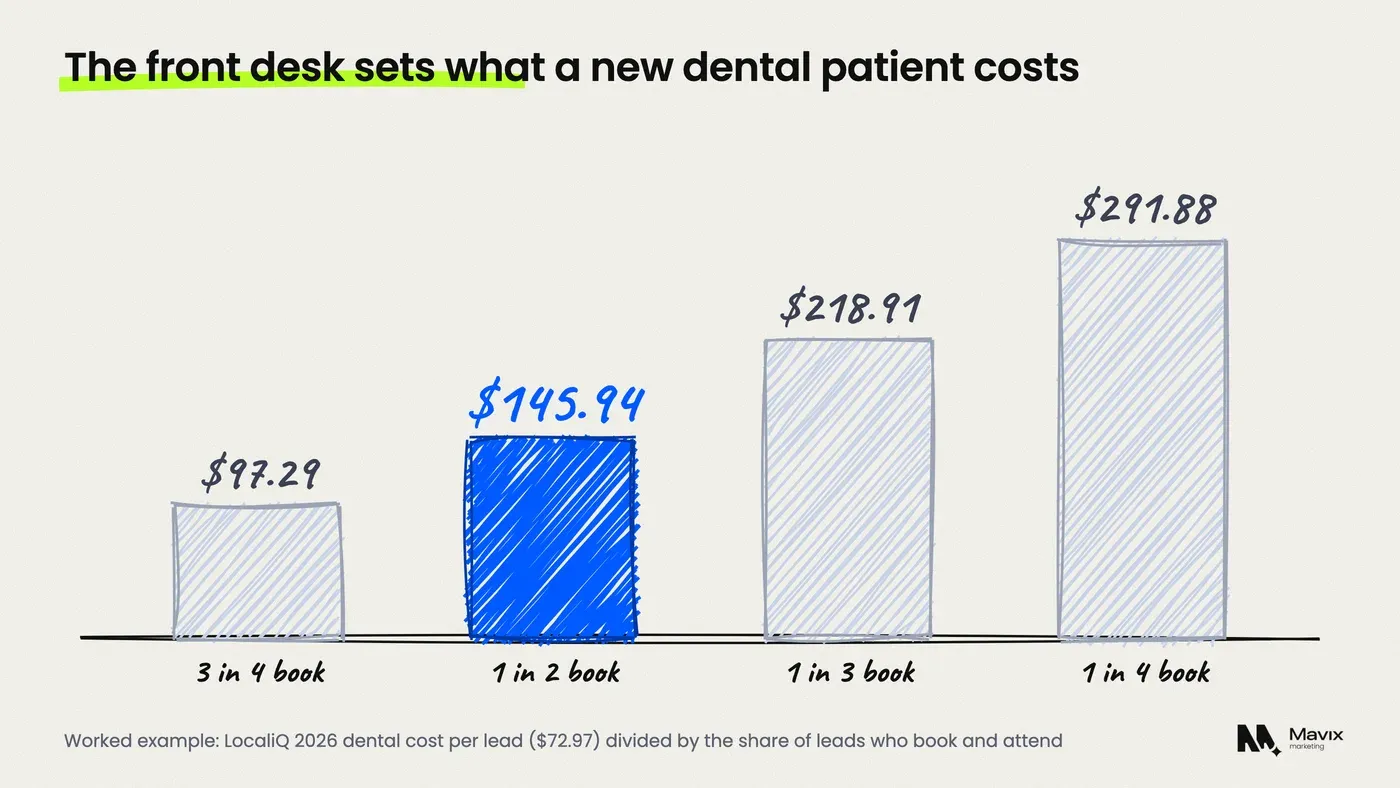
- Cost per new patient is cost per lead divided by the share of leads who book and attend: $145.94 if half do, $291.88 if one in four do.
- A person with a dental visit spent an average $887 a year on dental care in 2021, according to the federal Medical Expenditure Panel Survey.
- Implant campaigns can afford a higher click price only if consultations turn into treatment. A single implant averaged $2,143 before the crown in CareCredit’s 2023 to 2024 survey.
- Google’s personalized advertising policy treats invasive procedures, including surgical ones, as a sensitive health category, which removes remarketing lists and Customer Match from those campaigns.
How much does a Google Ads lead cost for a dentist?
A dental Google Ads lead cost $72.97 in LocaliQ’s 2026 search advertising benchmarks, built from thousands of its customers’ campaigns on Google Ads and Microsoft Ads (LocaliQ). A lead is whatever the account counts as a conversion, usually a call or a booking form, not a patient in the chair.
| Measure | Dentists and dental services | All industries |
|---|---|---|
| Click-through rate | 5.66% | 6.64% |
| Cost per click | $8.00 | $5.42 |
| Conversion rate | 10.67% | 8.18% |
| Cost per lead | $72.97 | $66.69 |
The table shows a trade where clicks are expensive but convert well. A dental click costs about 48 percent more than the all-industry figure, yet the lead costs only about 9 percent more, because more of those clickers call or book. That makes the landing page and the front desk as important as the bid. LocaliQ’s page does not state the campaign dates, so treat it as a 2026 reference point, not a target.
The full set of dental numbers, with sources, is in our dental marketing statistics for 2026. For how a lead price differs from a customer price across trades, read Google Ads cost per lead benchmarks.
What does a new patient cost from Google Ads?
A new patient costs your cost per lead divided by the share of leads who book and turn up. At LocaliQ’s $72.97 dental lead price, that is $97.29 if three in four leads become patients, $145.94 if half do, and $291.88 if one in four do. The booking rate moves the cost more than the click price does, and it is decided at your front desk.
How to work out your own figure:
- Take the cost. Ad spend for the last full month, from the Google Ads account.
- Count the leads. Calls over your minimum length plus booking forms, from the conversions column.
- Count the new patients. From your practice management software, the new patients who first called or booked in that month and came from Google Ads. Ask “how did you hear about us” at booking and record it.
- Divide. Spend divided by new patients who attended is your cost per new patient. Spend divided by leads is your cost per lead. The gap between them is your front desk.
If the gap is wide, look at missed calls and slow callbacks before changing the ads. Our post on speed to lead covers the callback side.
How do implant campaigns differ from general dentistry?
Implant campaigns sell a bigger, slower decision. A single implant averaged $2,143 before the crown in a 2023 to 2024 survey for CareCredit, with a range of $1,646 to $4,175. Crowns added $488 to $3,254 depending on material (CareCredit). General dentistry sells a cheaper visit that repeats every year.
The yearly value of a general patient comes from federal survey data. In the Medical Expenditure Panel Survey, people with a dental visit spent an average of $887 on dental care in 2021, in 2021 dollars. The survey is run by the Agency for Healthcare Research and Quality (AHRQ). That figure counts office-based dental spending only.
A worked comparison, assuming you will spend up to 20 percent of first-year revenue to win a patient, and the 10.67 percent dental conversion rate for both campaigns:
| Campaign | First-year revenue used | Most per new patient (20%) | Leads who become patients | Most per lead | Most per click |
|---|---|---|---|---|---|
| General dentistry | $887 | $177.40 | 1 in 2 | $88.70 | $9.46 |
| Implants (post only) | $2,143 | $428.60 | 1 in 4 | $107.15 | $11.43 |
The table shows that implant leads are worth more only when consultations turn into treatment. Because fewer implant enquiries go ahead, the higher fee buys only about $2 more per click in this example. Count three years of a general patient at $887 a year and the general campaign can pay more per click than the implant one. Use your own fees, consult close rate and recall rate in place of these figures.
What that means for the account:
- Separate campaigns. Implants, emergency, cosmetic and general care each get their own campaign and budget, so one cannot spend the other’s money.
- Separate pages. An implant click lands on an implant page with prices or financing and before and after cases, not the home page.
- Different scorecards. Judge general campaigns on new patients a month. Judge implant campaigns on consultations booked and treatment accepted, over a longer window.
What Google health policies apply to dental ads?
Google’s personalized advertising policy lists health as a sensitive interest category, and its health rules cover “invasive medical procedures, including cosmetic surgery, surgical procedures, or injections” (Google Ads policy). Campaigns that fall under it cannot use advertiser-curated audiences, which means no remarketing lists, Customer Match or lookalike segments.
In practice, an implant or cosmetic surgery campaign may be flagged under this rule, while a cleaning and checkup campaign usually is not. Google’s predefined audiences, such as in-market segments, and location targeting stay available. Plan implant campaigns around search intent and location, not around following past website visitors with display ads.
Patient privacy sits beside Google’s rules. Keep names, dates of birth and treatment details out of page addresses and out of anything sent to an ad tag. Check your conversion tracking setup with whoever handles your HIPAA compliance before adding tags to appointment forms.
What should a dental practice track in Google Ads?
A dental practice should track calls from ads, calls from the website, and booking form submissions as separate conversions, with a minimum call length that filters out wrong numbers. Google says you set the minimum call length yourself, and every call that lasts at least that long counts as a conversion. It adds that tracking calls from ads and from your website requires Google forwarding numbers (Google Ads Help).
The setup that makes the cost per patient sum possible:
- Call reporting on, with a call asset on every campaign.
- Website call tracking, so a number on the landing page is swapped for a forwarding number for people who clicked an ad.
- A minimum call length long enough to exclude hang-ups and wrong numbers. Pick a starting point, such as 60 seconds, then adjust it after listening to a sample of recorded calls.
- Booking form conversions counted on the thank-you page or the confirmation event, not on the button click.
- New patients matched back, monthly, from the practice software to the ad spend.
Our upcoming guide to Google Ads call tracking covers the settings in detail. If the account shows clicks and no calls, work through why Google Ads clicks bring no leads first.
When are Google Ads the wrong choice for a dental practice?
Google Ads are the wrong choice when the practice cannot answer the phone during ad hours, has no capacity for new patients, or has a ceiling per click below the going rate. At the $8.00 benchmark click price, a practice whose worked ceiling is $5 a click will lose money on each new patient, however the campaign is built.
Other cases where the money is better spent elsewhere:
- The listing is weak. A practice with few reviews and an incomplete Business Profile loses the map results that sit beside the ads. Fix that first with dental SEO.
- No landing pages. Sending implant, emergency and checkup clicks to one home page wastes the 10.67 percent conversion rate the trade can reach.
- Insurance mismatch. If most searchers in your area want a plan you do not accept, say so in the ads, or the calls will not book.
When the sums work, Google Ads management for dentists covers how the campaigns, pages and tracking are set up.
Questions people ask about Google Ads for dentists
How much should a dentist spend on Google Ads a month?
Work it back from the new patients you want. At LocaliQ’s $72.97 dental lead price and half of leads booking, a new patient costs about $146, so 20 new patients a month needs about $2,919 in spend. Raise or lower it with your own booking rate. Budgets far below that produce too few leads to judge whether the campaign works.
Are dental implant keywords more expensive than general dentistry keywords?
Published benchmarks do not split dental click prices by treatment, so check your own area in Google’s Keyword Planner before setting bids. What the numbers do show is how much you can afford. Implant fees are higher, but fewer enquiries go ahead. So the affordable click price for implants is only modestly higher unless your consult close rate is strong.
Can dentists use remarketing in Google Ads?
Sometimes. Google’s personalized advertising policy restricts advertiser-curated audiences, including remarketing lists and Customer Match, for ads in sensitive health categories, which include surgical procedures. Ads for implants or cosmetic surgery may fall under that rule. Ads for checkups and cleanings usually do not, but each campaign is judged on its ads and landing pages.
What is a good conversion rate for dental Google Ads?
LocaliQ’s 2026 benchmarks put the dental conversion rate at 10.67 percent, meaning about one click in nine became a call or form. A rate well below that usually points to the landing page, missing call tracking or ads showing for the wrong searches. A rate well above it is worth checking too, because counting short calls as conversions inflates it.
Should a dental practice use a different phone number for ads?
Yes, through Google forwarding numbers, which Google requires for tracking calls from ads and from your website. The forwarding number replaces your number only for people who clicked an ad, so your listings and printed materials keep the real number. Calls still ring at the practice, and Google records which campaign and keyword produced each one.
How long before dental Google Ads bring new patients?
Calls can start within days of a campaign going live, but judging cost per new patient takes at least a full month, longer for implants. Implant enquiries often go through a consultation and a treatment plan before anyone pays, so measure those campaigns on consultations booked in month one and treatment accepted over the following months.
The bottom line
Do not judge dental Google Ads on click price. Track calls and forms properly, count the new patients who attend, and divide the spend by them. If that number is below what a patient is worth to you over a year or more, spend more. If it is above, fix the front desk and the landing pages before touching the bids.
If you want the sum done on your own practice’s numbers, get your dental Google Ads account checked for free. You get your real cost per new patient and a list of what is wasting spend, usually within one working day.
Free review
Want this looked at on your own site?
Send the address. A person reads it and writes back with the two or three things that would move your enquiry number first. Free, and yours to keep whether you hire us or not.