Local citations in 2026: which listings still help you rank, which to fix first, and which to skip
Citations still count, but less than reviews. Which listings matter in the US, UK and Germany, how to fix wrong details first, and what a cleanup costs.
A handful of local citations still matter: Google Business Profile, Apple Maps, Bing Places, Facebook, Yelp and the main data aggregators, with correct and identical details on each. Past that core list, volume does little. In Whitespark’s 2026 survey of 47 local SEO experts, the number of directory listings ranked 110th for the map pack, and reviews gained weight while citations lost it.
This page is for owners of local businesses in the US, the UK and Germany who keep getting offers to “build 300 citations” and want to know what is worth paying for. It covers which listings to fix first, the core list by country, what to skip, and what the work costs.
The short version
- A local citation is any place online that shows your business name, address and phone number. Consistency matters more than count.
- Google’s own help page says prominence depends on links to your business and how many reviews you have. It does not mention directories.
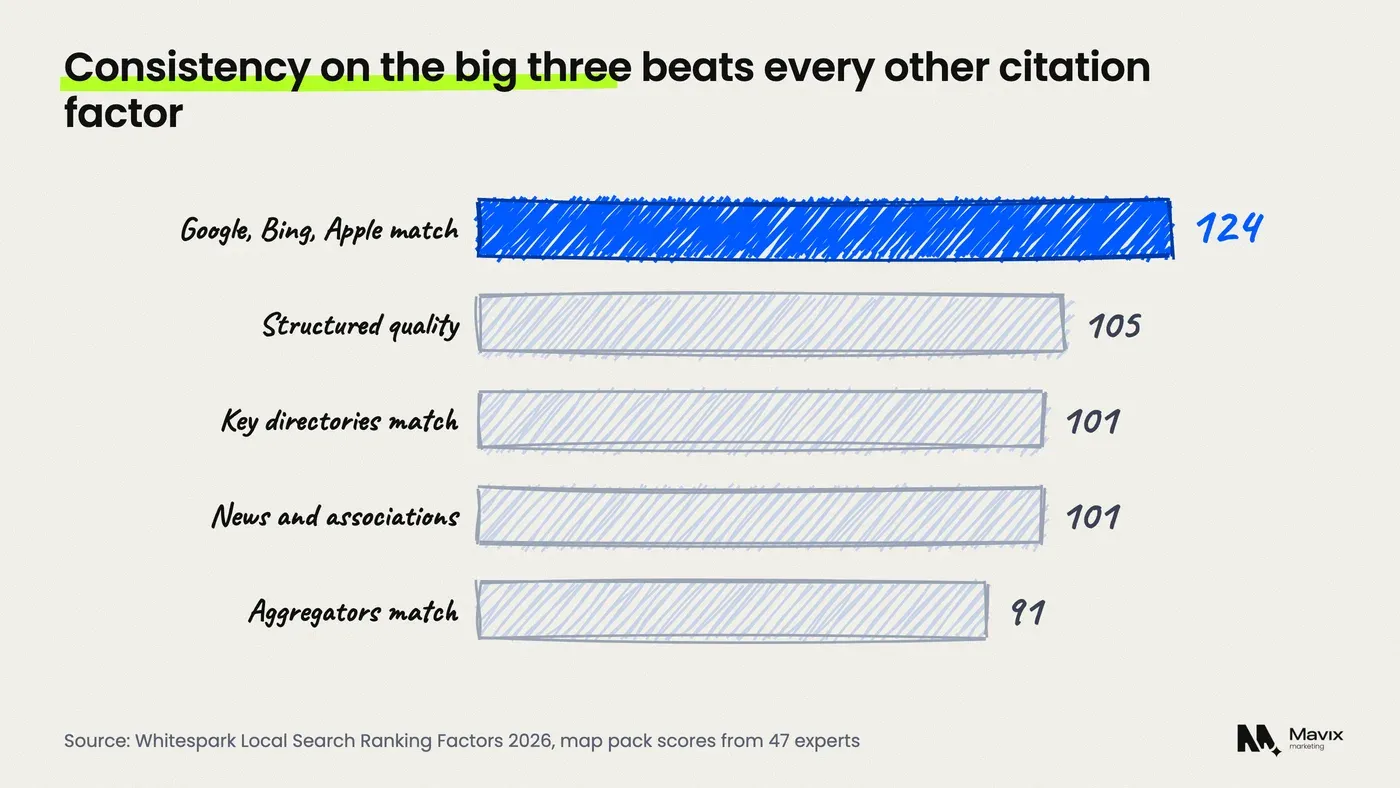
- In Whitespark’s 2026 ranking factors survey, the top citation factor was consistency on Google, Bing and Apple Maps, ranked 28th for the map pack.
- In a 2018 BrightLocal survey of 1,025 US consumers, 68 percent said they would stop using a local business after finding wrong details in online directories.
- Fixing 40 listings costs about $128 through BrightLocal’s Citation Builder at $3.20 a site, or $399 to $999 for a Whitespark cleanup package.
What is a local citation?
A local citation is any mention of your business name, address and phone number (NAP) on another website. Structured citations sit in directories with fixed fields, such as Yelp or Yellow Pages. Unstructured citations are mentions in news stories, blogs, chamber of commerce pages or industry association lists. Both tell search engines and AI tools that your business exists where you say it does.
The details have to match how you present the business in real life. Google’s guidelines say your profile name should match how the business is “consistently represented and recognized in the real world”, the phone number should reach that location and be under your control, and P.O. boxes are not accepted as addresses (Google Business Profile Help). Your citations should copy those details exactly.
Do local citations still help rankings in 2026?
Yes, but less than they did, and mainly through consistency on a few big sources. In Whitespark’s 2026 Local Search Ranking Factors, citation signals lost about half a percentage point of map pack weight, while review and behavioural signals gained the most (Whitespark). The survey asked 47 experts to score 187 factors.
Google’s own explanation is short. It ranks local results on relevance, distance and prominence, and says prominence is “based on info like how many websites link to your business and how many reviews you have” (Google Business Profile Help). Directories are not named. That is the honest starting point: citations support a listing, and reviews and links move it.
The citation factors the Whitespark experts rated highest for the map pack:
| Citation factor (Whitespark 2026) | Map pack rank | Score |
|---|---|---|
| Consistency on Google, Bing and Apple Maps | 28 | 124 |
| Quality of structured citations | 49 | 105 |
| Consistency on Yellow Pages, Yelp, D&B, CityGrid | 63 | 101 |
| Quality of unstructured citations (news, associations) | 64 | 101 |
| Consistency on data aggregators | 85 | 91 |
| Quantity of citations from locally relevant sites | 69 | 99 |
The table shows the pattern that matters: consistency and quality rank well, while the plain quantity of directory listings sits down at 110th. The same survey lists mismatched NAP and tracking numbers across the data ecosystem as a negative factor, ranked 24th of the factors that hurt.
Why do citations matter more for AI search?
AI assistants build their answers from what many sources say about a business, so a consistent presence across trusted sites helps you get named. Whitespark’s 2026 report says three of the top five factors for AI search visibility are citation factors, with the quality and quantity of unstructured citations, mentions in news, associations and lists, among them.
That shifts where the effort pays. A mention in a local news story, a chamber of commerce member list or a trade association directory helps both the map pack and AI answers. Another 200 low-traffic directories helps neither. Our guide to showing up in AI search covers the other signals those answers draw on.
Which citations matter most in the US, UK and Germany?
The core list is short in every country: the map platforms, Facebook, Yelp, and the national directories. Whitespark’s country lists put Google Business Profile, Bing Places and Apple Maps at the top for the US, UK and Germany alike (Whitespark). Get those right before anything else.
| Priority | United States | United Kingdom | Germany |
|---|---|---|---|
| Map platforms | Google, Apple Maps, Bing Places | Google, Bing Places, Apple Maps | Google, Bing Places, Apple Maps |
| Social and reviews | Facebook, Yelp | Facebook, Yelp UK | Facebook, Yelp |
| National directories | Yellow Pages, Superpages, BBB | Yell, Thomson Local, 118Information, BT Phone Book | Das Örtliche, Gelbe Seiten, 11880.com |
| Data sources | Data Axle, Foursquare, Neustar Localeze | Central Index, Scoot | Infobel |
| Then | Your trade association, chamber of commerce | Trade body, local council lists | Kennstdueinen, local Stadtbranchenbuch |
The table shows that the map platforms and the national directories differ by country, while the method does not. Apple Maps listings are managed through Apple Business, where you can claim a location and control hours, photos and key details on Apple Maps. Businesses selling into Europe from the US should read our list of local SEO mistakes in the UK and Germany before building listings there.
What are data aggregators, and do you need them?
Data aggregators are companies that collect business details and sell them to maps, apps and directories. In the US the main ones are Data Axle, which was called Infogroup until 2020, Foursquare, which merged with Factual in 2020, and Neustar Localeze. A wrong record at an aggregator can spread to dozens of smaller sites and reappear after you fix them one by one.

You need them in two cases: you have moved, rebranded or changed phone number, or you keep finding the same wrong detail on sites you never touched. A business that has never changed its details usually gets more from fixing the core list by hand. Whitespark sells a US data aggregator submission for $99 a location as a one-off.
How do you fix inconsistent citations?
Start with the source of truth, fix the listings that carry the most weight, and only then add new ones. Most citation problems come from an old address, an old phone number or a name that changed. Cleaning those up matters more than building anything new, because the Whitespark experts rank inconsistency as a negative factor. Wrong details also cost customers directly: in BrightLocal’s 2018 survey of 1,025 US consumers, 68 percent said they would stop using a local business after finding wrong information in online directories.
- Write your one true NAP. Copy the name, address, phone and website exactly as they appear on your Google Business Profile. Decide on “Street” or “St” and keep it.
- Search for old details. Search Google for your old phone number and old address in quotes. Every result is a listing to fix.
- Fix the map platforms first. Google, Apple Maps and Bing Places, then Facebook and Yelp.
- Fix the national directories for your country from the table in the previous section.
- Submit to the aggregators if you moved or changed numbers.
- Add the unstructured mentions that matter: your trade body, chamber of commerce and local sponsorships.
- Recheck in 90 days. Some sites update slowly, and some overwrite your fix with aggregator data.
Call tracking numbers need care here. Put your main number on every citation and use tracking numbers only in ads and on your website, set up so the main number stays visible. Our post on tracking phone calls from Google Ads explains how to do that without breaking your listings.
What does citation building cost?
Citation work costs from nothing, if you do the core list yourself, to about $1,000 a location for a full cleanup service. BrightLocal’s Citation Builder charges from $3.20 a site, or as low as $2 with bulk credits (BrightLocal). Whitespark’s listing packages run $399, $599 and $999 a location, one-off (Whitespark).
A worked example for one location:
- Doing the 10 core listings yourself: free, about one afternoon.
- 40 listings through BrightLocal at $3.20 each: $128.
- Whitespark Premium, which cleans up the top 10 sites and builds 42 new listings: $399.
- Whitespark Ultimate, which cleans up the top 100 sites: $999.
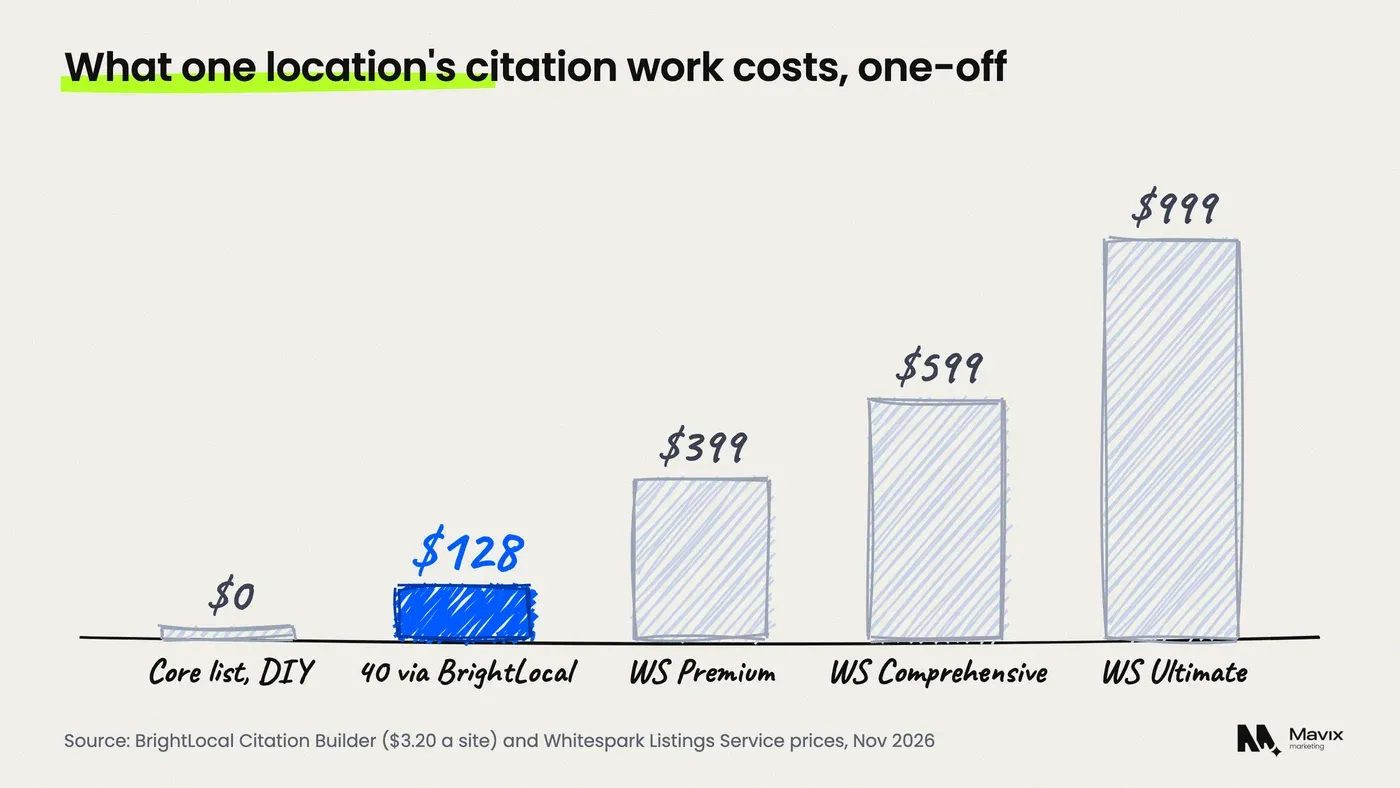
For most single-location service businesses, the $0 to $399 range covers it. Monthly listing subscriptions make sense only for chains with many locations. If citations are bundled into a monthly SEO retainer, ask how many listings are actually being built or fixed each month. Our local SEO cost guide shows what a full monthly package normally includes, our SEO pricing page sets out what each plan covers, and local SEO services start with this cleanup.
Which citations should you skip?
Skip anything sold by the hundred, directories nobody visits, and sites that are not in Google’s index. A citation only counts if search engines can see it, and one of the experts in Whitespark’s 2026 survey noted that many citation sites are losing pages from Google’s index. Paying for 300 listings on sites like that buys a spreadsheet, not visibility.
- Bulk packages of 200 to 500 “high authority” listings.
- Foreign or off-topic directories that have nothing to do with your country or trade.
- Paid listings with no traffic, where the only selling point is the link.
- Duplicate listings for the same location. Merge or remove them.
Citations also cannot fix a weak profile. If you are not showing in the map pack at all, start with why a Google Business Profile is not showing, and work through the local SEO checklist before buying listings.
Questions people ask about local citations
How many citations does a local business need?
Most single-location businesses need the 10 to 15 core listings for their country, plus a few strong local and trade mentions. Whitespark’s experts rank quantity of structured citations at 110th for the map pack, far below consistency on the main platforms at 28th. Add listings only where your customers or your trade actually look.
Do citations help with Google Maps rankings?
They help Google trust that your details are right, which supports your Maps ranking, but reviews and links matter more. Google says prominence depends on links to your business and the number of reviews you have. Whitespark’s 2026 survey rates consistency on Google, Bing and Apple Maps as the most useful citation factor, ranked 28th.
Should I use a call tracking number on my citations?
No. Use your main local number on every citation so the details match everywhere. Whitespark’s 2026 survey lists mismatched NAP and tracking numbers across the data ecosystem as a negative ranking factor. Keep tracking numbers for ads and your website, where they can be swapped in without changing your listings.
How long do citation fixes take to show?
Fixes on Google, Apple Maps and Bing show once each platform approves the edit, which is usually the fastest part. Directories and aggregators update on their own schedules, and some take weeks. Recheck your main listings after about 90 days, because some sites overwrite manual fixes with older aggregator data.
Are paid directories worth it?
A few are, when people actually use them to choose a business in your trade, or when membership itself builds trust, such as a trade association or the BBB in the US. Most paid listings sold on link value alone are not worth it. Check whether a directory sends you any visits in your analytics before renewing.
Do service area businesses need citations if they hide their address?
Yes. A service area business can still list its name, phone number and website, and many directories let you hide the street address. Keep the hidden address the same everywhere it is recorded, because aggregators may still hold it and pass it on to other sites.
The bottom line
Fix before you build. Get your name, address and phone number identical on Google, Apple Maps, Bing, Facebook, Yelp and your country’s main directories, add the trade and local mentions that mean something, and stop there. Spend the rest of the budget on reviews.
If you are not sure which of your listings are wrong, get your local listings checked for free. You get a list of every citation with a wrong name, address or phone number and the order to fix them in, usually within one working day.
Free review
Want this looked at on your own site?
Send the address. A person reads it and writes back with the two or three things that would move your enquiry number first. Free, and yours to keep whether you hire us or not.