
Law firm SEO: how to build practice area pages that rank, earn trust and turn searches into consultations
Most law firm practice area pages are thin copies with a city name swapped in. What a ranking page contains, when city pages are doorways, and the review rules.
A practice area page ranks when it answers a client’s real questions about one legal problem in your state, names the attorney who handles it, and makes the first contact easy. Build one deep page per practice area. Add city versions only where you have an office or real local work, because Google calls near-identical city pages doorway abuse.
This page is for partners and marketing leads at small and mid-sized law firms who want their practice pages to rank and bring in consultations. It covers what to put on each page, how to structure practice and city pages, attorney bios, the review rules, and why intake decides whether the work pays.
The short version
- Google gives more weight to trust signals on “Your Money or Your Life” topics, and legal problems sit squarely in that group.
- Google’s spam policies name “multiple domain names or pages targeted at specific regions or cities that funnel users to one page” as doorway abuse.
- A strong practice area page covers who it is for, the law in your state, the process, costs, the attorney, results you are allowed to show, and one clear next step.
- Google bans offering incentives for reviews and selectively asking happy clients only. The FTC’s 2024 rule bans fake reviews and incentives tied to what a review says.
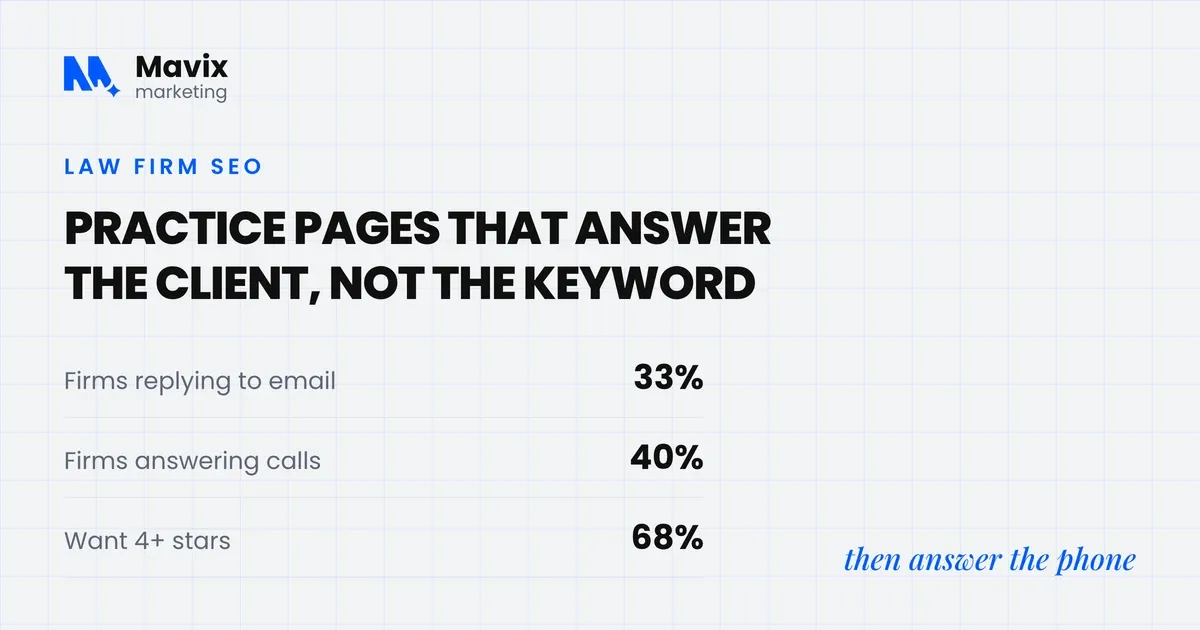
- In Clio’s 2024 secret shopper test, 33 percent of 500 law firms replied to an emailed enquiry and 40 percent answered the phone.
What is a practice area page?
A practice area page is the page on a law firm’s website that explains one type of legal work, such as car accident claims, divorce or DUI defence. It also invites the reader to get in touch. It is the page Google most often shows for searches like “divorce lawyer Austin”, so it carries more of a firm’s search traffic than the home page.
Most firms have a list of practice pages that read the same: two paragraphs, a list of services and a phone number. They rank poorly because nothing on them answers the question the reader typed. The rest of this page is about fixing that, one practice area at a time.
Why do law firm pages face a higher bar on Google?
Law firm pages face a higher bar because Google treats legal topics as “Your Money or Your Life”. Its guidance says its systems “give even more weight to content that aligns with strong E-E-A-T” (Google Search Central). That applies to topics that could affect people’s health, finances or safety. E-E-A-T means experience, expertise, authoritativeness and trust. Of the four, Google says trust matters most.
In practice that means three things on every practice page:
- A named author. Google “strongly encourage[s]” accurate bylines where readers expect them. A practice page should say which attorney wrote or reviewed it, with a link to their bio.
- State-specific facts. Deadlines, fee rules and court steps differ by state. A page that says “the statute of limitations varies” tells the reader nothing.
- Nothing a bar would call misleading. Results, specialist claims and testimonials all have rules, covered in the section on reviews below.
What should a practice area page include?
A practice area page should answer, in order, the questions a worried client asks before they call. Is this my problem, what happens next, what will it cost, who will handle it, and how do I start. Each answer needs proof the reader can check. The table sets out the sections that do the most work.
| Section | The client’s question | What makes it credible |
|---|---|---|
| Who this is for | “Is this the right lawyer for my problem?” | Specific situations, in the client’s words |
| The law in your state | “What are my rights here?” | Deadlines and rules with the statute named |
| The process | “What happens if I call?” | Numbered steps from first call to outcome |
| Costs and fees | “Can I afford this?” | Fee type stated: contingency, flat or hourly |
| The attorney | “Who will actually handle it?” | Named lawyer, bar admission, years in this area |
| Results and reviews | “Have they done this before?” | Outcomes and reviews within your bar’s rules |
| Questions | “What about my exact case?” | Short answers to the questions intake hears weekly |
| Next step | “How do I start?” | One action: call, form or booking, with hours |
The table shows that most of the page is answers, not sales copy. The fees row is where most firm pages go quiet, and it is the question every client has. You do not need to publish prices, but saying “we work on contingency, so you pay nothing unless we recover money” answers it in one line.
Your intake team is the best source for the questions section. Ask them for the ten questions callers ask most about each practice area, and answer those, in the words callers use.
How should you structure practice areas and sub-pages?
Structure practice pages as a hierarchy: one parent page per practice area, and child pages only for case types that have their own searches and their own facts. A personal injury firm might have a parent page for personal injury, with child pages for car accidents, truck accidents and premises liability, each linking up to the parent and across to each other.
- List your practice areas by revenue. Build the pages for the work you most want first.
- Split a case type into its own page only when clients search for it by name and the facts differ, such as truck accidents, where federal trucking rules apply.
- Link every child to its parent in the first few paragraphs, and the parent to every child.
- Link each practice page to the attorneys who handle that work.
- Keep one page per search intent. Two pages for “car accident lawyer” and “auto accident attorney” compete with each other.
The same logic applies to every service business with many services. Our post on service area pages covers the location side in more detail, and the law firm SEO page covers the links, reviews and technical work around it.
Should you build a page for every practice area in every city?
No. Build a city version of a practice page only where you have an office there, or real cases and local facts to write about. Google’s spam policies list “multiple domain names or pages targeted at specific regions or cities that funnel users to one page” as doorway abuse (Google Search Central). Five practice areas across eight suburbs is 40 pages that say almost the same thing.
| Your situation | Build a city practice page? | What goes on it |
|---|---|---|
| You have an office in that city | Yes | Office address, local court, attorneys based there |
| No office, but you handle many cases there | Usually yes | Local court, local facts, results from that area |
| Different state, different law | Yes | That state’s rules, attorneys admitted there |
| No office, few cases, same law | No | Mention the area on the main practice page instead |
The table shows the test: a city page earns its place when it holds facts that would be wrong on the main page. The local court, a local office and attorneys admitted in that state all qualify. Swapping “Austin” for “Round Rock” does not.
What makes an attorney bio page help rankings?
An attorney bio helps rankings when it proves the person behind the practice pages is real and qualified. It should state bar admissions and the year admitted, the practice areas they handle, education, notable cases or results the bar allows, publications and talks, and a professional photo. Each bio should link to the practice pages that attorney handles, and each of those pages should link back.

Three mistakes to avoid:
- Calling an attorney a “specialist” without certification. In Texas, the approved wording is “Board Certified, area of specialization, Texas Board of Legal Specialization”, and the certifying body must be named (Texas Center for Legal Ethics). Other states have their own versions.
- One bio page for the whole firm. Each attorney needs their own page to be linked as an author.
- Bios that never change. Add new admissions, talks and results as they happen.
What are the rules on reviews and testimonials for lawyers?
Lawyers face three layers of review rules: Google’s, the FTC’s and their state bar’s. Google bans offering incentives for reviews, asking only happy clients, and discouraging negative reviews (Google). The FTC’s rule, announced in August 2024, bans fake reviews and incentives “conditioned on the writing of consumer reviews” with a particular sentiment (FTC).
State bars add their own rules on testimonials, past results and disclaimers, and they differ. Check your state bar’s advertising rules before putting reviews or results on a practice page. This page is not legal advice on those rules.
Reviews matter for the call itself as well as for rankings. BrightLocal’s 2026 survey of 1,002 US adults found that 68 percent will only use a local business rated four stars or more (BrightLocal). Ask every client at the end of a matter, by the same method, and the rating will reflect your work. Our guide to getting more Google reviews has the asking scripts.
Why does intake decide whether law firm SEO pays?
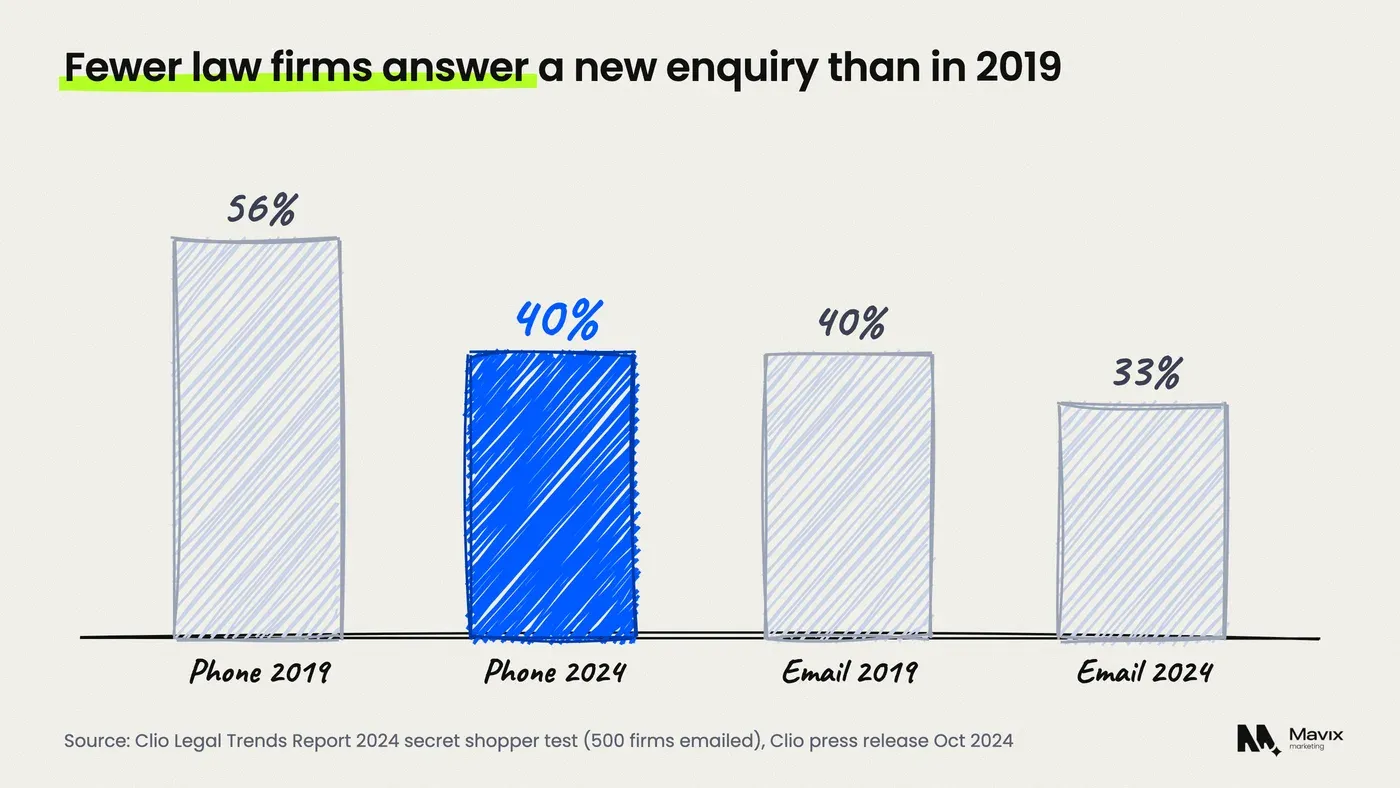
Intake decides it because rankings only produce calls, and calls only become clients if someone answers. In Clio’s 2024 secret shopper test, only 33 percent of 500 law firms replied to an emailed enquiry, down from 40 percent in 2019. It also found only 40 percent answered the phone, down from 56 percent (Clio via PR Newswire).
A worked example shows what that does to SEO. Say your practice pages bring 50 calls a month and one in four conversations becomes a client at an average fee of $4,000.
- At the 40 percent answer rate from Clio’s test: 20 conversations, 5 clients, $20,000.
- At a 90 percent answer rate: 45 conversations, about 11 clients, $45,000.
The pages and the rankings are identical in both lines. Only the phone changed. Fix intake before paying for more traffic, and read our post on speed to lead for the response times that matter. The law firm marketing statistics post has more of the Clio figures.
When will practice area pages not be enough?
Practice pages will not rank on their own in a crowded market if the firm has few reviews, few links from other sites and a weak Google Business Profile. Personal injury in a large metro is the hardest case: the top firms have years of links and hundreds of reviews. A new firm there should expect slow progress and may need paid search while the pages build.
- Thin authority. Links from local bar associations, law school alumni pages and local news count more than directory listings.
- A weak map listing. Many local legal searches show the map results above the web results. Our law firm local SEO page covers the Business Profile side.
- Paid search while you wait. Our post on Google Ads for lawyers explains how to run both without paying for clicks you would win anyway.
Questions people ask about law firm practice area pages
How long should a practice area page be?
Long enough to answer the client’s questions about that practice area in your state, and no longer. A page with the state law, a process section, a fees section and a short question list will run long naturally. A page padded to a word count reads worse and ranks no better than a shorter page that answers more.
Should every practice area have its own page?
Yes, every practice area you want clients for should have its own page, because each is searched separately and has its own law. Practice areas you take only occasionally can sit on a general page. Split a case type into its own page only when clients search for it by name and its facts differ.
Can we show case results on practice area pages?
Usually yes, within your state bar’s rules, which differ on how results, testimonials and disclaimers may be shown. Read your state’s advertising rules before publishing any result, keep the file that proves it, and never show a figure you cannot document if the bar asks.
Who should write practice area pages?
An attorney who handles that work should write or review every practice page, and the page should say so. A writer can draft from interviews with the attorney and the intake team. A lawyer admitted in that state must check the legal facts, deadlines and process before the page goes live.
Do city pages still work for law firms?
City pages work when they carry facts that belong only to that city: an office address, the local court, attorneys based there or cases from that area. Pages that swap one city name for another with the same text fit Google’s description of doorway abuse, which puts the whole site at risk of being treated as spam.
How long does law firm SEO take to show results?
Expect several months before new practice pages rank well in a competitive market, and longer for personal injury in a large city. Our post on how long SEO takes sets out what usually happens month by month. Pages for narrower case types in smaller markets often move first.
The bottom line
Pick your three most valuable practice areas and rebuild those pages first: state law, process, fees, a named attorney, reviews within your bar’s rules and one next step. Skip copy-paste city pages. Then make sure every call gets answered, or the rankings are wasted.
If you want to know which of your practice pages are holding the firm back, get your law firm’s practice pages reviewed for free. You get a page-by-page list of what is missing and what to fix first, usually within one working day.
Free review
Want this looked at on your own site?
Send the address. A person reads it and writes back with the two or three things that would move your enquiry number first. Free, and yours to keep whether you hire us or not.